Data centres, heat reuse and the future of circular energy systems
Data centres are quietly generating one of the most consistent and scalable sources of usable heat in the energy system. What changes when a data centre is designed to export heat, not just manage it?
Reusing heat can improve data centres’ performance, enhance perceptions of proposed facilities and support strategies for low-carbon heating for homes and businesses. Unlocking these benefits creates value for data centre operators and enables the sector to take an important step towards a circular energy system.
In data centres, 90-95% of all electrical energy consumed by IT and cooling is converted into heat. Facilities in Germany alone generate more than 13 terawatt-hours of heat annually, according to the International Renewable Energy Agency (IRENA). Yet around the world, most of this heat is discharged directly into the environment, representing a significant missed opportunity.
The continuous thermal output from data centres has huge potential for recovery and reuse. Recovered heat can be used in offices and homes, swimming pools, industrial processes, greenhouses and aquaculture facilities - a hyperscale data centre with a 100 MW IT load could heat tens of thousands of homes.
The potential opportunity is increasing month by month due to both rapid growth and technological advances. Driven by cloud and AI workloads, global data centre capacity is projected to rise from 103GW to 200GW by 2030. At the same time, advances in cooling technologies, such as liquid cooling, direct-to-chip cooling, and modular heat pumps, are enabling efficient extraction of high-quality heat.
Heat: from byproduct to valuable resource
Legislation is driving demand for data centres’ reusable heat. For instance, in the European Union, planning requirements, potential tax impacts, and district heating pathways reflect a wider global push to accelerate the expansion of renewable and recovered heat. Because heat from data centres is generally stable, weather-independent and available year-round, it aligns closely with these national timelines and can accelerate the phase-out of natural gas in urban areas – an important aspiration for many municipalities.
With some regions beginning to mandate a minimum percentage of heat recovery, a handful of projects are already leading the way. Since 2023, the Amazon Web Services data centre in Dublin has met 92% of the heat demand for the Technological University of Dublin’s Tallaght campus. Amazon also heats its Seattle headquarters using an underground district energy system that reuses heat from a neighbouring data centre. Meanwhile, an Equinix facility in Paris heats 1,000 homes, and in Bibai City, Japan, an innovative data centre that cools its servers with snow cleared from city streets and buildings is now recovering the heat for use in eel farming.
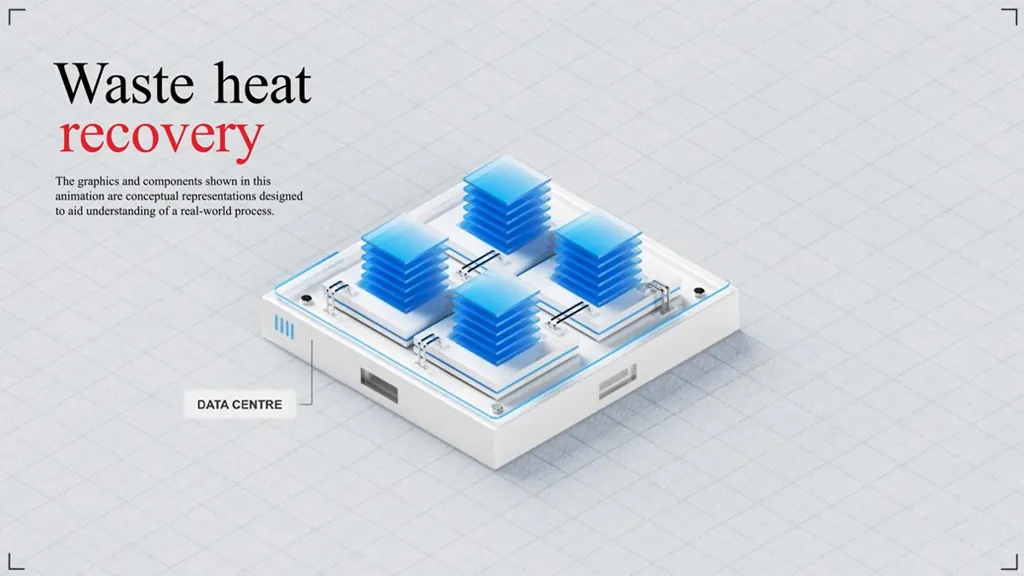
This is an opportunity for data centres to transform themselves from ‘energy sinks’ to ‘energy sources’, and the benefits go beyond compliance. Recovering and reusing heat improves the energy reuse factor (ERF) and can boost several other key performance indicators. Power usage effectiveness (PUE) improves because central cooling systems are no longer needed to remove the heat, thereby reducing site energy consumption. As these systems typically consume large amounts of water, heat recovery and reuse also offer opportunities for water savings and improved water-use efficiency (WUE). As the sector evolves and the economics change, reused heat could even become a reliable additional revenue stream for data centre operators – for example, by enabling grid services.
Providing heat makes data centres good neighbours
Perhaps the biggest benefit lies in how reusing heat can enhance communities’ perceptions of data centres and the knock-on impact on gaining planning approval from local authorities. By supplying nearby buildings, science parks, housing developments or industrial clusters with recovered heat, data centres help reduce local and regional carbon emissions. At the same time, they can lower their own cooling energy and overall electricity consumption. These are important considerations, given that data centres are often perceived as energy- and water-intensive facilities.
Heat reuse can help overcome these perceptions by offering tangible value to local people. At Arup, we call this the good neighbour theory – an approach to development that benefits the industry, the community, and the environment. It provides data centre players with an opportunity to build and strengthen their public brand by clearly demonstrating social responsibility and a focus on their local community. This will help the industry maintain its social licence to operate.
Instead of seeing data centres merely as hubs of consumption, we can turn them into allies for the ecological transition by recovering the heat they generate and using it to warm our cities.
Collaboration and early integration of heat recovery are key
At Arup, we’re working with both data centre owners and governments to help realise a win-win approach to heat recovery and reuse. With our specialists embedded in client teams, we’ve built close relationships and gained insights across regions including Europe, North America and Asia. In our experience, it’s clear that collaboration is essential. Data centres and off-takers must come together, build trust, and find ways to share the risks involved in developing heat infrastructure.
Expert advice can help bridge the gap, and governments are increasingly keen to connect producers with users. For example, the German government is funding an initiative to bring the two together and develop standardised, scalable solutions. AwaNetz will support up to ten reused heat networks, creating use cases with details of technical solutions, business models, contracts, risk regulations and a profitability calculation tool. Arup’s technical expertise is helping AwaNetz as it rolls out its model.
When our teams support hyperscale and smaller data centres, both new-build and retrofit, to take advantage of heat reuse opportunities, we emphasise the importance of early integration. This is the best way to unlock system-level gains. Considering heat recovery during the due diligence and feasibility stages, then integrating it into the concept design, ensures technical compatibility and regulatory compliance. It also positions data centres as visible contributors to resilient, low-carbon, and community-centred urban and regional energy systems.
By capitalising on the growing opportunity offered by heat reuse through collaboration and early integration, data centres can be at the vanguard of future, circular energy systems.
Contributors: Nanuk Rennert, David Davies, and Paolo Cresci.