Designing for the night: why 12-hour cities can’t sustain a 24-hour economy
How can cities support a 24-hour economy when they’re built for just 12 hours of activity? Tim Hunt explores why design is the crucial missing piece for cities aiming to expand their night-time economies.

Cities around the world are chasing a similar ambition: a vibrant 24-hour economy that attracts talent, boosts hospitality, supports creatives and keeps main streets alive well into the night. The topic has gained momentum in the media, and while policy and funding play a role, one crucial factor is often overlooked: design.
A 24-hour city can’t be legislated into existence. If a city is only designed for 12 hours of activity, it simply can’t sustain round-the-clock life. So, how do you design a city that truly works after dark?
In this article, I want to unpack the built-in bias toward daytime in most urban environments, explore the night as an economic frontier, explain why design is the missing link and outline five key moves cities must make to truly become 24-hour destinations.
The daytime bias
Picture this: it’s after dark and you’re heading out for dinner in a city district. The restaurants and bars are open, events are underway, but the streets feel lonely. Public spaces are either underlit or, in many cases, overlit. Shops are shutting their doors and alleys fade into darkness.
Demand for city life after sunset is growing rapidly. Around the world, more people want to be out later, and cities are chasing the economic benefits. London’s evening and night-time economy is already worth up to £26 billion a year, while Sydney aims to double its night-time economy revenue by 2030.
However, our urban environments haven’t kept up. Many cities are still largely designed for a nine-to-five world, and after dark is too often an afterthought in planning and renewal. If we want to unlock the full potential of our cities, we need to start designing for life at night not just during the day.
Night as an economic frontier
The night is not a void to be managed, but a frontier to be designed for. It holds untapped potential for opportunity, innovation and inclusion. Yet, the means to fully harness this potential are still emerging. Night is not simply a continuation of the day – it’s a distinct version of the city, with unique rhythms, users and challenges. Rethinking urban life after dark could be a powerful solution to today’s productivity and infrastructure pressures. A 24-hour economy isn’t about increasing consumption; it’s about smarter use of time and space. By extending activity beyond the traditional nine-to-five, cities can spread demand, support diverse working patterns, and make more efficient use of existing infrastructure.
For example, Federation Square in Melbourne demonstrates the transformative power of thoughtful night-time design. Our lighting masterplan reimagined the space as a safe, active and adaptable destination after dark. The design strikes a careful balance between wayfinding and atmosphere, enhancing cultural programming and perceptions of safety without compromising the site’s heritage. Crucially, the lighting system is designed for flexibility – scaling up for major events or dialing down for quieter evenings. By treating lighting as economic infrastructure, this project delivered more than visibility: it boosted visitation, supported local business and strengthened public trust.
The economic benefit for local economies is clear. For example, Melbourne’s night-time economy has rebounded strongly since the pandemic, growing from $3.2 billion in annual revenue and supporting over 30,000 jobs pre-COVID to $5.1 billion in the past year. However, this growth has happened largely organically. In contrast, cities like London, with its Night Czar, and Sydney through its 24-hour economy strategy show vision and dedicated governance can shape vibrant, inclusive and economically powerful after dark cultures. Melbourne already has momentum, and with strategic intent, it could unlock even greater potential.
Why design is the missing link
If cities want thriving nighttime economies, safer and more inclusive streets, dynamic local districts and live music scenes, and hospitality that doesn’t flatline after 9pm, then we need to start designing specifically for nighttime – not just assuming light alone equals safety and vibrancy.
Nighttime design brings together expertise in lighting, safety, social equity, atmosphere and sensory experience to shape how people feel and behave after dark. It’s about using light to shape perception and comfort, auditing nighttime movement patterns and collaborating with researchers to understand how women, girls and gender-diverse individuals experience safety.
For example, Melbourne’s Metro Tunnel Project is helping reshape the city after dark. Our team, in a joint venture with WSP and Arcadis, led the line-wide lighting strategy, setting the vision with our collaborators to ensure every station and public lighting interface was designed with safety, clarity and atmosphere in mind. This approach means stations won’t simply function as transit nodes, but as welcoming public spaces day and night that transition from daylight to artificial light. The project demonstrates how infrastructure investment, when designed for 24 hours, can expand productivity and confidence in city life.

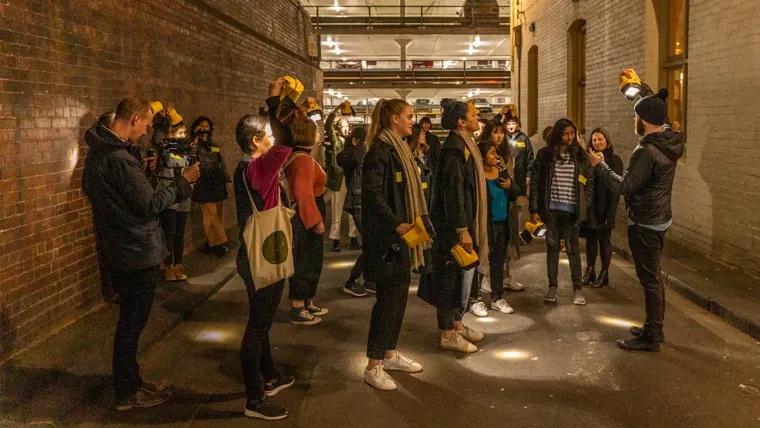
In Randwick, we used walkshops and inclusive design to develop a Creative Lighting Masterplan, creating a safer and more vibrant nighttime environment. This project demonstrates how lighting can enhance placemaking, accessibility, and well-being in complex urban health and education districts.

The approaches used on these projects needs to be scaled, systematized and mainstreamed. They apply in capital cities and across regional centers. As infrastructure investment flows into projects like new transportation hubs, hospital districts and regional university expansions, there is opportunity to design these assets for day and night use. A well-lit regional station, a hospital district that feels safe at all hours, or a regional main street that stays active into the evening directly contributes to productivity, equity and community confidence. The nighttime can be the key to unlocking economic tourism and overnight stays if we look at lighting as more than just lights.
Five moves cities must make
If cities are serious about building a 24-hour economy, here’s where to start:
-
Create precinct-specific night-time design strategies
Local councils, regional development bodies and community groups should co-design night plans tuned to local rhythms, shadows and identities. -
Recognize light as economic infrastructure
State and regional infrastructure agencies must fund night-time design for safety, storytelling, wayfinding and activating local economies. Regional business associations can co-invest where benefits are direct. -
Build a night-time design toolkit
Planning authorities, regional council and professional institutes should equip designers, architects, planners, engineers and economic teams with tools to audit and adapt environments after dark. -
Modernize crime prevention through environmental design (CPTED) to include more focus on spaces after dark
Shift from reactive surveillance lighting and CCTV to evidence-based, people-centred design that considers dignity and choice, and gives opportunity to hear voices of local people. -
Embed night-time design in policy
Government should integrate nighttime design into the pipeline of city and regional projects – from transport and health infrastructure to cultural and tourism precincts – ensuring night use is planned from the outset like it is for the daytime.
Making the next move together
The night isn’t the problem; it’s how we choose to design for it. If we approach the nighttime as a deliberate, crafted experience, the idea of a 24-hour city will remain just that: an idea, not a reality. A truly 24/7 future won’t happen by accident; it will take intention, collaboration and creativity. Rethinking urban spaces after dark is bigger than any one team or discipline. We know we can’t do it alone, so who else should be at the table, and where do you see the greatest opportunities to make the night-time safer, more vibrant and more inclusive? It’s time to challenge assumptions, share ideas and work together to unlock the full potential of our cities after dark.
If you would like to continue the conversation, reach out to our lighting team.