
How do we redesign urban highways to reconnect communities?
In our Issues section, we discuss the big questions facing the built and natural environments.
Last updated: June 2026
For too long, the convention of designing urban infrastructure for cars over people has led to fragmentation of cities, undermining the wellbeing and integration of communities.
As urban highways reach the end of their design life, we have an opportunity to rebuild better. If we want to decrease traffic congestion, reduce pollution, and reunify disconnected neighborhoods, we need to adopt a different approach to roadway development.
Much of the United States’ interstate highway system was constructed over 50 years ago. Built during a period when a car-first culture dominated city planning, highways carved through cities and bisected communities. Today, these often crumbling physical and social barriers stand in the way of neighborhood prosperity.

Defining a ‘people-first’ urban highway ethos
By working from a wider definition of what we want mobility to deliver, we can make different development choices. We still need to cross long distances efficiently, but cities and their residents are increasingly discovering the benefits of walking, cycling, and public spaces freed up for other uses. There are mobility and placemaking benefits for everyone:
Improved quality of life
Transforming urban highways into more local-scale, multimodal, walkable streets is a boon to residents’ health, wellbeing, and quality of life. Reduced vehicular traffic means less pollution, more space for residents to choose walking and cycling, and open green spaces support overall resilience. In areas bordering the Cross Bronx Expressway in New York, for example, residents experience asthma rates nearly three times higher than the national average. Conversely, “superblocks” in Barcelona, which prioritize active mobility, have been found to improve environmental conditions and wellbeing for residents.

Improved social cohesion and connection
Walkable urban streets increase everyday social contact, cultivating stronger connections between neighbors, shopkeepers, schools, healthcare, and community groups. Streets and local businesses become inviting places for people to linger. This casual interaction builds social capital, trust, and mutual support, which leads to stronger local identity and a sense of community stewardship. A study surveying a mid-sized Canadian city found that improvements to street design, where residents are encouraged to walk, can lead to a strengthened sense of belonging.

The economics of walkable streets
By continuing to invest in outdated, car-centric infrastructure, our cities are losing billions now and sacrificing their future competitiveness. Conventional highways divide neighborhoods, producing unappealing dead zones that hinder investment and development. Instead, with increased foot traffic, profits circulate locally, bringing ongoing value to communities. “The Pedestrian Pound,” an urban-economics concept stemming from research by the UK organization, Living Streets, demonstrates how money spent by pedestrians tends to stay local—and circulate longer—than money spent by car-based visitors.

Case study: Indianapolis Inner Loop
The interstate system that encircles downtown Indianapolis, Indiana, known as the Inner Loop, is paradigmatic of the mid-century infrastructure in the US that significantly stifles urban development.
Arup’s Indianapolis Inner Loop Visionary Study brought into focus the cost of this kind auto-centric infrastructure. The new vision outlines the environmental advantages, economic development opportunities, and community benefits of a redesign that prioritizes people over cars, while ensuring traffic efficiency.
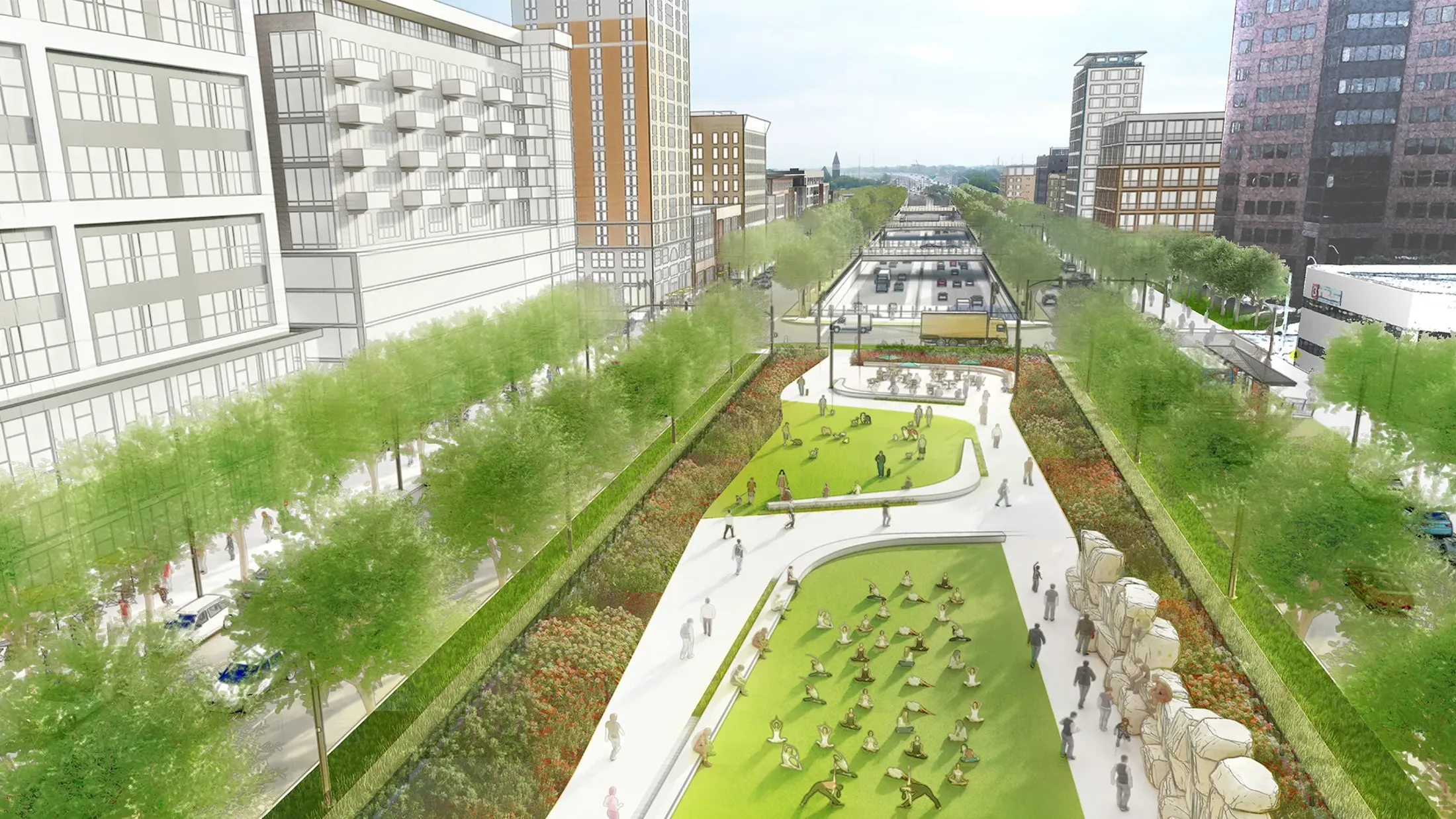
The new vision outlines the environmental advantages, economic development opportunities, and community benefits of a redesign that prioritizes people over cars, while ensuring traffic efficiency.
How do we unlock these benefits?
Here are five strategies for designing urban streets that support a thriving city and reconnect communities:

1. Give communities a clear role
Roads have a huge impact on neighborhoods – that’s why it’s vital to put local communities at the center of planning and decision-making so that projects reflect their needs, priorities, and the long-term wellbeing of the people they connect.
2. Break down bureaucratic barriers to infrastructure delivery
Urban highway projects tend to involve many government stakeholders. Coordinate across agencies, jurisdictions, and funding streams early to avoid delays and make complex regeneration projects easier to deliver.
3. Prioritize active travel and transit
When you reallocate road space to support walking, cycling, buses and transit, you reduce dependence on cars and offer mobility options to more of the community.

4. Explore funding mechanisms
The breadth of people-first highway regeneration projects leads to opportunities to access a wider range of funding sources. You can look beyond traditional public funding and consider models like public-private partnerships to advance ambitious projects.
5. Design for the future
People-first highway projects are all about not repeating the planning mistakes of the past. Use urban highway regeneration as an opportunity to build resilience into infrastructure, preparing cities for climate risks, population growth and changing travel preferences.
Stay focused on people-first outcomes
Overall, road and highway regeneration should reconnect communities, improve quality of life, and support more inclusive, sustainable cities.
Read our detailed article exploring how these 5 principles shape an enlightened and effective urban highway network.

The best time to start… is now
Transformation of highway networks can’t happen overnight. It’s important that everyone recognize that these efforts can take decades from idea to realization. Engineering a cap, recessing a highway, or redesigning a corridor is often the easiest part. The real work comes from keeping up the momentum over the span of years by aligning funding, approvals, stakeholders, and delivery.
The longer we wait, the longer communities stay divided, and the longer we miss out on the transformational benefits of designing better. Thriving cities require us to embark on the transformation today.