
Arup sets course for growth after delivering resilient performance
Major project wins, like the Brisbane 2032 Olympics and Paralympic Games Victoria Park masterplan, signal a healthy pipeline across strategic growth markets.
Last updated: 17th November 2025
Arup, the global built environment consultancy, has today issued its financial results for the year ending 31 March 2025.
The firm achieved an operating profit of £58.5 million (2.71%) before profit share allocation to members worldwide, compared to £59.1 million (3.9%) the previous year. Revenue was £2.16 billion, down marginally (2%) on the previous year. This reflected variable economic growth across Arup’s global operations. There was significant growth in sectors including the energy transition, resilient water infrastructure, data centres, and transportation infrastructure. However, there were challenging conditions in the arts and culture and property sectors.
Arup has a healthy pipeline of major projects, including recently winning the Victoria Park Masterplan for the Brisbane 2032 Olympic Games Precinct. The firm is also part of the joint venture appointed General Planner for the Fehmarnsund-Link, which will connect the German mainland to the Fehmarnbelt tunnel towards Denmark. The 2.2 km tunnel’s four-lane road and railway will help cut travel time between Hamburg and Copenhagen in half.
Setting the foundations for growth
In April, Arup revamped its board structure, introducing the roles of Non-Executive Chair and CEO for the first time. Hilde Tonne, previously of Norway’s transmission system operator Statnett SF, became Non-Executive Chair of the new Arup Group Limited Board. Jerome Frost, formerly Arup Group Chair, became CEO.
In the year to 31 March 2025, Arup undertook a global restructuring programme to align its workforce with client demand. In addition to natural attrition, this resulted in an overall headcount reduction of 810 employees. The firm also launched a new strategy in April for 2025-2030, focusing on high-growth sectors including water infrastructure, the energy transition, data centers, and transport to lead the global transition to sustainable and resilient systems. These changes and updates reflect a firm focused on its next phase of growth.
Delivery across high-growth sectors
In FY 2024/25, the firm delivered high-impact projects including:
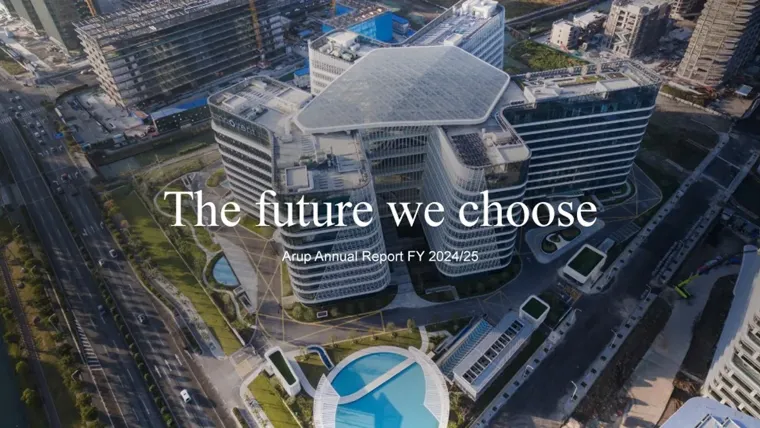
- Innovent Global R&D Center in Shanghai – a 37,000m² landmark biophilic campus uniting science, community and sustainability, reflecting Arup’s growing life sciences portfolio across Asia.
- Baltic Towers in Gdańsk – Poland’s first large-scale offshore wind facility, a flagship for Europe’s renewable-energy transition and a model for industrial regeneration.
- Delta’s Terminal C at New York’s LaGuardia Airport – a digitally enabled terminal integrating 30 systems for real-time operations, setting a new benchmark for data-driven airports.
- Severn Trent Water, UK – using advanced data analytics and AI to upgrade existing wastewater networks in Gloucester, improving resilience and helping extend the life of critical infrastructure.
Arup made further progress towards its net zero ambitions, reducing total carbon emissions by 39% against its FY 2018/19 baseline. Emissions intensity per member has fallen by 48% since the baseline year, reflecting ongoing investment in energy efficiency and sustainable practices.
Jerome Frost, OBE, CEO, said: “We’re approaching our 80th anniversary and have made important changes to strengthen Arup for future growth. We’ve reinforced our foundations and sharpened our strategic focus, equipping the firm to lead in the global transition to net zero and resilient systems.
“From the opening of Hong Kong’s Kai Tak Stadium and Belfast Grand Central Station to projects like the Brisbane 2032 Olympics, our focus is on working with clients and communities to shape a better world.”
Hilde Tonne, Non-Executive Chair of Arup, said: “Arup has transformed and grown over the decades, with thousands of members around the world today – from engineers, planners and economists to psychologists, material scientists and ecologists.
“Our revamped board structure is the natural next step in evolving our governance to meet the needs of a business of our scale, operating in an increasingly complex world. And our new strategy gives us a clear direction – helping clients realise commercial opportunity and accelerate the transition to a sustainable and digital future.”
Further information about Arup’s work to build safe, resilient and regenerative places can be found in our Annual Report.
Annual Report FY 2024/25
Explore our performance, the issues driving our global business and our approach to shaping a better world.
News
Explore more news from Arup
Future of Infrastructure Group and Arup launch roadmap to unlock the power of digital twins for Canada’s infrastructure
12th February 2026

New study outlines pathway for zero-emission fuel development on Canada’s west coast
15th December 2025

Finch West LRT officially opens, transforming Toronto transit
8th December 2025

New Arup-designed sidewalk sheds will transform New York City sidewalks
18th November 2025

Learn more about Arup
A global consultancy shaping infrastructure, buildings, energy and sustainability for the built environment.
