
How do you create a floating roof for one of the UK's leading engineering universities?
Engineering Heartspace
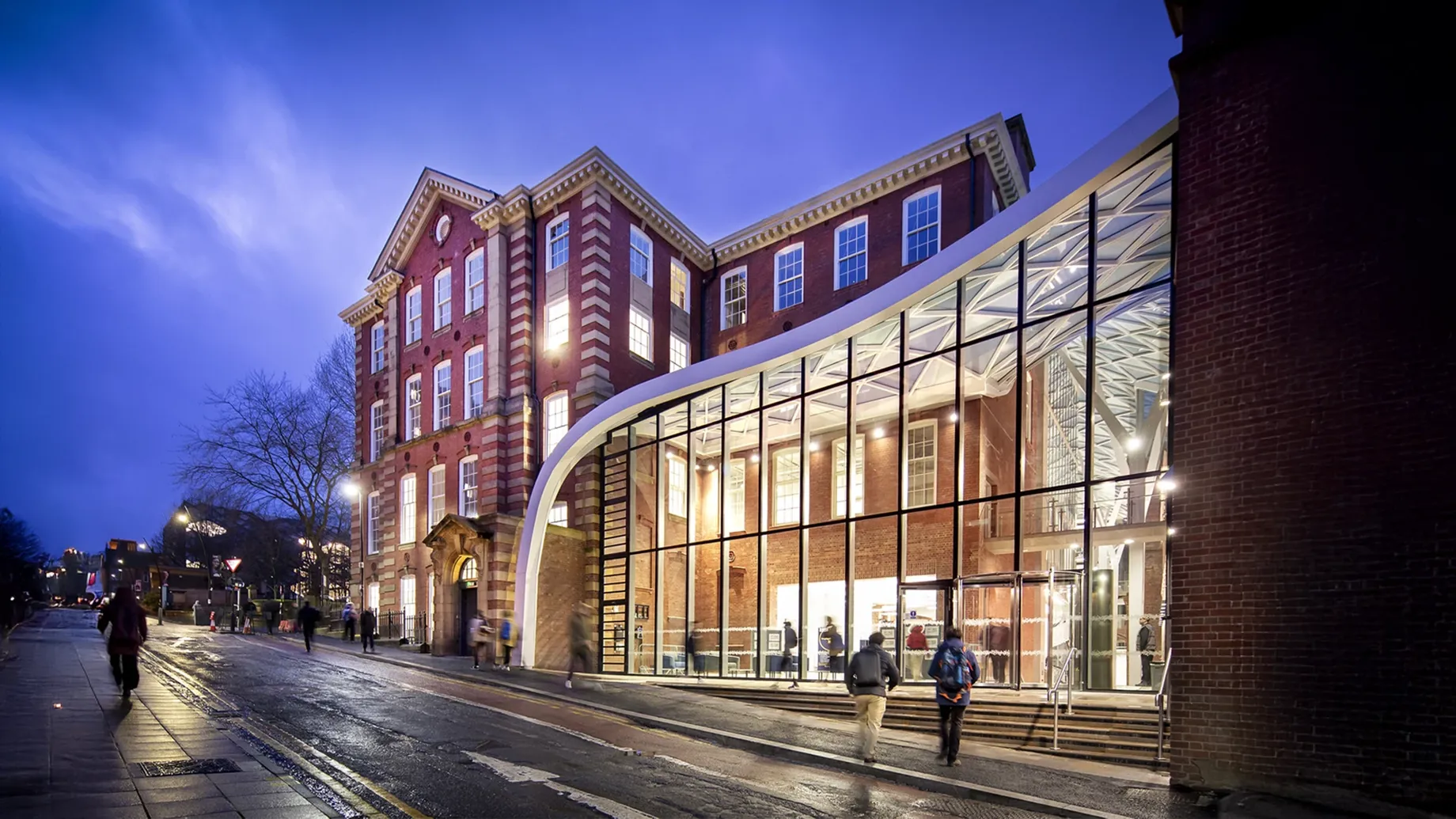
Two of the University of Sheffield’s most historic buildings required a transformation to become a thriving home for the Faculty of Engineering. The Grade II listed Frederick Mappin Building and 1885 Central Wing were segregated and under-utilised.
As one of the leading providers of engineering research and education in the UK, the University needed to unify the growing department in a collaborative and vibrant campus.
Engineering Heartspace has transformed a neglected, utilitarian courtyard into a quadruple height atrium under a striking glass roof. Arup delivered multidisciplinary services to unite two historic university buildings, improving access and movement. We created new spaces for research and collaboration, alongside a dedicated employability hub to support student careers.
Leading the roof’s geometry development using parametric tools, we shaped a 1,370m² bespoke glass structure that is a beacon in Sheffield’s skyline. Now, students, staff and the wider community experience a light-filled atrium that showcases innovative architectural engineering.
Arup has been involved from the outset of the university’s engineering campus transformation, shaping a strategy that prioritised carbon reduction while delivering state-of-the-art spaces for learning and research. Celebrating the historical character of the two buildings as an original feature, the space demonstrates engineering ingenuity for its occupants. Students, staff and the wider community can now be inspired everyday by the display of innovative architectural engineering above them.
Transforming historic architecture through structural engineering
Conserving and celebrating the heritage features of two of the university’s oldest buildings were central to the design vision. The Grade II-listed 1885 Central Wing and the 1886 Sir Frederick Mappin Building were not only preserved but will now feature prominently for the next century, inspiring future generations.
The exposed brickwork of the existing buildings is contrasted under the curved glass roof, creating a clear distinction between old and new. The glass roof was designed to be as structurally independent as possible from the heritage structures to avoid overloading, ensuring that the historical integrity was protected.
The triangular steel ‘tree’ columns supporting the roof were minimised and carefully positioned to frame the key features of the existing buildings. This helped increase sightlines to heritage details while maximising floorspace. The trees were constructed from tapering triangular sections, delicately echoing the ‘Star of David’ vents repeated across the historic facades. The result is a striking aesthetic.
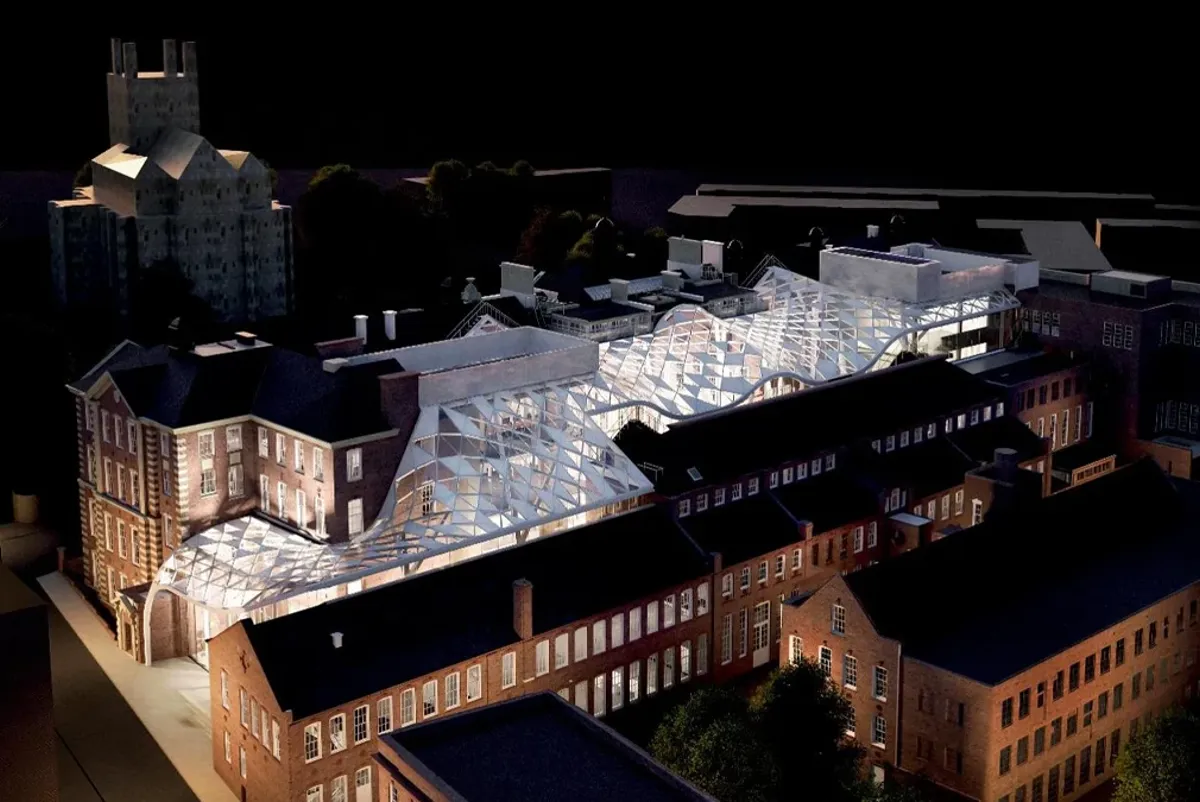
The illuminated Heartspace canopy crowns the Mappin Building and Central Wing, redefining Sheffield’s engineering campus.
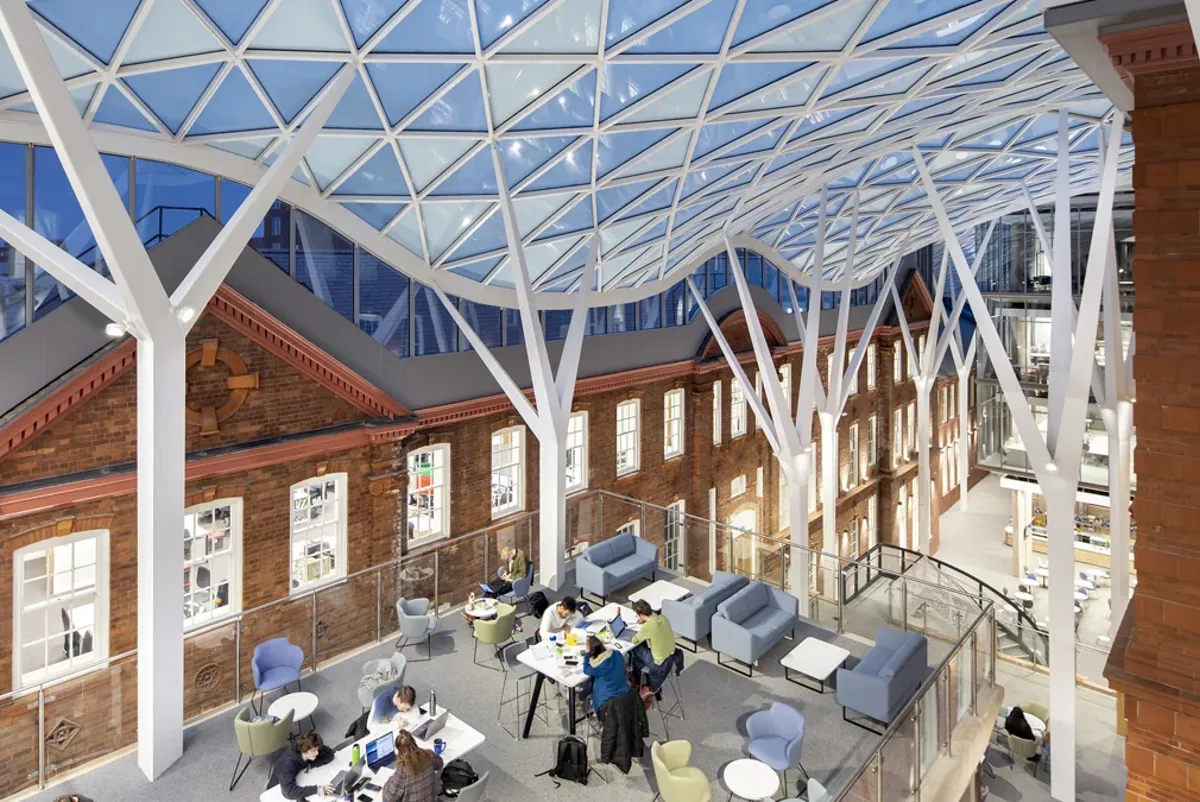
Heartspace’s quadruple-height atrium unites two historic University of Sheffield buildings beneath the striking free-form glass roof.
A floating glass roof for the courtyard
The roof forms the newly enclosed courtyard atrium, creating an interconnected hub that appears to float over the Grade II-listed frontages of the historic courtyard buildings.
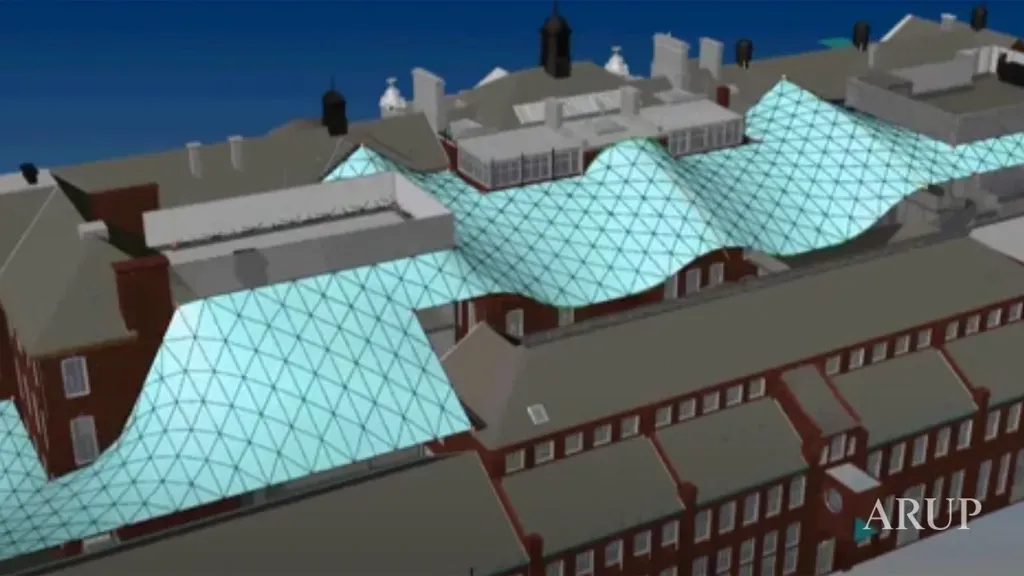
Collaborating closely with Bond Bryan Architects and Waagner Biro (WB), we drew inspiration from the buildings’ existing shapes and mirrored symmetry, resulting in roof lines that follow a natural rhythm of triangular and domed barrel vaults.
Using parametric software, we determined the structural forces and modelled a roof that relies on its geometry for stability. We also introduced a gradient to avoid water stagnation and rain staining. The engineering-driven parametric roof form crowns the new combined building as a prominent feature in Sheffield’s skyline, a city globally renowned for its expertise in engineering.
Reducing embodied carbon
A strategy to ‘repair rather than replace’ existing buildings helped retain the embodied energy and carbon from their original construction. We effectively recycled the building fabric and embedded the scheme within the circular economy.
Using exposed concrete within the courtyard as part of the internal architecture minimised follow-on trades, greatly reducing waste and embodied energy. 50% cement replacement with Ground Granulated Blast-furnace Slag (GGBS) was specified, reducing the concrete’s embodied carbon content by approximately 40%.
We are delighted with our new home for the Faculty of Engineering. Arup delivered cost-effective structural engineering solutions at Engineering Heartspace, that supported both our ambitious vision and our low carbon objectives for this new development.
Passive design measures were adopted to regulate temperature in the atrium, utilising the natural features of both the existing buildings and new courtyard blocks. Through thermal modelling, we assessed internal comfort conditions and, in collaboration with WB, advised on the specification of solar control and opaque glazing to mitigate the need for mechanical cooling.
Heating was supplied by the Veolia Sheffield district heating network – a high efficiency system powered by city waste – providing high grade heat with lower CO² emissions than traditional systems.
Specialist research laboratories and collaboration spaces were optimised to reduce steelwork weight, decreasing embodied carbon within the material, transport weight and the number of lorries required. This optimisation alone is estimated to have saved around 20,000 km of travel – equivalent to over 53,600 kg of CO₂.
A long-standing partnership
Arup has worked with Sheffield University since 1960. Our multidisciplinary design expertise can be observed in projects such as the lighting design for the university's concourse and its multi award-winning building: The Diamond.
Projects
Explore more education projects

Fostering arts and culture through a sustainable, expanded campus
California College of the Arts Campus Expansion, USA

Realising a sustainable campus landmark
National Taiwan University Humanities Building, Taiwan

A sustainable retrofit designed around staff and students
University of Southampton Business School, United Kingdom

Repurposing an old school building into a space for 21st century science
Sir William Henry Bragg Building, University of Leeds, United Kingdom
Get in touch with us
If you'd like to speak to one of our education experts about any of the issues raised on this page or a potential collaboration then please get in touch by completing the form.
