
Boosting passenger satisfaction and commercial success at Europe’s busiest airport
Heathrow Airport Commercial Revenue Programme
Heathrow Airport, the UK’s only hub airport and largest port by value, is operating beyond its original design capacity and facing pressure to reduce congestion, improve the passenger experience and unlock new revenue. To support its future ambitions, Heathrow partnered with Arup, its long-standing and trusted advisor on major infrastructure projects since the late 1980s.
As lead designers for Heathrow’s Commercial Revenue Programme (CRP), we are delivering a wide range of projects, from viability and feasibility studies through to concept design. This includes transforming underused areas into new retail units, restaurants, lounges and facilities; refurbishing VIP lounges; optimising departure lounge seating; expanding the digital offering; and improving supply flows through the consolidation centre for retailers and restaurants.
Every step to improve capacity and reduce pressure on Heathrow’s overstretched infrastructure supports UK connectivity and growth, with the airport serving as the nation’s hub for tourism, investment and trade. The latest plans will enable Heathrow to serve an additional ten million passengers a year, while reducing in-the-air and on-the-ground carbon emissions by three million tonnes.
Creating space for passengers and sustainable growth
To help create 70,000m2 of new or upgraded space for retail units, restaurants, lounges and other facilities, we assisted Heathrow in finding opportunities to relocate retail storerooms and offices from prime terminal zones to back-of-house areas.
Unlocking this valuable space will increase choice for travellers, enriching the passenger experience while boosting commercial revenue. This will help keep airport charges low and fund vital improvements, while making Heathrow a more valuable proposition for airlines and retailers.
As a member of the Heathrow Carbon Working Group and partner of the Centre of Excellence for Sustainability – focused on research, testing and accelerating innovation in sustainable aviation – we have identified substantial opportunities for carbon reduction. These include the use of lower-carbon concrete, which can cut emissions by up to 50% compared to conventional mixes. In addition to providing technical and design expertise, we take an active role in the working group meetings, sharing knowledge in topics such as diesel-free sites, sustainable procurement, and PAS2080 – a global standard for managing carbon in building and infrastructure.
To ensure every project is designed to reduce carbon emissions, we supported the establishment of Heathrow’s Carbon Management Standard, which requires life-cycle assessments and data-driven insights to cut emissions. This is a key step in the airport’s goal of reaching net zero by 2050.
Reimagining the VIP experience
Heathrow has been setting the standard for VIP travel since the 1960s, originally catering to royalty and diplomats and becoming commercially available in 2009. We are collaborating on the design of refurbished VIP lounges across Heathrow to enhance the experience for premium passengers, a priority segment for the airport.
The refurbishment of the Royal Suite, near Terminal 4, will upgrade facilities for world leaders, private-jet passengers and dignitaries. A new T5 bar-lounge concept will introduce luxury services, including private security checks and boarding. This follows the £3 million rebrand and refurbishment of ‘The Windsor by Heathrow’, a private area offering a personalised ‘door-to-plane’ service.
Optimising seating for travellers
Departure lounge crowding and seating availability are key drivers of satisfaction and directly influence Heathrow’s Airport Service Quality (ASQ) score. In 2024, more than 50% of passengers reported crowding and low seat-finding scores in Terminals 3 and 5. However, simply adding more seats is not the answer: some passengers perceive empty seats as unavailable when they are located in busy or noisy areas.
Our proposals address space constraints through smart seating choices and layout. Engaging with airport stakeholders, we evaluated seating options across criteria, including size, comfort, colour, ease of cleaning, accessibility, carbon impact and cost. We then tested a range of layouts, applying the latest psychological insights to identify the best solutions. These improvements have the potential to enhance the lounge experience, raise Heathrow’s ASQ score and deliver benefits for airlines.
The architectural designs and thought processes developed by Arup introduced a novel approach to airport seating. These concepts resonated strongly with Heathrow, and when implemented using existing assets, delivered significant and measurable improvement in passenger experience.
Delivering projects in a live airport
With the airport accommodating significantly more passengers than its design capacity, the potential for construction activity to cause disruption is enormous and the risk of escalating costs is high. Heathrow benefits from our proven track record of delivering projects in fully operational airports – on time, on budget and with minimal disruption to passengers, airlines and retailers.
Working collaboratively with Heathrow and its partners from the outset, we develop robust evidence and governance to secure investment and set projects up for success. Leveraging our multidisciplinary expertise, we test each aspect rigorously to tackle potential issues before they arise. This includes acoustic, fire, structural and vibration engineering; mechanical and electrical systems; transport modelling; accessibility and inclusion; and aviation security.
We then design and phase projects to maintain a constant flow of travellers, whether replacing escalators or creating a temporary flight connection centre until the permanent facility is upgraded. Having led the CRP covering 2022–2026 (H7), our teams are now helping to drive the next phase from 2027–2031 (H8).

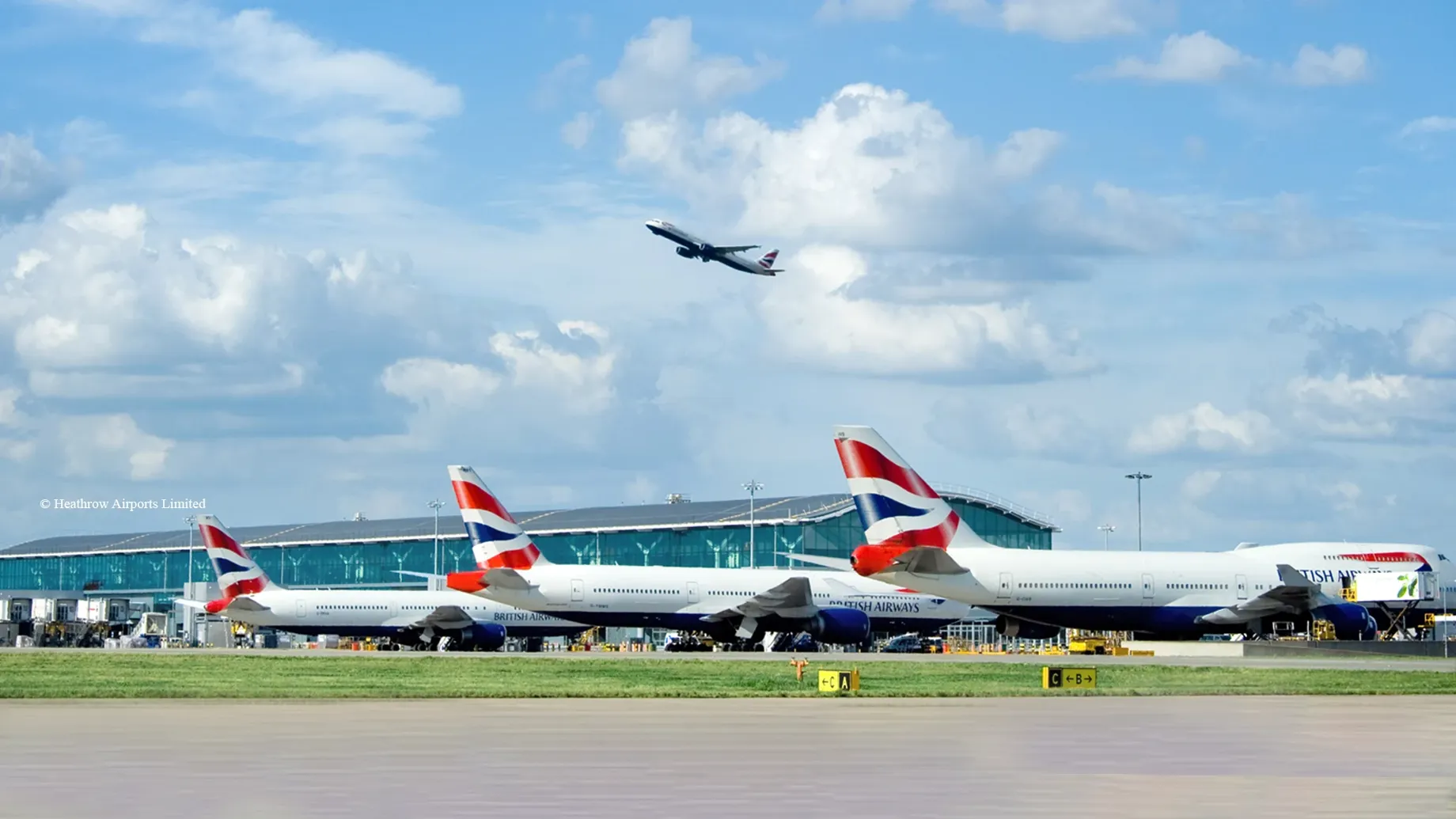
The airport’s capacity will expand from 82 million to 92 million passengers annually by 2031. Image credit: Heathrow Airports Limited.
Enhancing service and revenue through digital platforms
Our digital team collaborated with Heathrow throughout the H7 CRP, offering support from initial strategic assessments to business justifications, all while ensuring projects met key objectives: increasing commercial revenue, enhancing passenger satisfaction and improving operational efficiency.
During this time, we contributed to several initiatives including managing digital project delivery within client governance frameworks, gathering requirements from business sponsors and creating tailored solutions for each proposal. We also secured detailed cost data from suppliers and identified major risks and assumptions. This enabled Heathrow to make informed decisions about which projects should advance to implementation.
After projects began, we continued to support the airport by providing design assurance throughout the design development and implementation, ensuring these projects stayed aligned to original requirements and integration principles.
Increasing flow through the consolidation centre
All food, drink and retail goods enter Heathrow via a consolidation centre, where they are screened and then distributed to outlets across the airport. With more people travelling through and spending longer in terminals, the consolidation centre was struggling to keep pace. This risked shortages and empty shelves in shops, restaurants, cafés and bars.
To optimise throughput, we rebalanced chilled and ambient storage to reflect changing demand and identified opportunities to increase capacity within the existing footprint. These improvements will smooth the flow of supplies to airport outlets, enhancing the passenger experience, boosting retailer performance and further strengthen the airport’s commercial success.
Balancing stakeholder needs
Heathrow’s commercial revenue plans are guided by feedback from over two million passengers, insights from 400 pieces of research and input from 150 subject-matter experts across nearly 30 organisations, including airlines, the Heathrow Passenger Forum and the Heathrow Business Coalition.
We are a member of Heathrow Business Coalition, which brings together export firms, iconic British retailers and key suppliers. Through quarterly meetings, we gain valuable insights into their priorities and challenges and share plans for growth. With over 26% of the UK’s exports by value passing through Heathrow, when the airport thrives, so do businesses across the UK.
Building on the success of our accessibility and inclusion focus on commercial revenue projects, Heathrow engaged with us to help update its inclusive design standard for all projects. This standard ensures spaces that are welcoming, functional and built to serve everyone for generations to come.
Projects
Explore more aviation projects:

Reimagining the passenger experience at the world’s busiest airfield
Chicago O’Hare Concourses D and E, USA

Designing a transformative multi-modal gateway to Los Angeles
LAX/Metro Transit Center, USA

Redefining Japan’s future airport city
Narita Airport City, Japan

Transforming the travel experience at Zayed International Airport
Zayed International Airport Terminal A, United Arab Emirates
Get in touch with us
If you'd like to speak to one of our aviation experts about any of the issues raised on this page or a potential collaboration then please get in touch by completing the form.
