
How can redesigning an urban highway catalyze economic development and improve wellbeing?
Indianapolis Inner Loop Visionary Study
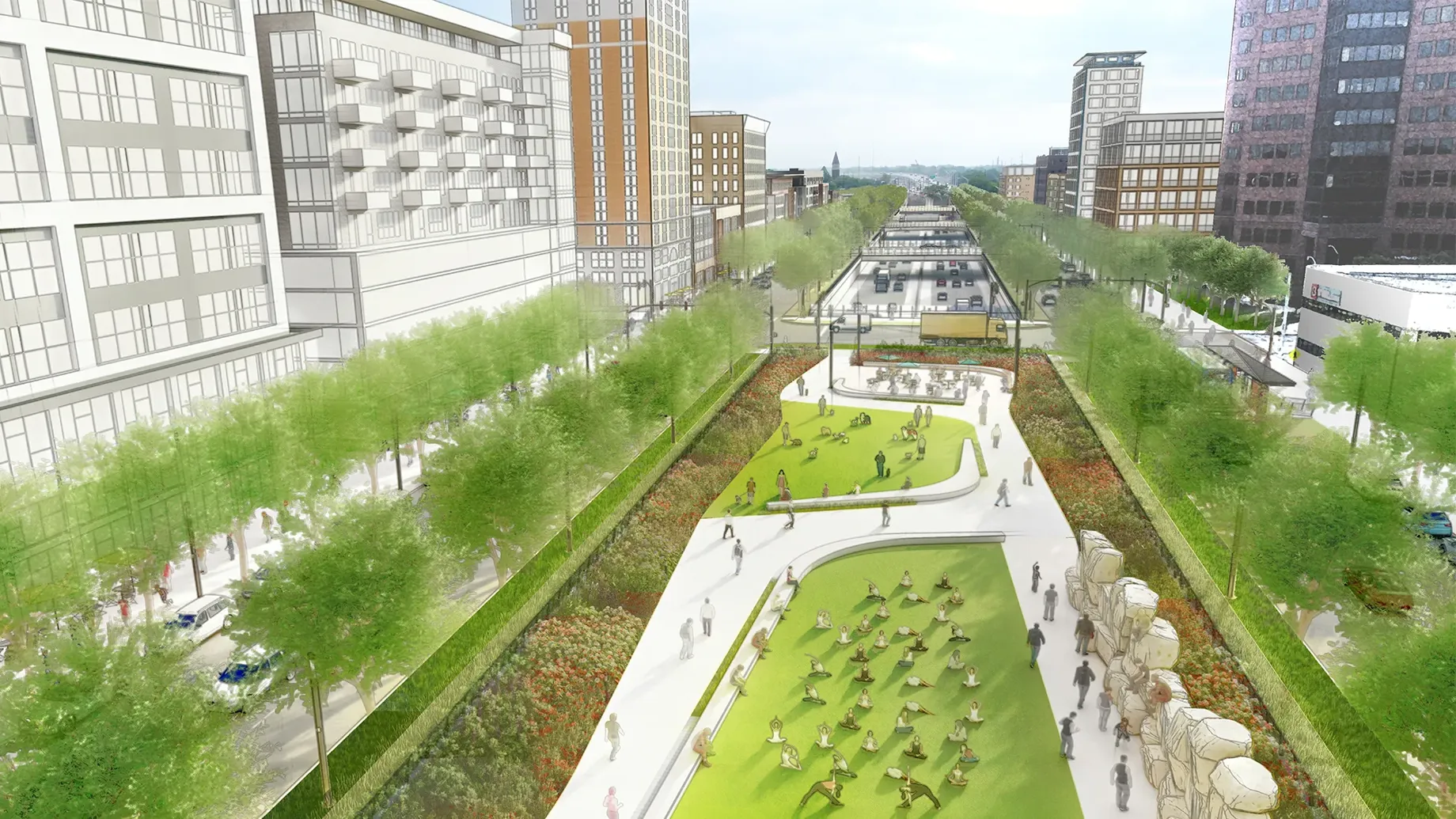
The interstate system that encircles downtown Indianapolis, known as the Inner Loop, was originally built in the 1970s and has significantly influenced the urban development of the city. Almost 50 years since its completion, the main interchanges and bridges of I-65 and I-70 are reaching the end of their lifecycle and will require major upgrades and ground-up reconstruction.
As the Indiana Department of Transportation makes plans to rebuild the Inner Loop, a diverse coalition of residents are envisioning new possibilities for improvement that will create a safer and sustainable highway network.
To inform the community-led plans for the Inner Loop redesign, Arup conducted a comprehensive feasibility study for the Indy Chamber and the Rethink Coalition, a grassroots-movement-turned-nonprofit. The Total Value Report offers a holistic comparison between rebuilding the Inner Loop as-is and recreating it as a recessed highway, outlining the environmental impacts, economic development opportunities, community benefits, and cost analysis of both options. Arup’s study found that the recessed interstate concept is technically feasible, which could have overwhelmingly positive benefits for surrounding communities.
The new vision for the Inner Loop integrates a greenway and multi-modal boulevard system to address historic inequities and create transformational redevelopment opportunities in downtown Indianapolis, improving the city as a regional center for people to live in, work in, and visit.
A comprehensive framework for analysis
Original plans for the Inner Loop did not assess the impacts that introducing obstructive freeways would have on residents and businesses. During its construction, thousands of homes and buildings were demolished, businesses were cut off from the city center, and an estimated 17,000 people were displaced. Today, these effects are still being felt in downtown Indianapolis. The city is not as well connected as it used to be, and historically marginalized communities have been disproportionately impacted.
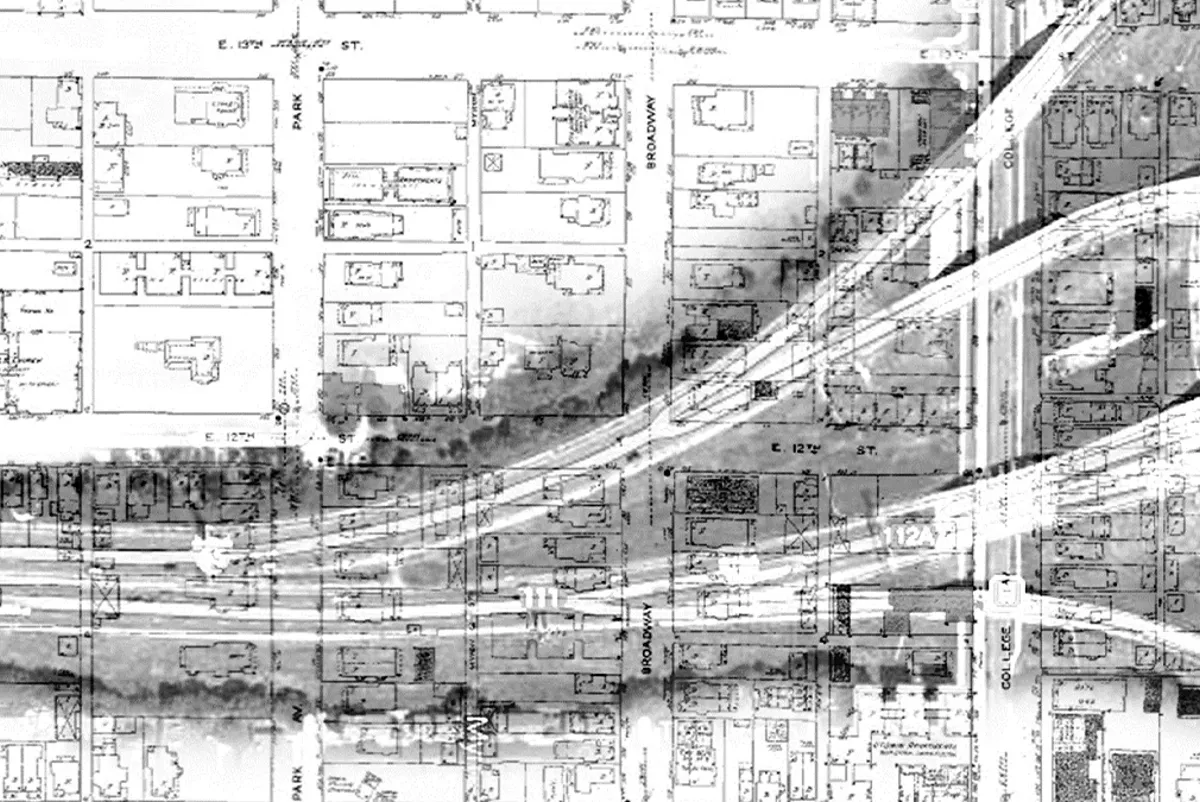
North Split overlayed on pre-existing urban fabric. Fifty years ago, thousands of homes and buildings were demolished to make way for the Inner Loop.
To conduct a comprehensive evaluation of the reconstruction options of I-65 and I-70, Arup developed a broad set of criteria for performing a more comprehensive and equitable examination, expanding beyond the standards used when the Inner Loop was first conceived. Legacy assessments focused exclusively on elements like traffic capacity, motorist safety, construction complexity, and cost — leaving out crucial considerations.
The new visionary study addresses overarching themes such as local connectivity, quality of life, community completeness, and equitable development. The report compares both the as-is and recessed options through both sets of criteria. Arup also investigated the technical feasibility of redesigning the Inner Loop as a recessed highway system, including the financing and implementation of the project.
Positively transforming the urban landscape
While the Inner Loop was first conceived to connect suburban homes to the city center of Indianapolis, the freeway system has created both a physical and mental barrier within downtown Indianapolis. A large number of city blocks that previously housed businesses and residents have been replaced with parking lots. In addition, historic Black, ethnic, and racially-mixed neighborhoods, once vibrant and economically productive communities, are significantly fragmented.
To address historic social and environmental justice challenges, the recessed highway concept envisions key physical interventions that could benefit local communities and make restorative redevelopment possible. Arup’s report found that lowering interstate lanes below grade will positively transform the layout of Indianapolis. The reduced footprint of the recessed option would allow the recapture of up to 75 acres of land downtown, making room for new businesses, housing, and public green spaces.
The current Inner Loop design creates inequities for vulnerable groups. If redesigned, the new traffic flow would promote equitable development by increasing local access to businesses and high-quality parks. In addition, the integration of greenways parallel to the recessed freeway would increase the overall connectivity of downtown. By removing barriers generated by the Inner Loop, the recessed highway concept will address historic systemic impacts, help to restitch local neighborhoods and communities, and contribute to the urban resurgence of downtown Indianapolis.
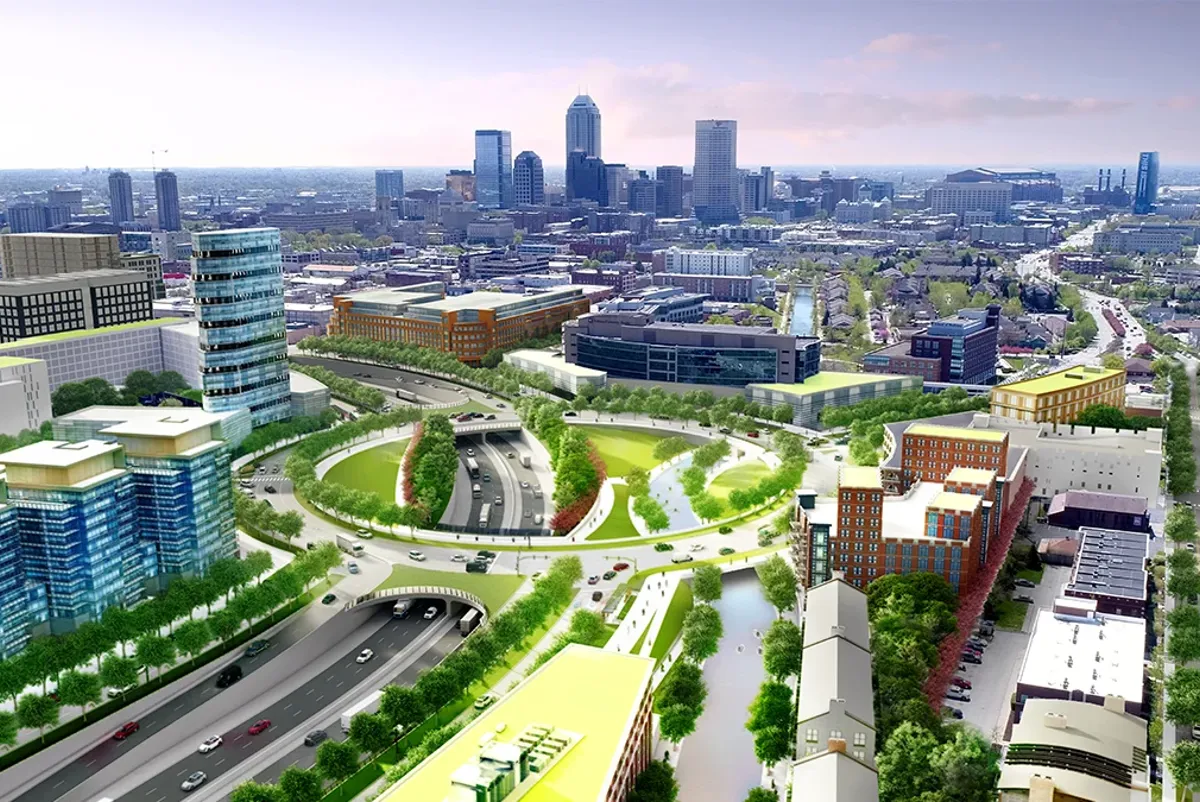
Northwest Gateway after redesign (Image provided by Rethink Coalition, Inc. / Rundell Ernstberger Associates, Inc.)
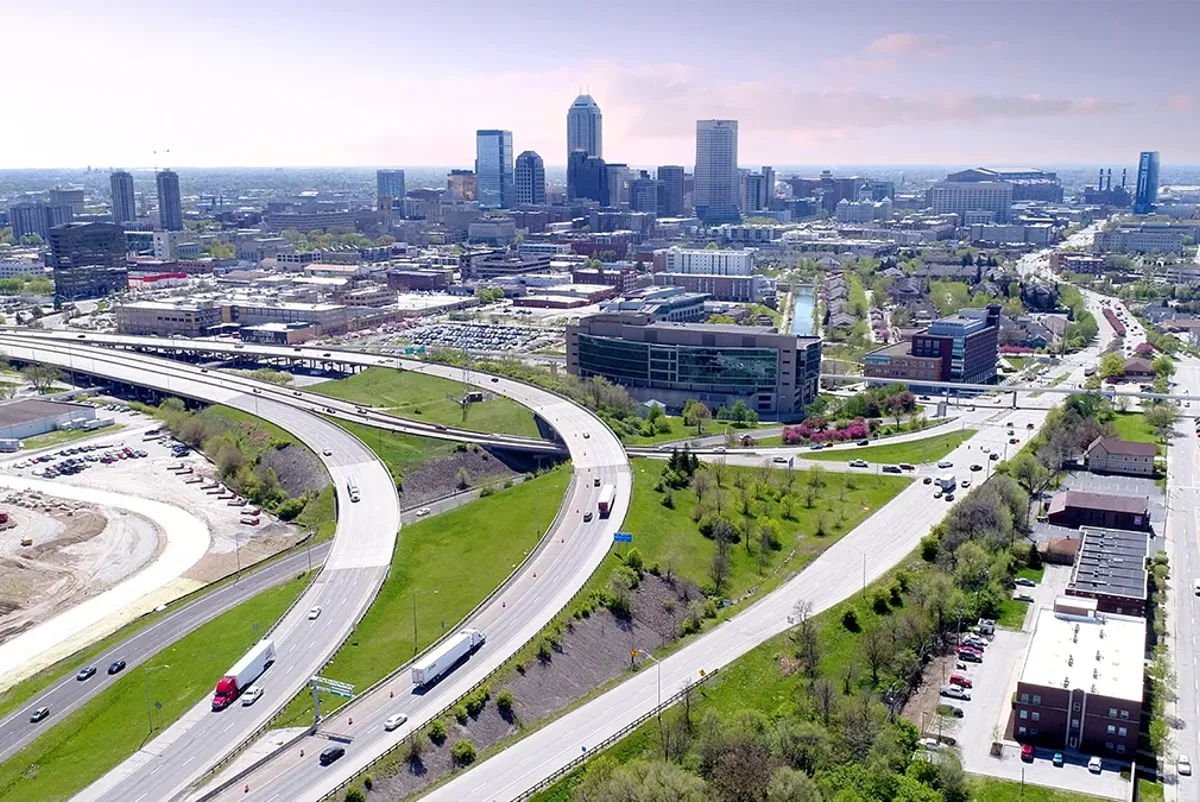
Northwest Gateway today (Image provided by Rethink Coalition, Inc. / Rundell Ernstberger Associates, Inc.)
Improving safety and wellbeing
Additional key findings in Arup’s report include improvements to safety and wellbeing. A recessed interstate would increase pedestrian and cyclist safety through enhanced crossing conditions, a dedicated cycle track, and larger, continuous sidewalks. Slower vehicle speeds, reduced local traffic, and open parks and green spaces will also improve local air quality and noise pollution, improving the environment for residents, commuters, and visitors. In addition, the recessed option would support the integration of a public transit system in the future. Altogether, Arup’s report advocates that the redesign of the Inner Loop would create a more sustainable, equitable, and accessible future for downtown Indianapolis — while offering a unique opportunity to catalyze equitable development of the urban core.
Our methodology for evaluating Rethink Coalition’s vision can serve as a guidebook for other American cities as 20th century highway infrastructure reaches the end of its useful life. At this critical juncture, Arup’s research for Rethink Coalition and its partners provides a more complete framework for rebuilding the Inner Loop to achieve a range of tangible benefits for surrounding communities — and to help Indianapolis right historical harms and forge a more equitable and prosperous future.
Rethink Coalition Inc.
Projects
Explore more roads and streets projects

Illuminating a community path for the nighttime safety and enjoyment of pedestrians and cyclists
Somerville Community Path Lighting, USA

County-wide adaptation strategy to protect a critical Bay Area transportation corridor from sea level rise
Marin County Sea Level Rise Adaptation Study, USA

California’s first long-span cable-stayed bridge
Long Beach International Gateway Bridge, USA

Planning an electric bus corridor that links communities across California’s Central Valley
Kings/Tulare Cross Valley Bus Corridor Plan, USA
Get in touch with us
If you'd like to speak to one of our roads and streets experts about any of the issues raised on this page or a potential collaboration then please get in touch by completing the form.
