
Revitalizing the National Geographic Society’s headquarters with a new Museum of Exploration to showcase storytelling for explorers of the future
National Geographic Museum of Exploration
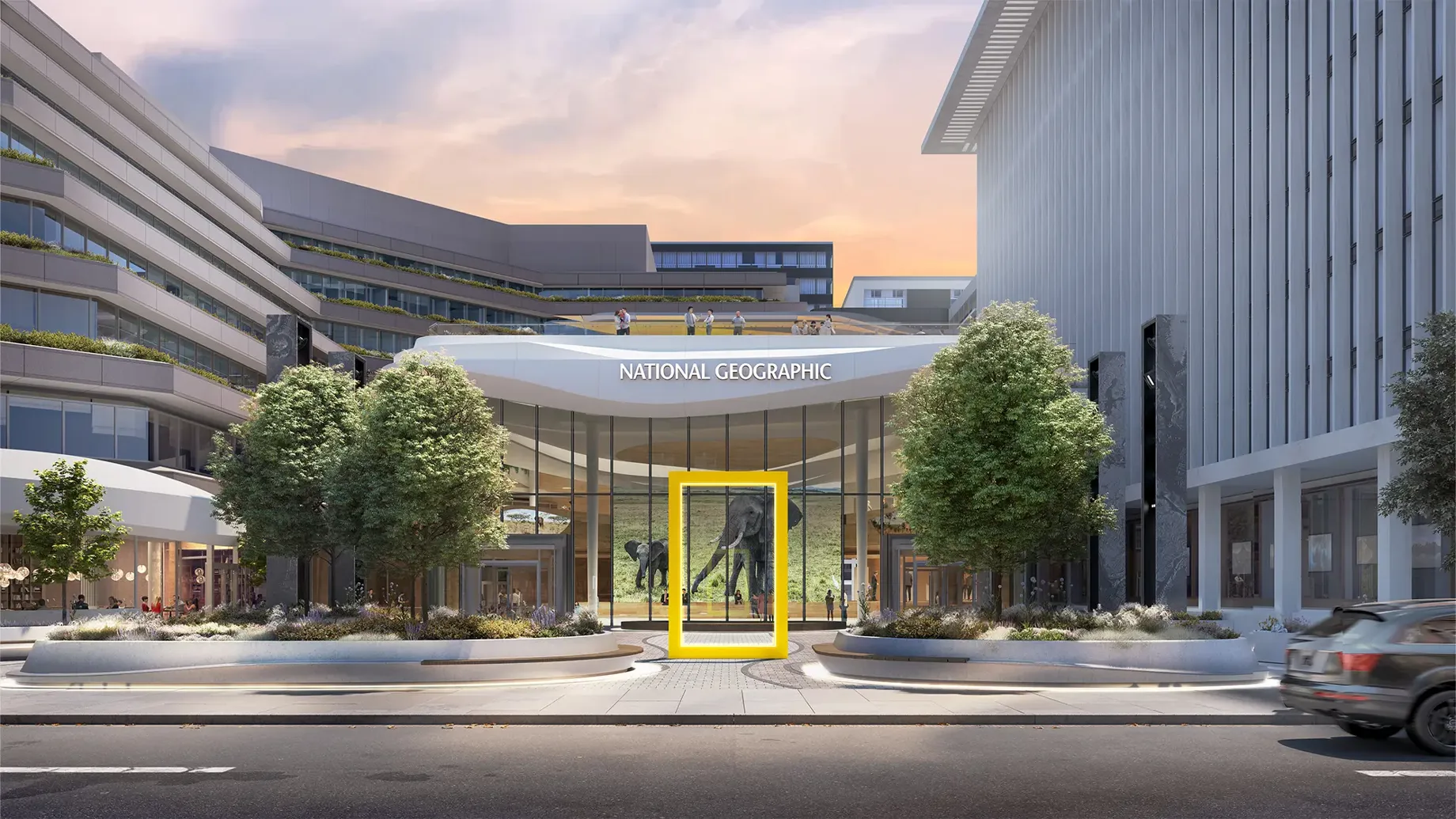
Revamping the National Geographic Society’s nearly 130-year-old headquarters, including the building of a new museum, required a comprehensive design with accessibility and sustainability at its core. The campus, composed of unique structures built throughout the 1900s, needed to be better integrated, both for staff and for the public.
Working with architect Hickok Cole, Arup provided structural and acoustic engineering to realize the Museum of Exploration and better connect National Geographic’s campus. This required an engineering focus on a new building, historic buildings, and designing exhibits, while integrating the structure and detailing into the architectural vision for the campus. On a project of this scale and complexity, the success of the larger vision depended on the careful resolution of the structural details to limit disruption to daily operations active during construction.
The National Geographic Museum of Exploration is a state-of-the-art public attraction located at the National Geographic Society’s reimagined campus in Washington, D.C. This sustainably built destination is central to the Society’s mission to illuminate and protect the wonder of our world through the power of science, exploration, education, and storytelling. The expansive space features a wide array of attractions, including curated exhibitions, a nearly 400-seat theater, a refreshed eatery, an immersive outdoor nighttime experience, and specialized learning spaces throughout the campus.
Integrating the historic with the new on an active campus
Arup’s structural approach required sensitivity and close attention to the varied building systems and construction methods used across the National Geographic campus. This project repurposed rooms, improved accessibility, and opened portions of existing floors to create more impactful exhibit spaces. To achieve this, the team drew on global expertise to ensure the revitalized structures met modern strength and performance requirements. The design aimed to limit new structural intervention wherever possible, reducing cost, disruption, and the embodied carbon associated with new materials. Some of the most important structural work on this project is defined by what visitors will not see: the careful adaptation of existing buildings so they can support a new public role for another 100 years.
The new glass pavilion, which serves as the campus gateway, sits directly above the first basement level and three stories of below-grade parking. This below-grade structure houses parking, fabrication spaces, and other critical facilities that were essential to keeping the campus active and functional during construction.
To preserve those operations while meeting the programmatic requirements of the jewel-box pavilion, Arup carefully positioned new columns around parking spaces, drive aisles, and existing services. The solution required shifting columns away from structurally optimal locations, embedding transfer beams within the new plaza, and introducing sloping columns and braces to reconcile structural, operational, and architectural demands.
New columns to support the pavilion in the basement posed their own constructability challenge. The aim was to limit demolition, avoid existing services, and work within the constraints of an active basement and parking structure. To address this, Arup developed a telescoping column detail and construction sequence: columns were fabricated short enough to be brought into the basement and positioned between existing slabs, then extended upward to meet the structure above. This approach provided the tolerance needed to work with unpredictable existing conditions while avoiding costly demolition and penetrations through the existing building envelope. By sandwiching the new columns between floors, the team created a precise structural intervention with minimal impact to ongoing operations.
One of the defining features of the existing M Street Building lobby was a large circular opening on the second floor, creating a double-height space beneath a ceiling depicting a starry night sky. When reimagining the visitor experience, Hickok Cole used this feature as the setting for the new “Under the Stars” stair, which spirals through the existing opening and appears to belong naturally within the original space.
Achieving that effortless appearance required significant structural upgrades. Arup supported the new stair back to existing columns at the perimeter of the opening, using new steel collars and low-profile, heavy-walled tube elements to keep the supporting structure concealed while preserving the architectural intent.
Additionally, our team applied sound-absorbent finishes to reduce echo and control noise build-up. For example, a historic lobby was outfitted with modern acoustic measures to best serve its new purpose as an education centre and sound-absorbing plaster was used in ceilings.
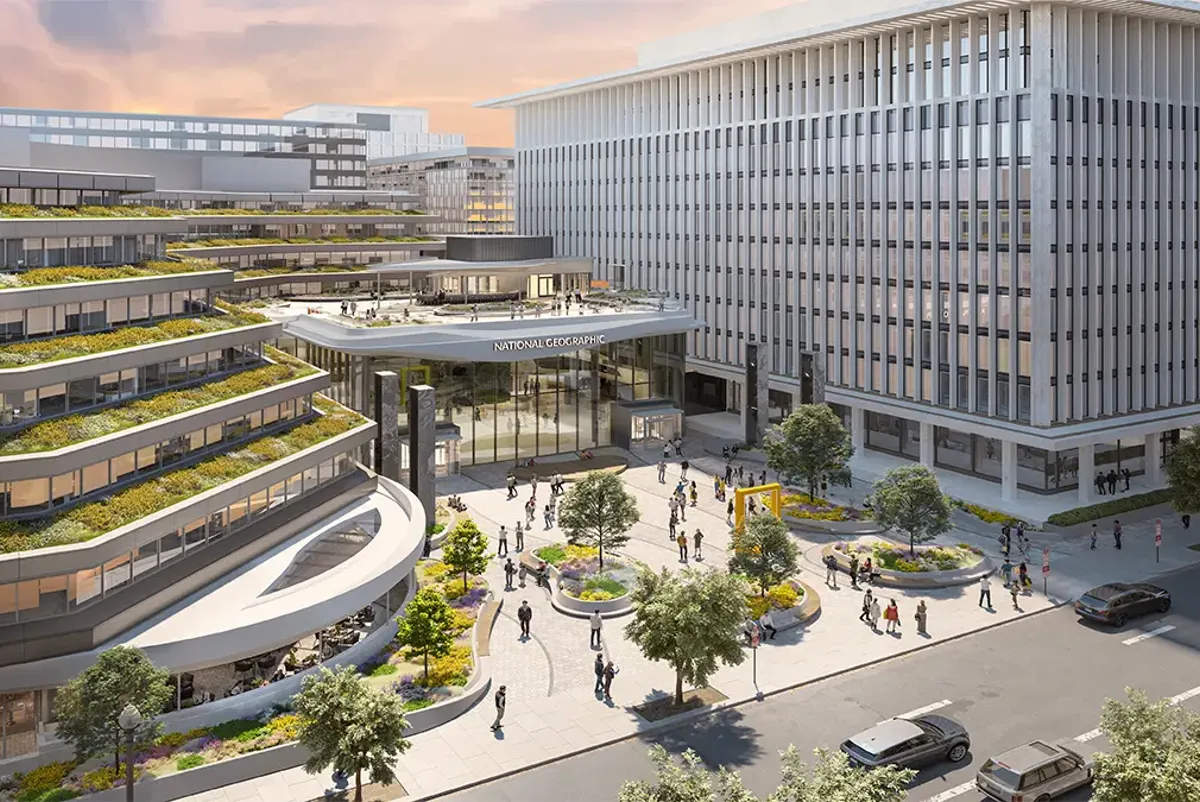
Artist's rendering of the exterior front courtyard of the renovated National Geographic Society headquarters and Museum of Exploration, opening June 26, 2026. Courtesy of the National Geographic Society
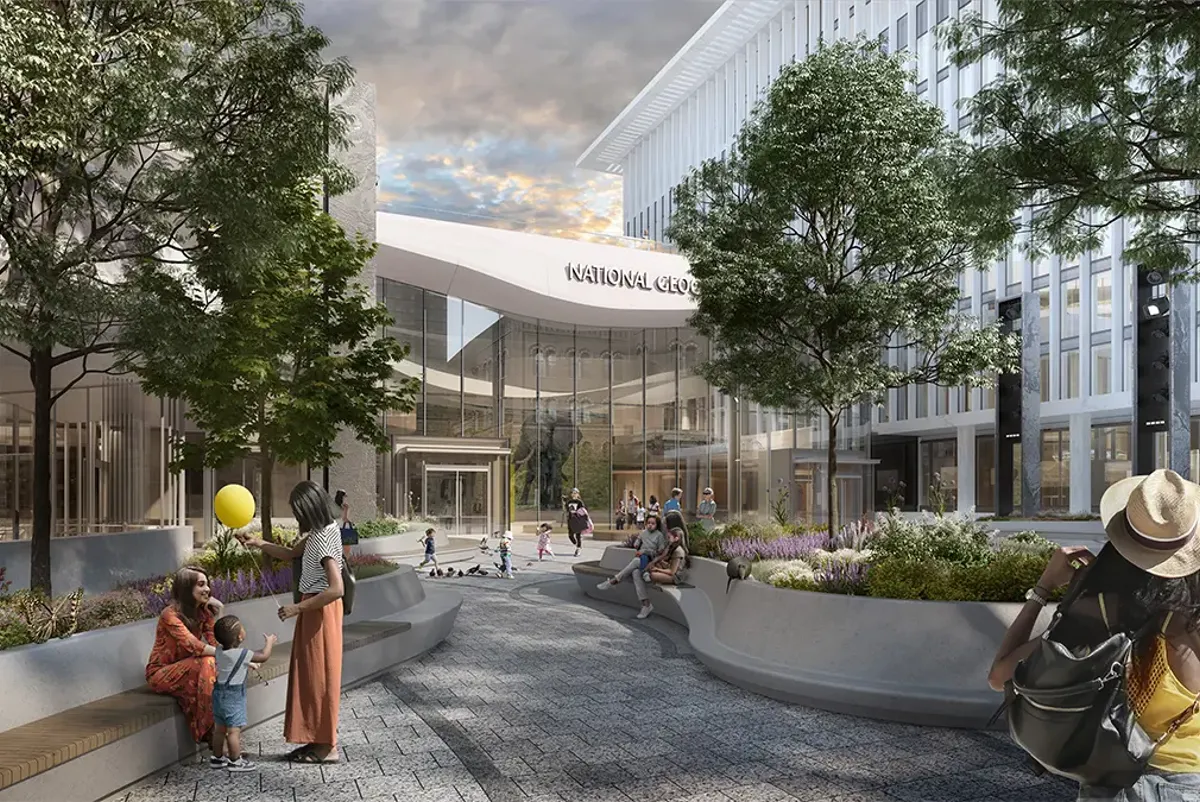
Artist’s rendering of the pavilion at the Museum of Exploration, opening June 26, 2026. Courtesy of the National Geographic Society
Reducing embodied carbon through reuse and design innovation
Sustainability was embedded in the project from the outset, aligning National Geographic Society’s values with the design team’s commitment to responsible, low-carbon engineering. By reusing the existing campus buildings and limiting new structural work primarily to the glass-box entry pavilion, the project significantly reduced the need for new materials while preserving the value of the existing structures.
Arup also reduced embodied carbon within the new work. Low-carbon concrete was specified for the new foundations, below-grade works, plaza, and the pavilion’s concrete-over-metal-deck slabs. Measured against the finalized design — which already reflected embodied-carbon reductions achieved through dedicated design effort — this specification reduced the carbon associated with concrete by more than 20%, saving approximately 165 tonnes of carbon dioxide equivalent.
Beyond material specification, the design process included evaluating options not only for cost and constructability, but for carbon impact as well. Drawing on Arup research, the team switched from lightweight to normal weight concrete composite slabs during the design process. Although unconventional, the heavier, normal weight concrete can have up to 80% less embodied carbon by volume than lightweight concrete. In this case, the change had minimal impact on the architecture, steel tonnage, and foundations, while reducing the pavilion’s embodied carbon by 10%, saving approximately 50 tonnes of carbon dioxide.
In response to National Geographic’s goal to avoid Styrofoam insulation and plastics within the project, Arup and Hickok Cole rethought the design of the regraded public plaza. The plaza, a vital new part of the project, needed to be raised upwards of 5ft in some locations. The original approach to achieve this used a thin concrete layer over lightweight rigid insulation, which reduced structural weight but introduced nearly 100 tonnes of Styrofoam-related carbon. Through careful review of construction sequencing, fire requirements, and the existing plaza structure, Arup replaced the rigid insulation with metal deck formwork, saving more than 50 additional tonnes of carbon dioxide equivalent.
Holistic design for an immersive storytelling experience
A key component of the Museum of Exploration is built around an immersive storytelling experience built from light and sound. These audio and video projections, however, required extensive use of technology that needed to be incorporated into the overall architecture of the building. This led to extensive collaboration between Arup, Hickok Cole, and the immersive design team to incorporate, conceal, or showcase the relevant speakers and projectors into the structure of the project.
At the main campus entrance, the project created a unique opportunity to activate the plaza through an immersive and responsive nighttime light show. The experience relies on precisely aligned projections from four 40ft-tall media towers, where the structural design question was not simply whether the towers could stand safely, but how much they could move before wind-induced deflection would compromise image alignment and disrupt the visitor experience.
Answering that question required more than standard code-based structural criteria. The team needed to understand the visual tolerance of the projected content, the behavior of the towers under local wind conditions, and the point at which movement would become perceptible to visitors. Arup brought together in-house experts in audiovisual design, immersive experience, wind engineering, and structural engineering to define those performance expectations and translate them into a buildable structural solution.
This integrated approach enabled the design team to communicate clear performance criteria to the client and engineer the projection towers without unnecessary conservatism. Through close structural and architectural collaboration, the team also incorporated structural steel within the tower cladding to provide the necessary stiffness, completing an integrated design response that supported both the technical performance and the architectural intent.
From the project’s earliest stages, four sculpted structural columns were envisioned as defining elements at the front of the pavilion. Hickok Cole sought columns that would be expressive without relying on cladding to create their form. Through close collaboration with steel fabricators, the design team developed bespoke shapes that could be built using off-the-shelf steel components.
As the project’s audiovisual ambitions evolved, these columns were further adapted to serve as integrated media towers, concealing speakers, projectors, and related systems. The result is a set of structural elements that act simultaneously as support, sculpture, and infrastructure — a visible expression of integrated design.
Arup's expertise was instrumental in transforming our ambitious design ideas into an immersive, high-performing museum experience.
Moment Factory, MyCoto, Walt Disney Imagineers, HITT, Goppion
Projects
Explore more arts and culture projects

Delivering lighting, acoustics, AV, and theater design for the Theodore Roosevelt Presidential Library
Theodore Roosevelt Presidential Library, USA

La Sagrada Família: a collaboration in digital and stone
Sagrada Família, Spain

A net-positive botanical garden built for research and resilience
Marie Selby Botanical Gardens, USA

Expanding a New York cultural landmark dedicated to contemporary art
The New Museum of Contemporary Art Expansion, USA
Get in touch with us
If you'd like to speak to one of our arts and culture experts then please get in touch by completing the form.
