
Advancing the future of marine conservation in Sharjah
Sharjah Marine Science Research Centre, University of Khorfakkan
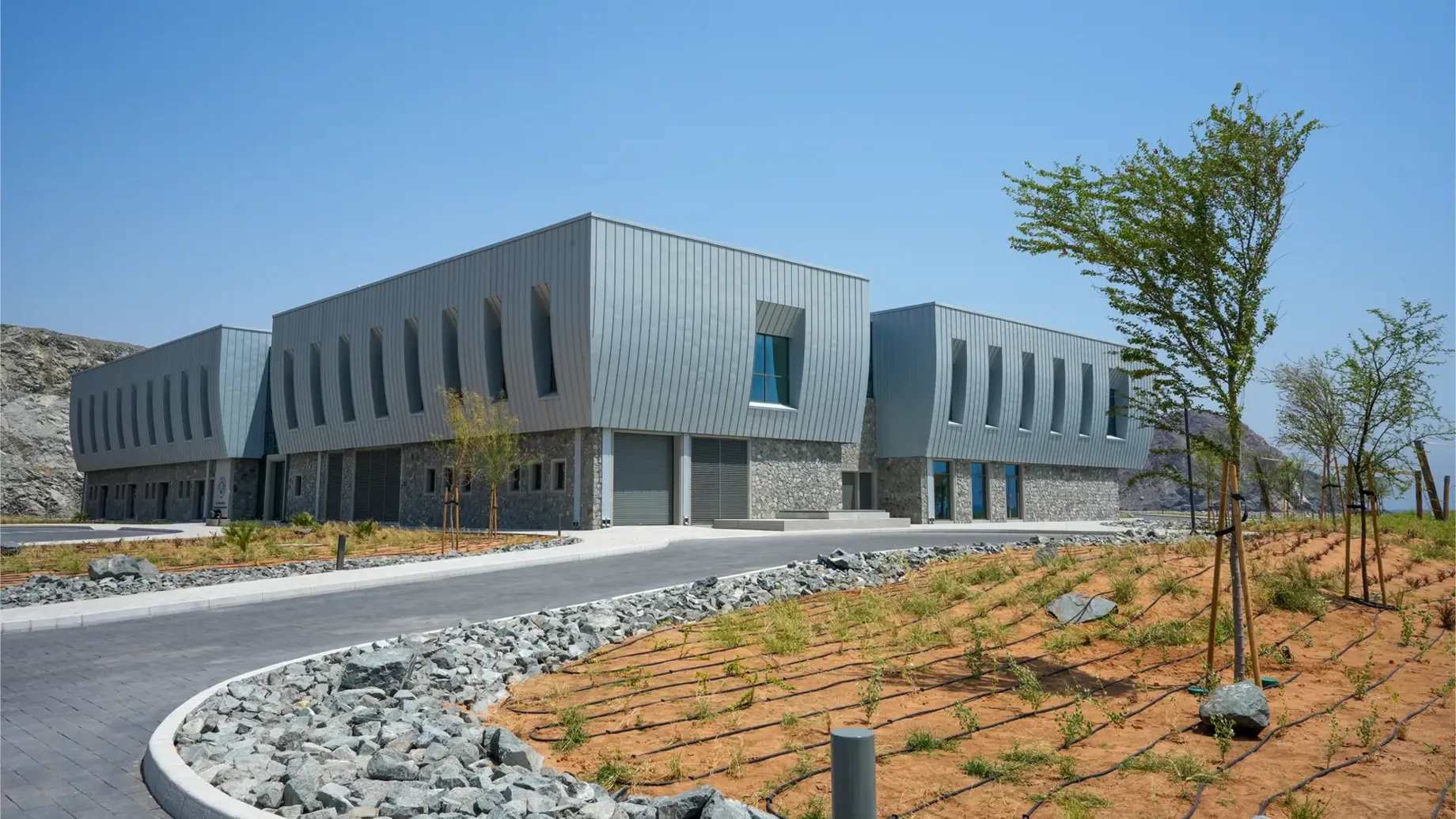
The specialist Marine Science Research Centre at the University of Khorfakkan in Sharjah will study the UAE’s abundant coral reefs, deep-sea environments and coastal ecosystems. Arup led the development of the state-of-the art facility, which was funded by the Government of Sharjah.
As lead consultant during the design stage, we played a central role across many aspects of the project. We determined the optimal position and orientation for the buildings and worked with a local architect: ATI Consultants to incorporate local materials. We also designed and engineered the services, making the building as sustainable as possible by minimising energy consumption and recycling water.
Collaborating with academics globally, including teams from the University of Exeter, researchers will use these new facilities to enhance understanding of the marine ecosystems and species around Khorfakkan. The centre’s laboratories and teaching spaces provide ideal conditions for research, while its harbour and dive facilities offer direct access to offshore ecosystems.
Optimising building placement and orientation
The site is a former quarry on a coastal plateau, where part of the land is formed from excavated material. This artificially created area is at risk of long-term settlement and storm damage. So, after conducting borehole tests to identify the original natural coastline, we altered the proposed plans, shifting the buildings 25m further inland. This ensured that the foundations are on solid rock, within the original coastline and clear of any potential storm surge. We also rotated the main building to place the basement in the ideal position. to make the building stable and robust.
Our civil engineers analysed the potential for surface water flooding after heavy rainfall and designed a storm drain to intercept overland flows from the surrounding Hajar Mountains. This will take the water around – rather than through – the site.
We also seized the opportunity to cut carbon and create a distinctive identity for the buildings. Working with the architect, we chose a façade that blends titanium zinc with high-grade gabbro stone sourced directly from the site. The coarse-grained, igneous rock used to be quarried here, so it not only cuts transport emissions but also anchors the building in its landscape.
Titanium zinc resists corrosion, even in marine conditions, by developing a natural patina that protects the surface. Together, the metal and stone produce a robust, low-maintenance envelope.

Our MEP engineers used their life sciences experience to design systems that provide control over the temperature and humidity of the air throughout the buildings. Credit: ATI Consultants

Throughout this project, we drew on our experience of working in the UAE as well as our existing relationship with the Government of Sharjah. Credit: ATI Consultants
Designing complex services for laboratories and aquariums
Laboratories are highly serviced buildings, and the Marine Science Research Centre is no exception. Our MEP (mechanical, electrical and plumbing) engineers used their life sciences experience to design systems that provide control over the temperature and humidity of the air throughout the buildings, as well as ensuring appropriate air exchange rates for the laboratory and aquarium spaces. We also oversaw the design of 13 different gas supply systems to the laboratories.
The centre’s research activities demanded five different water systems: potable water, deionised water, seawater, artificial seawater that has a controllable salinity, and grey and blackwater which are treated on site and used for irrigation. Both types of seawater are stored in large concrete tanks within the building ready for use, and there is a separate drainage and storage system for contaminated water. Each system needed its own pipework, tanks and pumps, all of which we integrated into the building.
To protect the systems and operations at the centre, we designed the systems with easy access for routine maintenance. Our design for the complex drainage systems in the undercroft ensured that the pipework and valves are accessible for repairs, maintenance and potential future adaptations.
On the ground floor, the aquariums will house a variety of species. Working with the client’s aquarium specialist, we developed systems to allow the rooms to hold a series of tanks that can operate with different water temperatures suitable for a range of species.
We coordinated all the building services, laboratory services and structure using a shared BIM environment. The fully integrated model simplified decision-making and reduced risk, while making sure that even the complex water systems would be straightforward to install, commission and maintain.
Seamlessly integrating global and local expertise
Throughout this project, we drew on our experience of working in the UAE as well as our existing relationship with the Government of Sharjah. With such a high-performing building, it was vital for us to develop the brief together and understand exactly what was needed. This covered everything from inspiring teaching spaces to systems for cleaning and drainage that prevent the spread of disease.
Our team in Dubai led the project through the design and permitting phase. They worked with local consultants and called on global laboratory and science expertise from the Arup team in London, while our Madrid office provided BIM services.
The Marine Science Research Centre opened in October 2025. Its facilities will host a new generation of future marine scientists and support the university’s ambition to become a global leader in marine science research and ocean sustainability.
ATI Consultants / Aquatilis AQS FZE / SPMC Landscape Architects / DLME Quantity Surveyors
Projects
Explore more science projects

Bringing science and community together under one roof
Innovent Global R&D Center, Mainland China

Creating a collaborative environment for the premier particle physics laboratory in the United States
Fermilab Helen Edwards Engineering Research Center, USA

A space for life-saving research
Ragon Institute, USA

Designing high-performance laboratory infrastructure to foster research collaboration
Pacific Northwest National Laboratory Grid Storage Launchpad (GSL), USA
Get in touch with us
If you'd like to speak to one of our science experts about any of the issues raised on this page or a potential collaboration then please get in touch by completing the form.
