
Engineering the world’s tallest statue – a tribute to Sardar Patel’s legacy
Statue of Unity
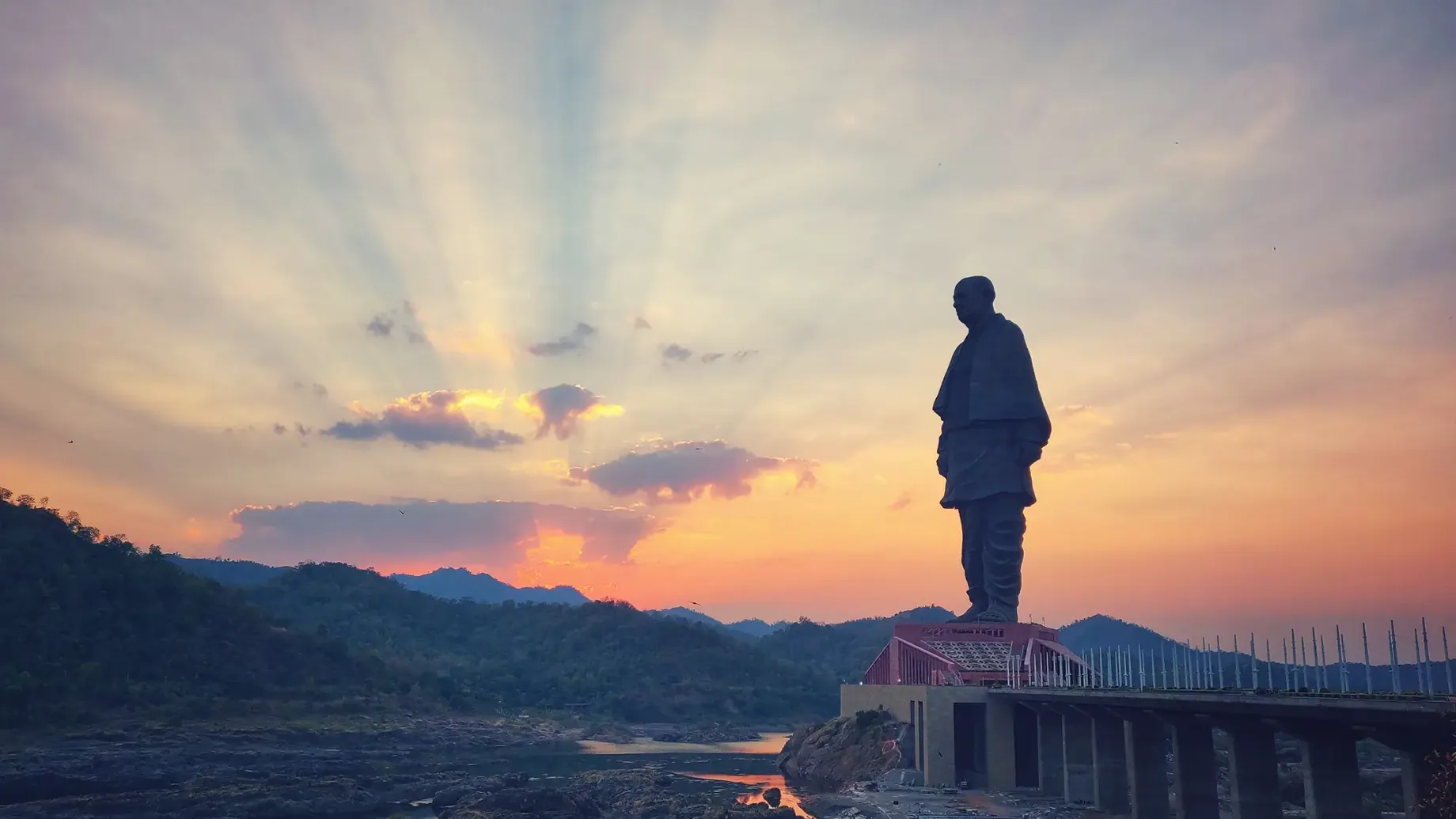
The towering figure of Sardar Vallabhbhai Patel – a leading politician who helped unite India and campaigned for independence from Britain – looks out over the Narmada River in Gujarat, India. Made of bronze and supported by an internal core and frame, the Statue of Unity is the world’s tallest statue. At 182m, it is almost twice the height of the Statue of Liberty.
Arup’s structural and geotechnical engineers worked with contractor Larsen & Toubro to bring sculptor Ram V. Suttar’s vision to life. In addition to our core engineering expertise, Arup also provided a range of specialist services. These spanned façades engineering, MEP (mechanical, electrical and plumbing), seismic, wind, vertical transportation and materials.
Together, we devised a structure capable of supporting a statue of this scale. It was designed to endure intense wind forces, seismic activity and other extreme dynamic environmental stresses. We also designed and engineered the site’s exhibition hall and visitor facilities.
To meet the tight programme, we maximised the use of off-site manufacturing and assembly. This approach helped to keep the programme on track, with work completed in time for Prime Minister Narendra Modi to inaugurate the statue.
Overcoming challenging conditions
Contractor Larsen & Toubro asked Arup to support its bid for the contract, and later to find a way to complete this challenging project on schedule. We began by exploring how the statue could be built and supported, while researching the risks it would need to withstand. Working closely with Larsen & Toubro, we put together a team made up of experts from Arup’s offices in India, supported by further technical specialists based in the UK.
Our very first visit to the site showed that this project would be anything but straightforward. The Statue of Unity towers over the Sadhu Bet hillock in the Narmada River, connected to the riverbank by a 300m bridge. Our geotechnical engineers found that the ground at the site was soft and unstable from repeated fluvial flooding. The site’s relatively remote location meant there were no major roads leading to it.
We also discovered that the river was teeming with crocodiles – an extra hazard for the site team to navigate. This region of India regularly experiences earthquakes, so we brought in our seismic engineering experts to assess and mitigate structural risks. High winds at the site, blowing across from the nearby Sardar Sarovar dam, were another important consideration.
We quickly determined that these site constraints were a potential risk to the schedule and would make working on site difficult. To overcome this, we devised a process to fabricate and assemble as much of the statue as possible off-site.
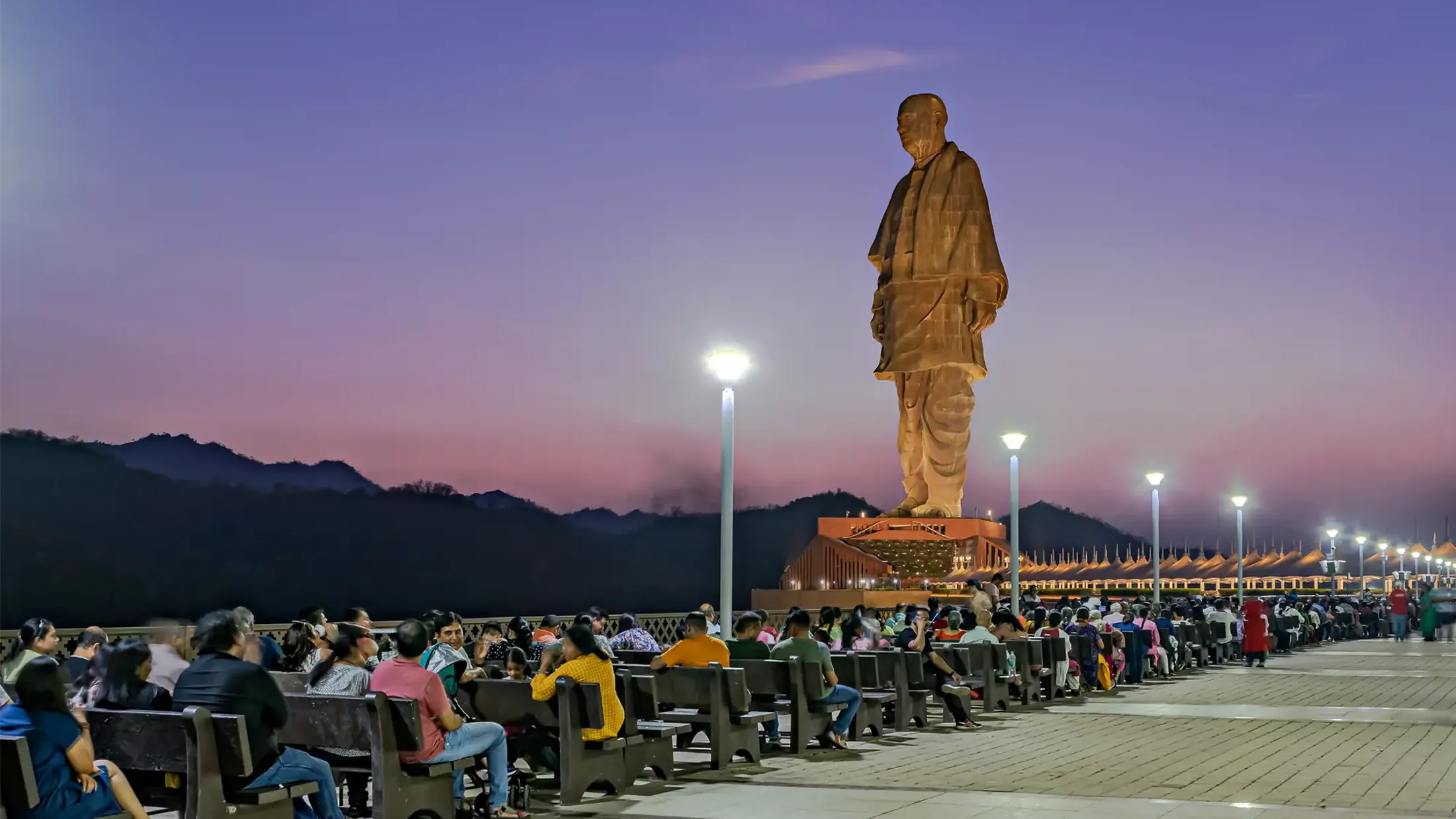
The Statue of Unity was inaugurated by Narendra Modi, the Prime Minister of India, in 2018 and now attracts 30,000 visitors a day.
Designing for manufacture and assembly
Our structural engineers designed twin oval concrete cores that rise inside the statue, all the way from the foundations, up through Patel’s feet to his shoulders. These stabilise the statue and house the internal lifts that take visitors to the viewing gallery at his chest. A complex 3D steel framework surrounds the cores, connecting them to the modules of the bronze façade that gives the figure its form. Movements in the support structure could have caused fractures in a conventionally welded cast bronze shell. To address this, we developed an innovative modular system that enabled prefabrication and rapid installation without huge scaffolding.
We divided the surface of the statue into approximately 600 large panels, arranged into 27 rings of modules, that could be manufactured offsite before being hoisted and fixed into position by crane. Each large panel was roughly 6m by 5.5m,formed from smaller 2m by 2m panels that were welded together and mounted onto lightweight steel trusses. The small panels enabled us to reproduce Suttar’s design precisely, using a combination of advanced digital and traditional sand-casting in a specialist foundry.
This was the first time this technique had been applied to a mega-structure of this nature. It cut the installation time by more than half compared to traditional methods. Flexible joints between the panels allowed the statue to safely flex and ‘breathe’ with changes in temperature and wind. For the areas requiring a highly detailed finish – including the face, hands and feet – we used traditional in-situ assembly to ensure everything fitted together perfectly.
To keep visitors on the viewing gallery safe and comfortable, we had to minimise movement and vibration as the wind whips around the curved surfaces of the façade. Our solution was to design two tuned mass dampers, one on each core, that help to reduce vibration and limit the effects of any seismic activity.
Integrated design ensuring seamless delivery
This project demonstrates the power of integrated design. Its success relied on taking an integrated approach, bringing together Arup’s multidisciplinary expertise from concept to completion. By aligning geotechnical, structural, seismic, materials, and vertical transportation design, we were able to manage complex interdependencies, maintain quality across every facet of the project, and meet a demanding deadline.
The Statue of Unity was inaugurated by Narendra Modi, the Prime Minister of India, in 2018 and now attracts 30,000 visitors a day. As well as telling the story of Patel’s legacy, the statue itself has become a source of collective pride for the people of India.
The project won the Best Tall Non-Building Award of Excellence at the 2022 CTBUH Awards in recognition of its innovative engineering and rapid delivery.
Awards
-
2022 CTBUH Awards
Best Tall Non-Building Award of Excellence
Projects
Explore more arts and culture projects

Creating a new paradigm in live entertainment
Sphere, USA

Delivering El Paso’s first purpose-built children’s museum
La Nube STEAM Discovery Center, USA

Enhancing an iconic New York City institution on the Museum Mile
The Frick Collection, USA
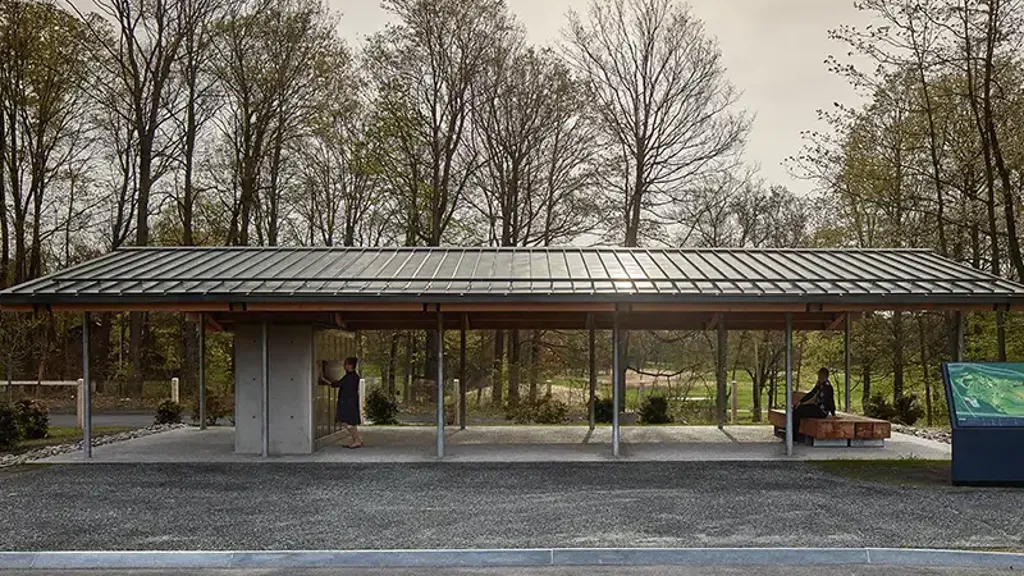
Supporting the enduring legacy and regeneration of a valued art center
Storm King Art Center Capital Project, USA
Get in touch with us
If you'd like to speak to one of our arts and culture experts then please get in touch by completing the form.
