
Modern workplace design is increasingly complex - is there a better way to approach it?
So many factors now shape the working environment, it's increasingly hard for investors, developers and tenants to arrive at a design that works for them. We explore new ways to navigate this complicated task.
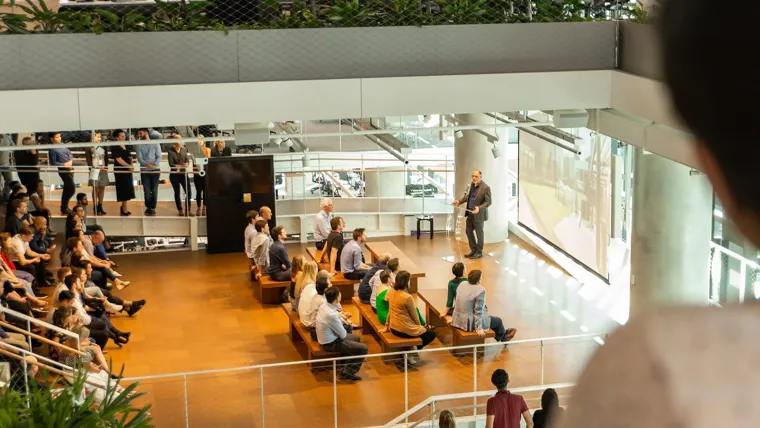
How does your workplace make you feel? It’s a question that wouldn’t have made much sense to developers or business managers 30 or 40 years’ ago, but in today’s world, the question of what a brilliant workplace is, of what the working environment should feel like, has never been more subtle or important.
Typical commercial buildings can last from 50 to 150 years. However, trends in workplace design move faster, reshaping choices and priorities every five to seven years, often in surprising ways. Design has increasingly borrowed from other contexts. Playful spaces like retail and hotel designs have been borrowed yet at the same time, the division between work and home has become opaque.
Commercial office design has been reshaped by a technology that allows synchronous and asynchronous working practices particularly after the global pandemic. Coworking spaces set up for startup culture have redefined the scale and type of design preferred in hybrid and flexible working environments. Organisations’ net zero goals and use of connected IOT systems have reshaped the infrastructure requirements for workplaces. A wider understanding of neurodiversity in the workplace has also emerged, with renewed focus on inclusivity and wellbeing. For urban populations, the workplace’s surrounding amenities and social connection to the neighbourhood have emerged as priorities for employee retention.
At the broadest level, for organisations considering a new workplace or retrofit in their existing location, the very nature of work itself is a topic of consideration.
Responding to new trends in workplace design
Developers and commercial office owners are increasingly conscious of this layered definition of successful workplace design. In our work at Arup, every year the requests for research and insights into what occupants want, need and are thinking grow and are shaped by our Foresight team. Clients understandably want to bring the expectations and ultimate reality of the workplace experience closer together. This matters, because companies express their values though the workplace experience they offer.
When we sit down with developer or tenant clients, the need to navigate these complex, human-centric questions is central to our approach. Today’s workplace must support existing ways of working with five generations while preparing for tomorrow’s – a demanding brief to achieve. With clients’ understandable interest in gaining the most engaging, flexible and appealing destination spaces, the challenge is how to balance the long list of design considerations in a practical, thoughtful and successful way. It requires a mix of curiosity, economic, psychological, design and technical insights to harmonise these requirements within a valid and realisable scheme.
Our approach is person-focused and builds on five central ideas:
- Workplaces should embody and support an organisation’s purpose and values
- Workplace wellbeing is fundamental to employee’s sense of belonging and retention
- Workplace design must drive high utilisation and low-cost, rapid adaptability
- Workplaces should offer seamless digital services and operation … but only what’s sufficient
- Workplaces exemplify an organisation’s sustainability commitments
1. Design underpins an organisation’s purpose and values
How many times have you walked into a company’s headquarters only to be bewildered at how at odds the environment feels, compared to the organisation you know? At its most ambitious, workplace design should be able to embody the meaning and identity of an organisation. Fundamentally, workplace design can align people, ideas and values to help build the identity of an organisation – for its people, its clients, visitors, investors and everyone else.
Our approach has always been to draw on our advisory insights into organisational culture, to initially define the desired workplace experience. Is it a collaborative space full of energy and interaction? Or a setting for focused work? Do people need flexibility or prioritise hybrid working? There are myriad dimensions to explore and which will inform a meaningful and effective design.

2. A sense of belonging
Technology infrastructure and hybrid working have enabled working anywhere but that’s not always the best outcome for organisations. In the always-on digital era, many employees crave a place to do work more effectively and in essence the workplace itself is a company’s promise to its people: here’s where we do our collective best work. Our approach is to explore the organisation and its people requirements and build that into our design ethos.
Our people and organisations team help clients to explore these fundamental questions about how a working environment should be designed to best meet the always evolving needs of the people that work there. It’s a rich and complex question that must balance an organisation’s culture, ambitions, informed by psychological insights as much as business strategy and financial goals.
The workplace operates in a wider local context too, one that adds layers of value and meaning. Clients increasingly have to consider their employees’ wider net of connections, their proximity to important services like pre-schools, gyms, green spaces and neighbourhoods that define other parts of their lives. Simply moving to a larger, cheaper working environment, perhaps out of the city centre, could affect morale and retention.
3. Workplace design must support high utilisation and low-cost, rapid adaptability
Ever since the pandemic ended, the utilisation question has been the dominant discourse with real estate leaders, clients and tenants. For many city offices, demand is now higher on Tuesday/Wednesday/Thursday than before Covid – combine this trend with less-dense office spaces and there is a greater requirement for space. Loneliness has been a factor I have listened to first hand in utilisation conversations and workplace culture. Those that are on a floorplate with limited social connection to others, or a sense of isolation on particular days have been themes we see in Arup’s occupier experience surveys. Adaptability and flexibility in the underlying workplace design is critical if clients are going to be able to make best use of the space they’ve committed to.
4. Workplaces should focus on digital services occupants really need
Not every client sector will need the maximalist interpretation of the ‘smart office’. Instead, it’s essential to develop a digital strategy that will support the building’s efficient management and operation, with future flexibility built-in in terms of systems and platforms. Technology evolves quickly which is both a design factor to account for, but also a reminder that over-specification today is a risk to avoid. Once more, understanding the culture of the client is an effective way to shape digital provision that’s the best fit for the building’s users in a cyber secure way.

5. Workplaces must demonstrate sustainability in action
There’s growing awareness of the sustainability implications presented by the built environment and organisations have a clear responsibility for their wider carbon footprint and carbon handprint. Sustainability credentials matter to employees, visitors, customers and clients alike. That’s why, today, workplace design should be recognised as an ideal context for retrofit, recycled materials, imaginative functional reuse and the maximisation of energy and resource efficiency. These constraints and opportunities should be part of every workplace design brief.
We also frequently help clients to explore the expanded use of outdoor roof spaces and green terraces – key aspects in the ultimate working environment experience. Of course, these spaces can only be used for a finite number of activities or functions – renewable energy production or air source heat pumps, perhaps a green seating area with pollinator planting for client events, or further office space to keep the building fabric in use for longer. Aligning these interconnected priorities – net zero, green space and return on investment – can be tough. But it’s an interdisciplinary challenge that our teams thrive on.
Learning by doing
When we reflect on our own work, helping clients to approach workplace design in an innovative, sustainability-led way, projects like 1, Triton Square in London or Quay Quarter Tower in Sydney come to mind. They demonstrate how ambitious reuse can turn existing buildings into exemplars of responsible design:
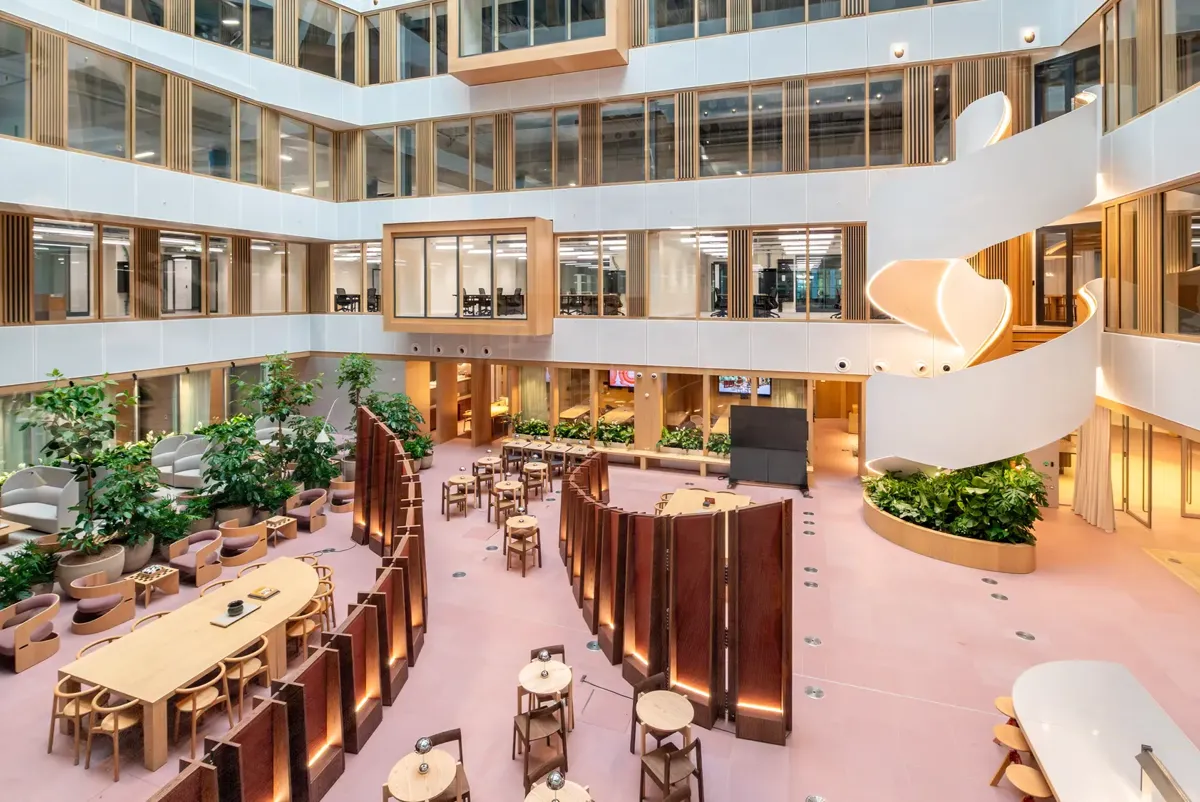
Our work on 1, Triton Square was a chance to revisit an earlier project, reimagine the space and its purpose, while achieving huge CO2 emissions savings within an attractive and functional redesign.

Quay Quarter Tower, originally built as the AMP Centre in the 1970s - Arup helped to transform the traditional office building into the centrepiece of a thriving new cultural precinct in Sydney.
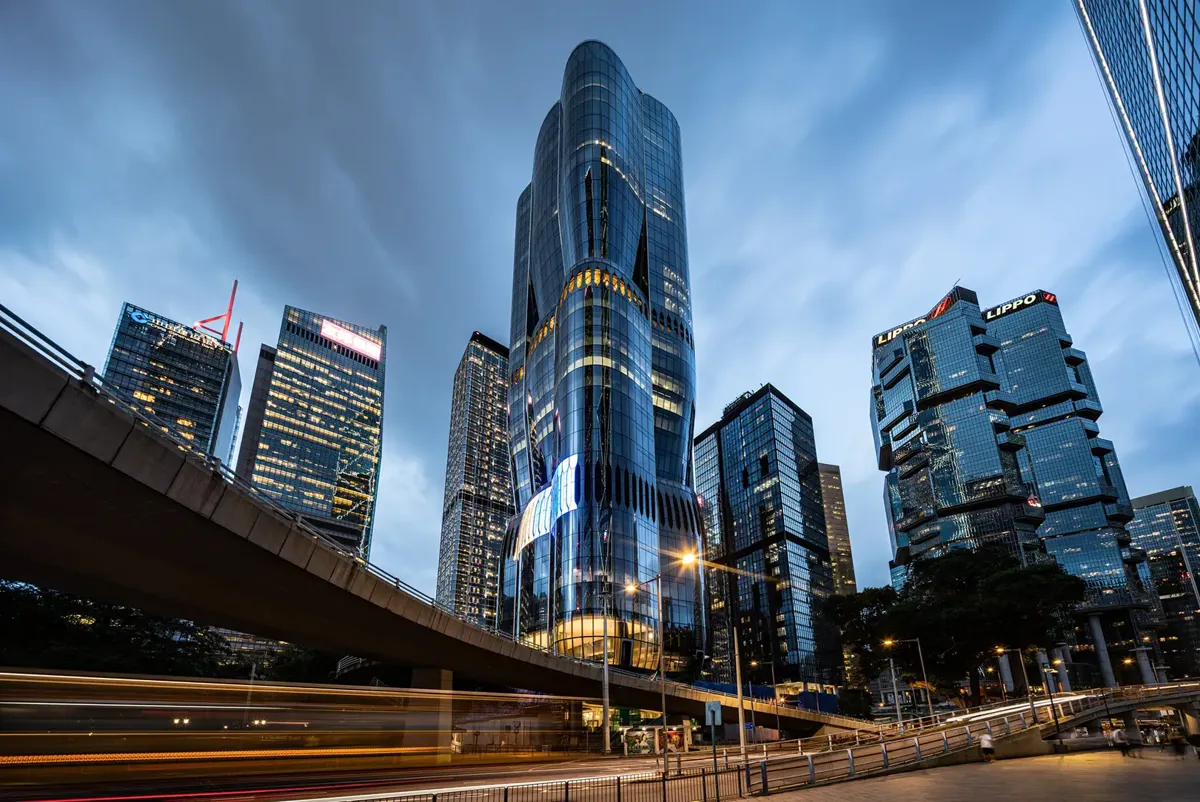
The Henderson Building Hong Kong - a working environment focused on tenant wellness, that's also designed to significantly reduce operational carbon emissions through user behaviours and digital analytics.
Workplace design – listening, learning, innovating
Improvements to workplace design can be transformative to the bottom line, by boosting creativity, social connection and collaboration, as well as employee retention. For clients with multi-site estates, the application of workplace design at a wider scale is an opportunity to embed consistent priorities and shared experiences. This can be achieved using data-led planning, developing adaptive portfolio strategies, with supporting investment guidance to future-proof a client or developer’s real estate strategies.
Today, most successful companies pride themselves on being adaptable, learning organisations. Learning what their people need in order to work happily, productively and collaboratively, is a complex but essential first step in the process of effective workplace design.
To find out more, talk to our workplace architecture team.
Insights
Explore more property insights
Timber buildings are gaining appeal – but what are the whole life carbon savings?

Digital, human, inclusive – how to design a workplace for neurodivergent people
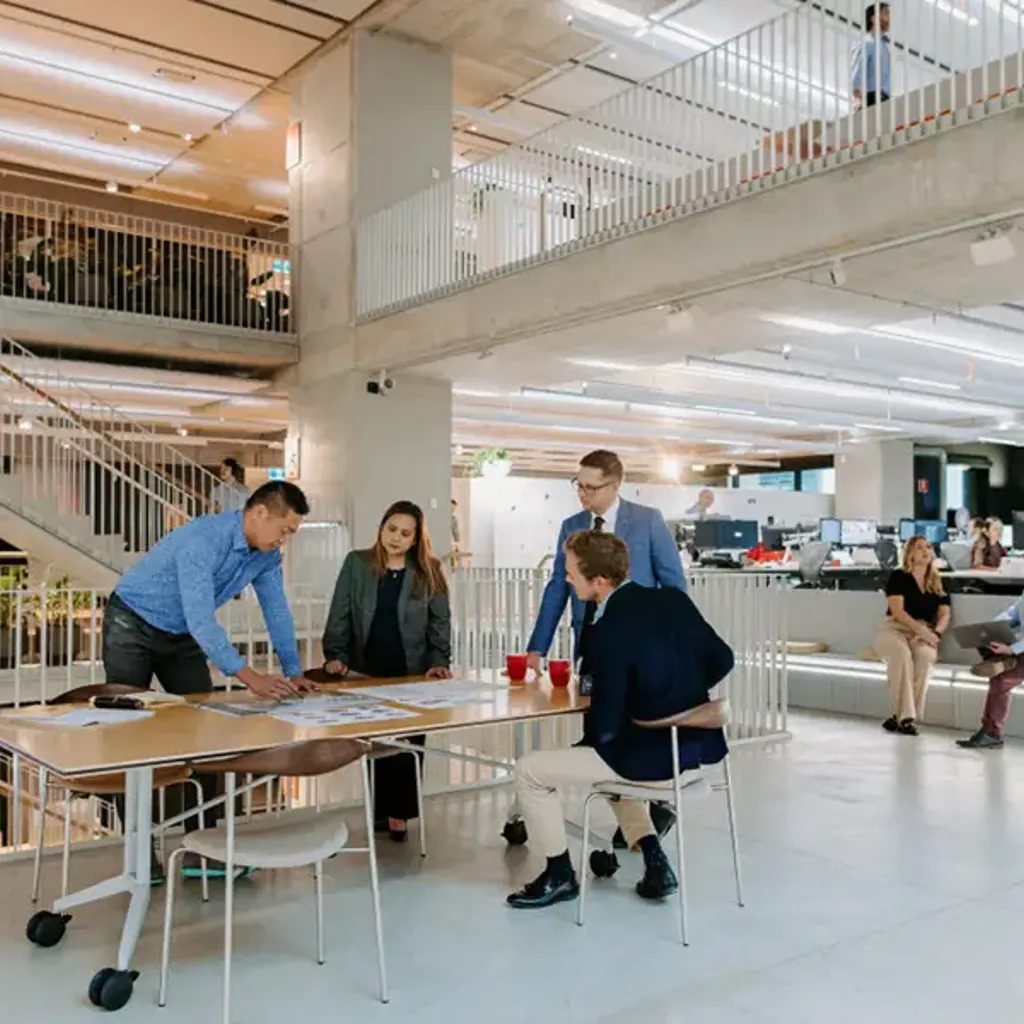
Can virtual design and construction (VDC) transform the efficiency of today’s building process?

Achieving net-zero buildings: An action plan for market transformation
