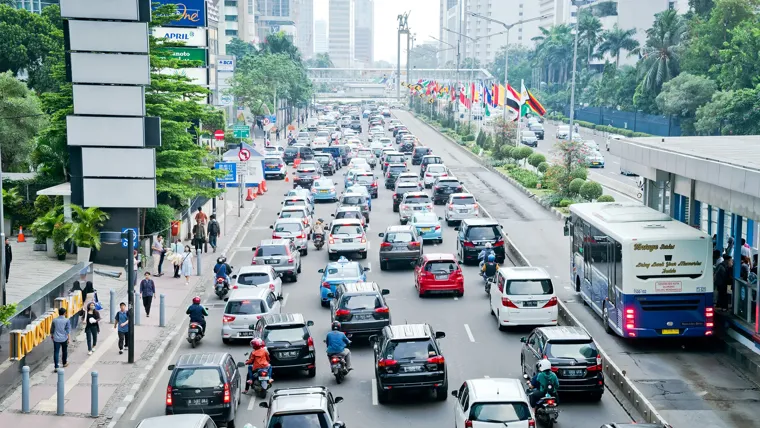
For many, rapidly urbanising cities across Southeast Asia traffic congestion is a daily struggle. The economic cost of this paralysis can reach billions of dollars each year. 

As cities grow and personal vehicle ownership rises, managing traffic becomes an increasingly daunting challenge. Traditional traffic management systems, with their limited adaptability and high costs, are no longer sufficient to address the needs of rapidly growing cities. 

Artificial intelligence (AI) and machine learning (ML) powered tools are offering new ways to manage traffic congestion. These digital systems offer a new way for cities to implement cost-effective intelligent transport systems (ITS) that are dynamic and adaptive, to improve incident detection, forecast traffic speeds, anticipate congestion and provide decision support in proactively managing congestion. Ultimately, they support the implementation of more sustainable urban transportation policies.
 

Traditional ITS vs AI-powered ITS 

Conventional ITS often struggle with complex operational environments and poor data integrity, resulting in suboptimal performance such as inaccurate incident detection. Additionally, these systems rely heavily on reactive measures, lack real-time situational awareness, and depend on manual monitoring of traffic conditions. Major challenges include: 

  • Fixed rule-based decision-making approaches: existing ITS lack the flexibility to adapt to changing traffic conditions, network growth or unpredictable incidents. 

  • Delayed detection and responses: the lag time between traffic incidents and response measures often results in significant traffic jams, increased travel times, higher vehicle emissions and longer recovery times. 

  • Limited predictive capabilities: traditional systems are not equipped to consider future traffic patterns or anticipate incidents for which pre-emptive measures can be implemented. 

  • Fragmented and erroneous data sources: data used in current systems are sourced from various providers with differing standards and quality that hinder real-time decision making. 

  • High operational costs: maintaining an extensive network of ITS field infrastructure and technology can strain the resources of emerging economies. 

From reactive to predictive traffic management 

AI-powered ITS don’t just enhance existing systems; they redefine what’s possible, turning data into actionable intelligence. They enable cities to move away from battling congestion that is already happening, by gaining the power to predict and prevent it: 

1. Dealing with traffic issues before they happen 

By analysing real-time data streams from sensors, GPS and social media, AI can detect traffic incidents faster, predict congestion before it happens, and optimise responses across agencies. One of the most exciting shifts is in response plan generation – a task traditionally handled manually. AI models can learn from thousands of past scenarios, identify what worked and what didn’t, and propose robust, data-driven response strategies in seconds. This means operators can spend less time analysing and more time acting to reduce delays, improve safety and cut emissions. 

2. Insightful, data-driven urban planning  

Urban planning and infrastructure development often involve overwhelming volumes of data. By processing large, diverse datasets such as traffic flows, weather patterns, land use and more, AI ITS systems can uncover hidden correlations and predict future trends. These insights enable planners to design smarter networks, prioritise investments and anticipate demand shifts long before they materialise. AI turns raw data into strategic foresight, helping cities plan for resilience rather than reacting to crises. 

3. Targeted and cost-effective implementation 

Rolling out ITS city-wide can be daunting, especially for emerging economies. AI offers a pragmatic alternative: start small, prove value, then scale. For example, applying AI-driven congestion prediction at critical nodes such as ports or airports can deliver immediate benefits with minor upfront costs. These focused deployments use readily available data, build confidence in the technology and create a roadmap for broader adoption. Once models demonstrate success in these high-impact areas, they can be expanded across the wider network, delivering smarter mobility without breaking the budget. 

AI isn’t just an upgrade to traditional ITS; it’s a paradigm shift. By combining predictive power, operational agility and cost efficiency, AI positions transport systems to be proactive, adaptive and future ready. 

How to effectively implement AI-enabled ITS 

The effective implementation of AI-enabled ITS in emerging economies relies on the synergy between technology, institutions and operations. If any one of these three pillars is lacking, the benefits of the system will be difficult to achieve. 

1. Establishing institutional policies, practices and culture 

Emerging economies need to establish policies and practices that foster collaboration among all stakeholders in traffic management, from control room operators to emergency responders and traffic police. Creating a culture of data sharing between third-party operators and data providers is essential.

2. SOPs and upskilling for operational excellence 

Establishing standard operating procedures (SOPs) is vital to translating the insights and recommendations from AI-enabled decision support systems into on-ground actions. These SOPs should include processes for exchanging information between traffic management operators and stakeholders in the transport ecosystem. Additionally, emerging economies must invest in upskilling their workforce to ensure operators can effectively act on AI-generated insights and fully make use of the systems.

3. Data security and interoperability 

Robust data privacy and cybersecurity laws are necessary to prepare emerging economies for AI-enabled ITS and future technologies. The data-driven nature of AI/ML models requires careful governance of the collection, quality, and privacy of data and related reporting processes to ensure the safe and efficient flow of information. Ensuring interoperability between different systems and technologies is also critical to maximise the effectiveness of AI-enabled ITS. 

Learning from global experience 

Alleviating traffic congestion is a powerful real-world proof of the positive impact of AI. We recently delivered an AI-powered decision support system for Virginia Department of Transport United States, integrating real-time data and predictive analytics to recommend proactive responses to incidents and congestion. This multi-agency platform has enabled a shift from reactive to proactive management. It is improving safety, reducing congestion, lowering emissions and supporting a move towards more sustainable travel options. 

In Europe, we have helped develop a nationwide ITS for a leading transport authority. This strategy focused on integrating digital technologies and inclusive design, ensuring that real-time travel information and future-ready infrastructure can support the adoption of connected and automated mobility solutions. Projects such as this highlight the importance of early planning, data governance and cross-agency collaboration – key lessons for emerging economies. 

We have also supported the implementation of an integrated corridor management system for a major metropolitan area in North America. By using advanced ITS devices and data-driven operations, we improved bus service efficiency, reduced travel times, and enhanced network reliability. These outcomes demonstrate how targeted, data-driven interventions can deliver tangible benefits, even in complex, high-demand environments. 

A great solution for growing cities 

As emerging Southeast Asian cities continue to grow, traffic and associated impacts are only set to worsen if unaddressed. Tackling congestion requires a comprehensive, multi-faceted approach that encompasses planning, implementation and operations.

By embracing AI/ML technologies, these economies can create more efficient, sustainable and resilient transport systems, ultimately improving the quality of life for their citizens. It is time for stakeholders to take decisive action and use AI’s intelligence and insights to address the pressing challenges of urban traffic management across Southeast Asia.