
What is the materials transition?
The materials transition imagines a shift toward more sustainable, resource-efficient, nature positive and circular material practices.
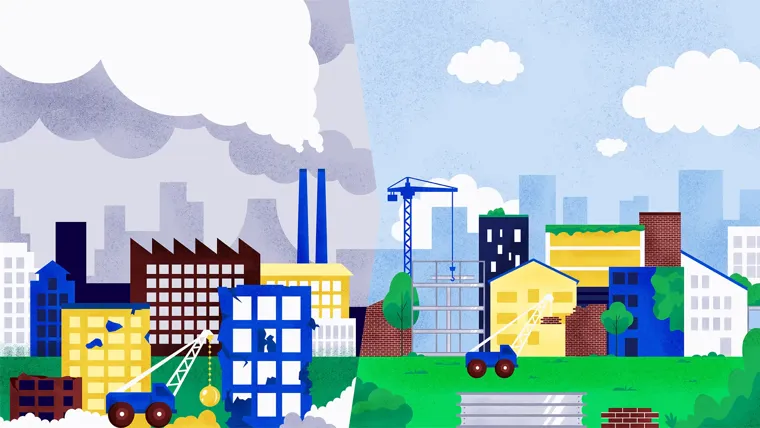
Last updated: December 2025
In the face of our global climate crisis, alongside increasing resource scarcity and nature loss, it is essential that we make more deliberate and responsible choices about the materials we use to shape our built environment. From the concrete used in our bridges through to the glazing in our facades, the extraction, processing, use and disposal of materials account for a significant portion of global carbon emissions, environmental damage and waste generation.
As a concept, the materials transition imagines a shift toward more sustainable, resource-efficient, nature positive and circular material practices across industries and supply chains. It’s driven by the need to reduce our environmental impact, carbon emissions, and reliance on finite raw materials. This transition is reshaping all aspects of engineering and architecture, changing the way we design, build, maintain and restore the world around us.
Why now?
The materials transition is critical if we are to achieve our global climate goals, improve resource security and reduce our systemic impact. The materials transition is not just about reducing harm, it is about redesigning our systems to adapt, regenerate and thrive.
Our global buildings stock alone is responsible for almost 40% of global energy related carbon emissions, with the global building stock expected to double in size by 2050. We are currently using up the renewable resources of 1.7 Earths, and if nothing changes, that’s projected to increase to 3 by 2050. That’s deeply incompatible with our shared reality – we only have one Earth! Things must change.
At Arup, we approach the materials transition for the built environment through 3 key dimensions:
Extraction and processing: reducing harm at the source
The extraction and production of materials for construction like cement, steel, aluminium, and glass are among the most carbon-intensive industrial processes in the world. For example, the cement and concrete sector emits approximately 8% of total global CO2e emissions each year. However, impacts reach far beyond just greenhouse gas emissions – for example, one study found that 95% of the construction sector’s impact on nature occurs with upstream (supply chain) activity, and there are significant ethical impacts that materials supply chains can have on individuals and communities.
To reduce this impact, the industry must:
- Reduce demand for virgin raw materials through smarter design and substitution for secondary materials.
- Electrify industrial processes and use renewable energy sources.
- Capture residual carbon emissions during production and find durable utilisation and storage applications.
Being able to influence the impact of materials at source gives us even greater control over the lifetime impact of the materials we choose to deploy on our projects.
Extend, reuse, rethink: recognising the value of materials
Our cities are huge repositories of high value materials that with careful planning can be recovered and reused when a particular asset comes to the end of its useful life. Enabling reuse and recycling at scale, shifts the construction industry from a linear ‘take > make > dispose’ approach to one centred on circularity. Often, although not always, the lowest impact choice we can make is the choice to revitalise and repurpose the assets and materials that we have already invested carbon, resources, and money in. We should be shifting from mining virgin materials, to capturing the most value from our existing built and lived environment
This involves a shift to:
- Design for disassembly and materials recovery.
- Use of reclaimed materials in new construction and value them equally, or more highly, than virgin materials.
- Use of data to track provenance and future use to unlock recovery and reuse opportunities (e.g. through use of BIM or ‘material passports’).
- Development of recycling infrastructure that maintains material quality and performance at the highest end of the value chain.
This approach presents exciting challenges, for example: how do we adapt designs to existing material stocks, how do we ensure safety and compliance when using reused components where provenance is uncertain, and how can we capture material flows across the built environment.
Substitute: transition to new and low-carbon materials
While there are no ‘silver bullet’ construction material solutions, there will be a role for substitution in the materials transition. This can vary from simple material swaps, to reimagining of whole systems, challenging the status quo to deliver optimal outcomes for people and the planet. Innovation is accelerating the development of new materials that are holistically lower impact. These materials offer new performance, a new aesthetic and new opportunities for sustainable, or even regenerative design.
From mycelium to algae-based bio-based materials through to low-carbon concrete or green steel, the industry needs to focus on:
- Substituting high-carbon materials with lower-impact alternatives.
- Using nature-based or bio-derived materials that sequester carbon long-term within the structure.
- Exploring new applications for industrial by-products and waste streams.
- Ensuring scalability, durability, and regulatory acceptance of emerging materials.
The transition to these new materials does not come without challenges, from a lack of robust supply chains through to regulation and standardisation. These are not insurmountable and we need to collaborate across the industry to accelerate this transition.
The materials transition is an essential development for our industry. We must urgently cut carbon emissions while also reducing the broader social and environmental impacts of material use as we work to build safe, resilient, and regenerative places.
Jo da Silva
Global Director - Sustainable Development
How do we build using fewer resources?
