
Arup delivers facade and acoustic engineering for Oxford University’s new cultural campus
This new cultural hub, with facade and acoustic engineering by Arup, blends architectural heritage with modern innovation.
Last updated: 6th October 2025
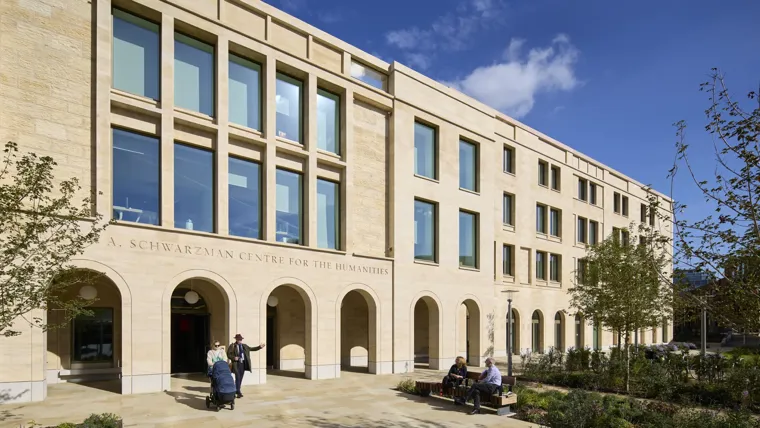
The Stephen A. Schwarzman Centre for the Humanities, at the University of Oxford is set to open on 13 October 2025, marking a significant milestone in the university's commitment to the Arts and Humanities.
Arup, in collaboration with Hopkins Architects, developed the facade strategy for the building and the acoustic design of a 500 seat concert hall.
The facade combines traditional brick and stone with modern off-site prefabrication using precast concrete panels, minimising joints to create a cohesive appearance. Aluminium-framed glazing was incorporated into the design, and thermal analysis supported insulation and airtightness requirements, contributing to the building targeting Passivhaus certification by the end of the year.
Arup’s acoustic team worked closely with university representatives and musicians to develop the acoustic brief and design for the concert hall, black box, and rehearsal room. Every potential noise-generating element in the concert hall from the ventilation to the lighting was scrutinised, including laboratory testing, to achieve a silent canvas for the performances.
Using digital acoustic modelling and the Arup SoundLab - an immersive environment for exploring and shaping sound – the acoustic team tested design possibilities, enabling the university team to experience the acoustic of the concert hall prior to construction and providing flexibility in design for different musical styles.
The campus Great Hall is enclosed by a timber-lined internal dome, protected by an external glass and steel structure, with the glazing system developed by Hopkins Architects and Arup.
Tateo Nakajima, Arup Fellow, states: "We're proud to have contributed our integrated design and planning expertise to the Stephen A. Schwarzman Centre at Oxford University. Throughout this project, we sought to combine technical excellence, a sensitivity to context and heritage, and a strong focus on human experience and social impact.
"We've brought our unique perspective to the concert hall and studio spaces which were crafted with the Oxford community in mind, reflecting the opportunity for such spaces to create a truly meaningful place of conversation and communication between artists and audiences for generations to come."
Education at Arup
From primary education to universities, libraries to research labs, we understand how to respond to the evolving landscape of education.
News
Explore more UKIMEA news
Arup engineers recognised in Top 50 Women in Engineering Awards 2025
27th June 2025
Arup and Autodesk team up to accelerate industry-wide collaboration
17th June 2025

Global survey reveals US planners, architects, and engineers ahead of global average on artificial intelligence adoption
7th May 2025

Net-zero buildings can become the norm – new report shows how to take action
28th March 2025
Learn more about Arup
A global consultancy shaping infrastructure, buildings, energy and sustainability for the built environment.
