
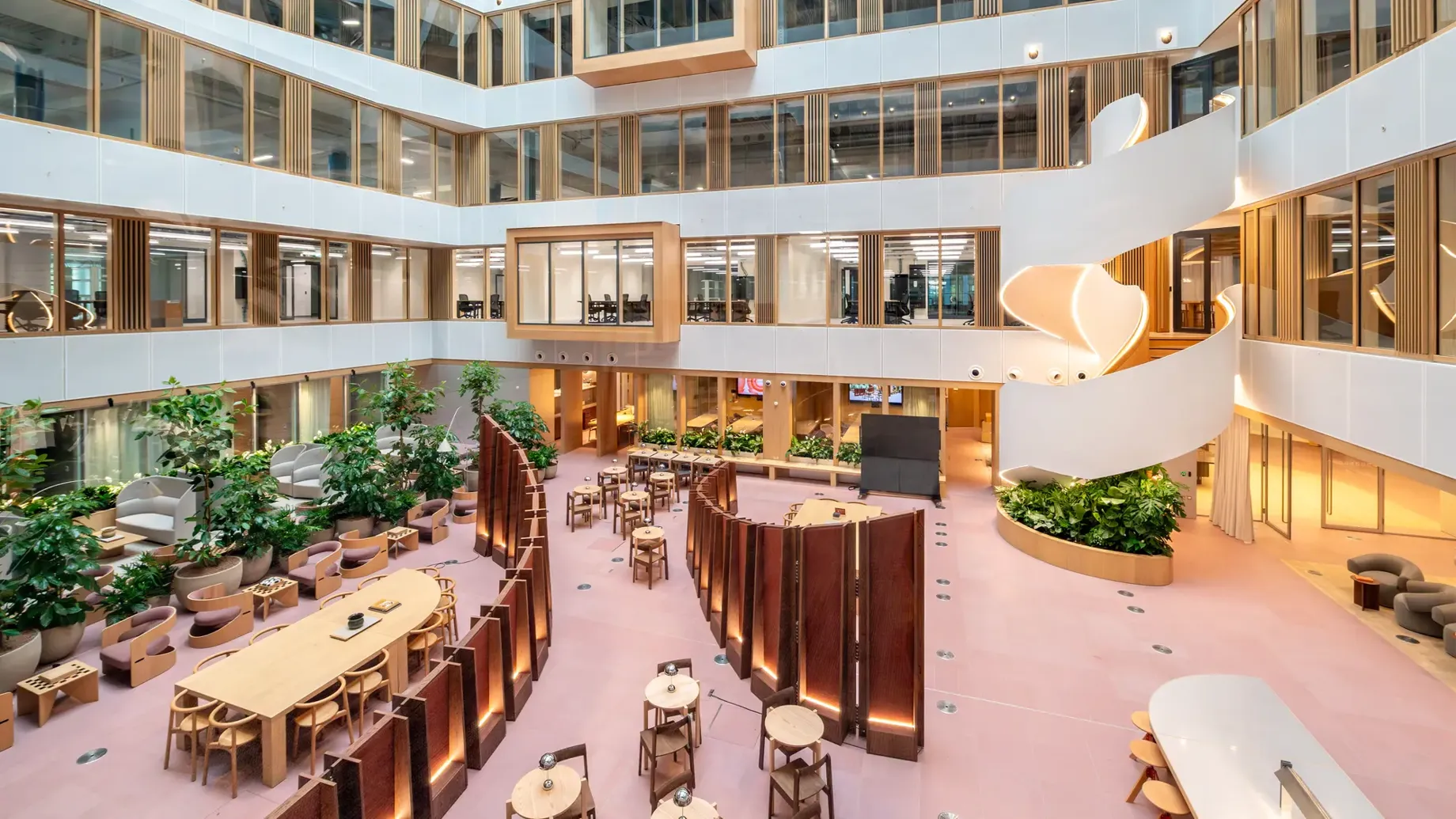
British Land and Royal London Asset Management wanted to create a thriving space that could grow with the evolving needs of Central London. As the area shifted towards the science and technology market, it needed to adapt and increase the size of the building. The team’s progressive mindset to sustainability provided an exciting retrofit challenge.
Our original design 20 years ago kept flexibility in mind which meant we could refurbish rather than build new. Transforming the building into a flagship science and technology hub required a multidisciplinary team. Our marginal gains approach saved 40,000 tonnes of carbon and project completion was 30% faster – when compared to a typical new build. We delivered three extra floors, twice as much net office area and a BREEAM Outstanding sustainability rating, while retaining façades and superstructure.
1 Triton Square demonstrates that refurbishment can be exciting, attractive and sustainable, if the client is able to champion a progressive strategy. Our decades long relationship with British Land enabled us to adapt and push the boundaries on what is possible. Saving more carbon in design and construction than the building will produce during its 20-year lease, the result is a renewed landmark for the science community and for net zero.
Building retrofit and a 'marginal gains' approach
Arup originally designed 1 Triton Square for British Land in the 1990s. Twenty years later, customer needs evolved, and British Land alongside new joint venture partner Royal London saw potential to increase the building’s size and transform it for today’s market – opting for refurbishment to save time, money and embodied carbon.
Led by an all-Arup design team, it became clear through the design process that there was an opportunity for a highly sustainable outcome. A “how much can we retain and reuse?” philosophy underpinned the team’s actions throughout the project.
The team chipped away at every aspect to save carbon, cut waste and deliver the best working environment possible. Through the marginal gains approach, they refined and optimised dozens of systems, components and strategies to deliver a highly sustainable building.

Many thanks to Arup and all the hard work that has been put in on the project, not just since working under Overbury but since the early design stages as well. It's a great success.
Circular economy principles in action
The project’s reuse philosophy reflects Arup’s commitment to circular economy principles and promotes sustainable design across the built environment.
Triton’s façade represents one of the largest examples of circular economy practices in the industry, requiring the removal, refurbishment and reinstallation of over 3,000m² of façade, comprising over 25,000 parts. This approach alone saved over 2,400 tonnes of carbon and represented a 66% cost saving when compared to a new façade.

3,500 m2 of façade panels (equivalent to over a dozen tennis courts) were refurbished at a pop-up factory less than 30 miles away.

Each panel was inspected, deep cleaned and refurbished ready to be reinstalled.

The 1 Triton Square façade represents one of the largest examples of circular economy practices in the industry to date. © Simon Kennedy
The redevelopment of 1 Triton Square has been significantly enhanced through Arup’s Total Architecture approach. The advantages of using a single designer across key professional disciplines are clear - shortened lines of communication ensure the team move seamlessly through the project at the same pace. More importantly however, is a single culture ensuring the team operate with a highly collaborative approach, and challenge one another’s ideas which is considered essential to achieving a successful outcome for the client.
Pioneering space for a thriving science community
Following the completion of the base build, our team then moved to creating the fit out for lab spaces, ensuring that every aspect of the design supported both scientific innovation and operational efficiency.
Building on the award-winning, innovative carbon savings, the laboratory spaces are complemented by a flexible co-working space under the British Land ‘Storey’ brand, and large, open-plan grade A office space. The building and atrium have been adapted to feature floor to ceiling windows for natural light, nearly 500m² of green roofs promote biodiversity, four panoramic terraces and five balconies for socialising, working and relaxing.
As part of the fit out, pods were installed in the atrium alongside a bespoke spiral staircase - overcoming significant structural challenges to create a sculptural centrepiece that encourages connection. Crafted with precision, the staircase features a custom steel exterior and a finely detailed timber interior, with its flowing geometry digitally modelled through 3D scanning to provide a seamless transition from the atrium to the labs.
Vibration testing and mock-ups exceeded the benchmark of building performance for life science labs. This enabled the use of reclaimed raised floor panels, demonstrating how monitoring existing structures can optimise solutions before costly mitigations.
The ambition is to create a holistic ecosystem of science, technology and AI focused businesses within a single building at the heart of the Knowledge Quarter. Central to this ecosystem will be the community of scientists, researchers, and collaborators, connected to the wider life science community.
1 Triton Square has been designed to adapt and grow for the future needs of the organisations it will be home to.
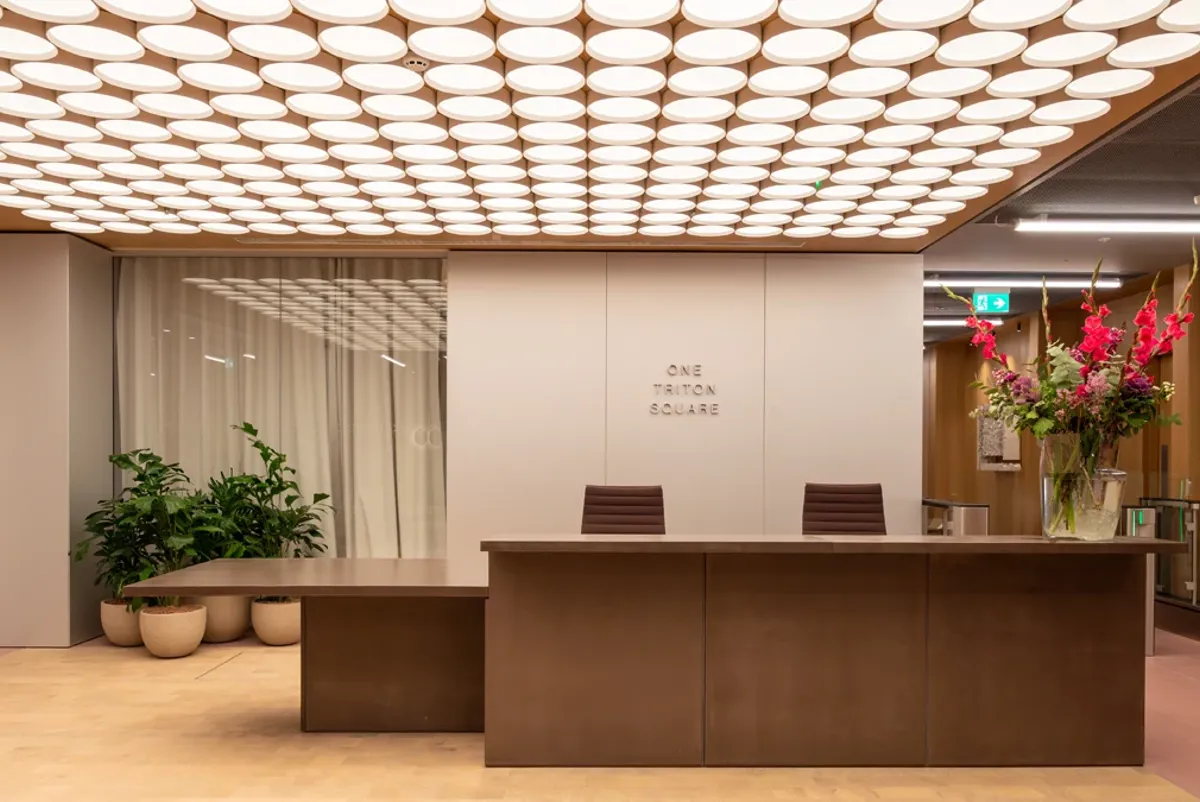
The new fit out enhances the arrival experience from the ground floor entrance.
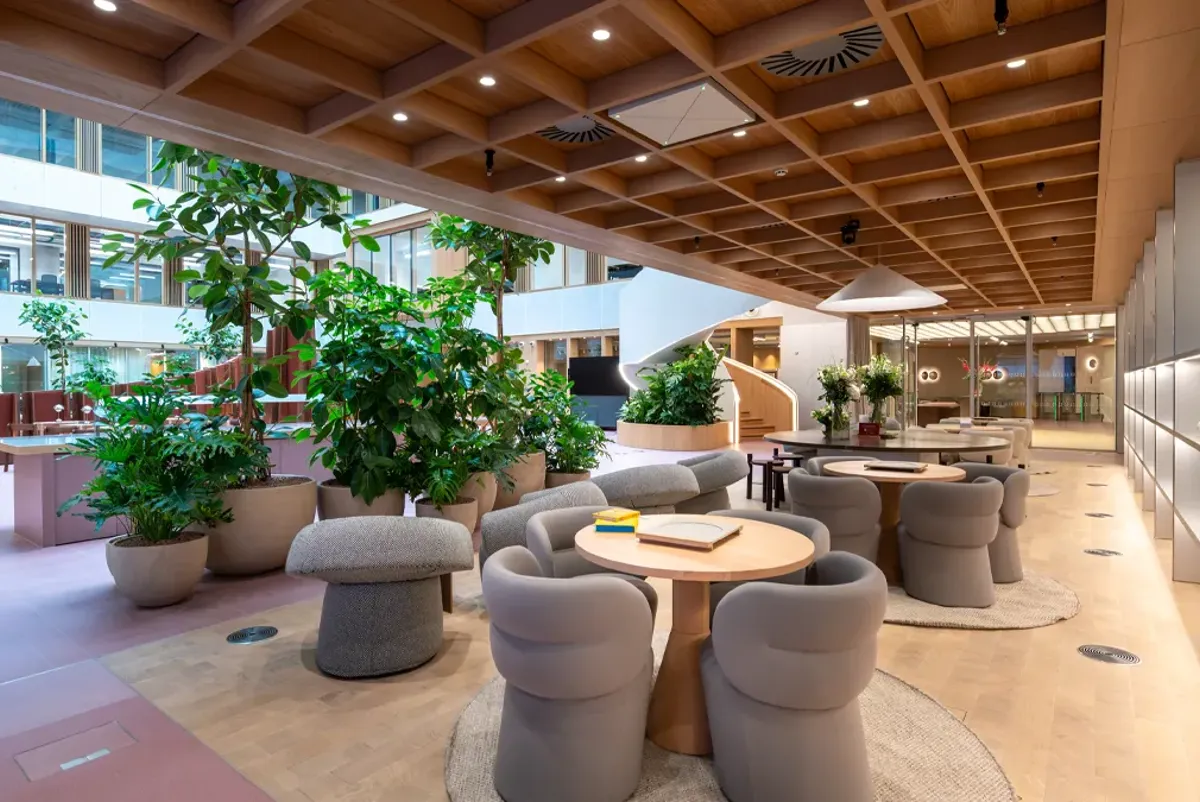
Atrium pods and a bespoke spiral staircase form a sculptural centrepiece overcoming structural challenges to encourage connection.
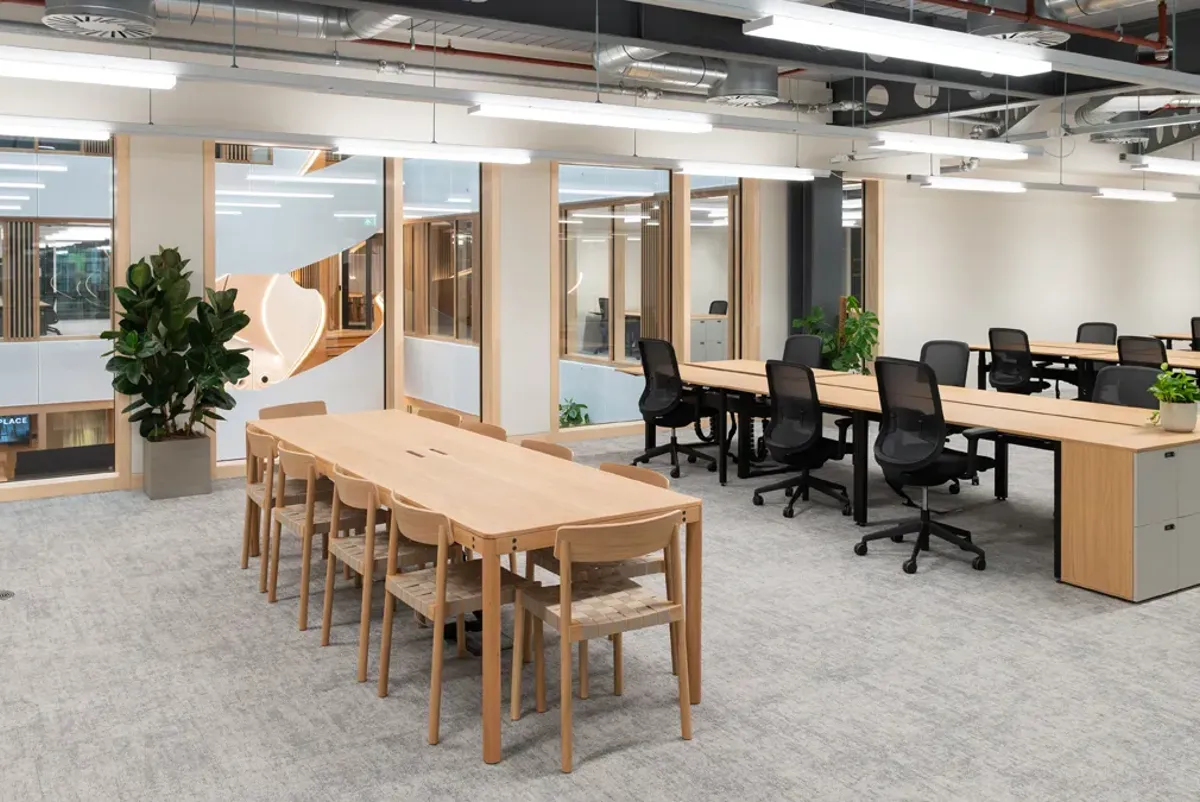
The laboratory spaces are complemented by a flexible co-working space and a large, open-plan office space.
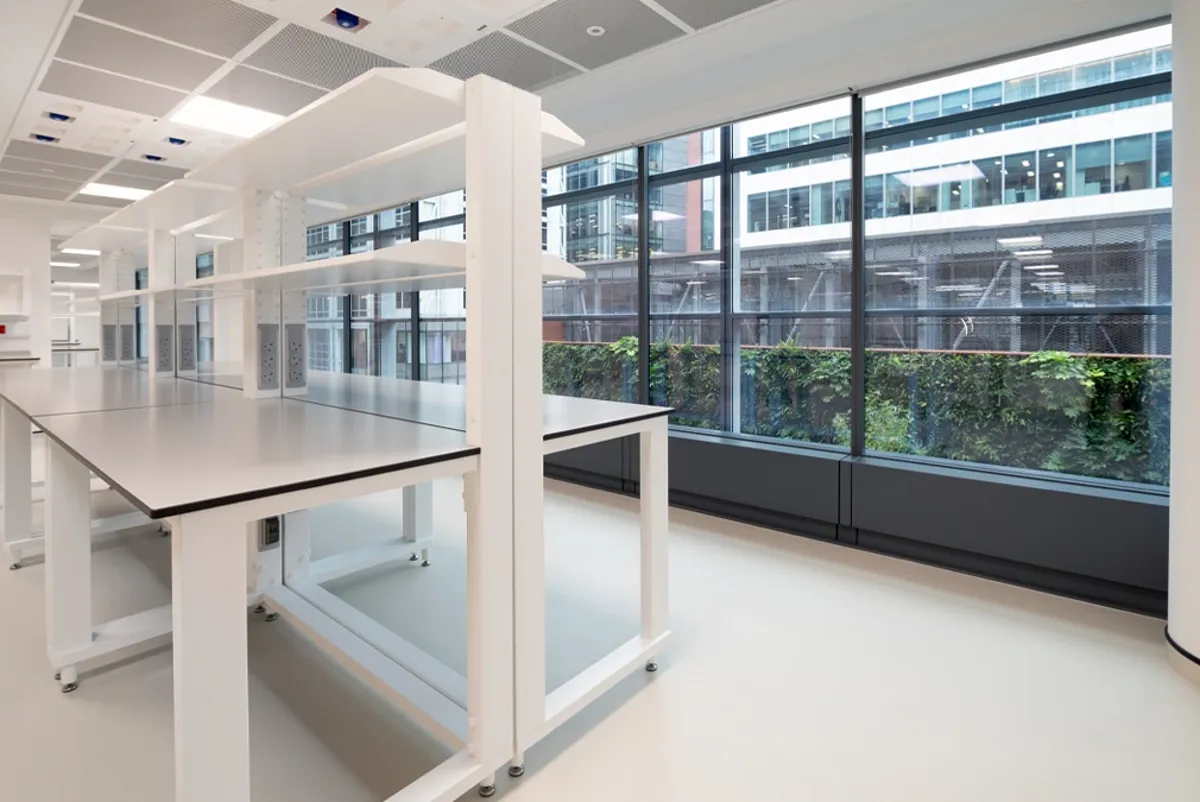
The laboratory spaces were designed to support scientific innovation and operational efficiency.
Did you know?
-
Low carbon
1 Triton Square is now one of the lowest carbon HQs in the UK, with 40,000 tonnes of carbon saved compared to new build workplace - the equivalent carbon from the annual energy consumption of 9,900 average UK homes. It has been delivered 30% faster than a new build – with 6,000 fewer lorry journeys required by opting to refurbish the building.
-
Expansion
The reuse and strengthening strategies enabled three additional storeys to be added to the existing building, increasing the floor area by 70%
-
Capacity
It has secured the biggest pre-let in London’s West End in over 20 years.
-
Reuse
We reused as much of the existing structure and fabric as possible – 3,300m2 of limestone, 35,000 tonnes of concrete and 1,900 tonnes of steel. This accounts for 45% of the total carbon saving, the remainder of which stems from our marginal gains approach.
Awards
-
BCO Awards, 2022
Innovation Award
-
Façade Design and Engineering Awards, 2022
Project of the Year, Sustainability
-
The Institution of Structural Engineers Structural Awards, 2022
Award for showcasing the power of circular economy principles across all aspects of a project
RLAM / Lendlease / Overbury / M3 Consulting / Piercy & Company
Projects
Explore more architecture projects:
Sustainability meets digital infrastructure
New office and training building for Equinix, Germany

Technical design advice to ensure the functionality and viability of Dubai's new super slender skyscraper
Muraba Veil, United Arab Emirates

Improving accessibility and user experience for tram stops in Melbourne
La Trobe Street Tram Stop Upgrades, Australia

Copenhagen's M4 metro line extension: five new stations to improve city connectivity
Copenhagen M4 metro line to Sydhavn and Valby, Denmark
Get in touch with us
If you'd like to speak to one of our Architecture experts about any of the issues raised on this page or a potential collaboration then please get in touch by completing the form.
