
Modelling one of the world’s busiest airports to guide capacity growth
Heathrow Airport Airfield Modelling
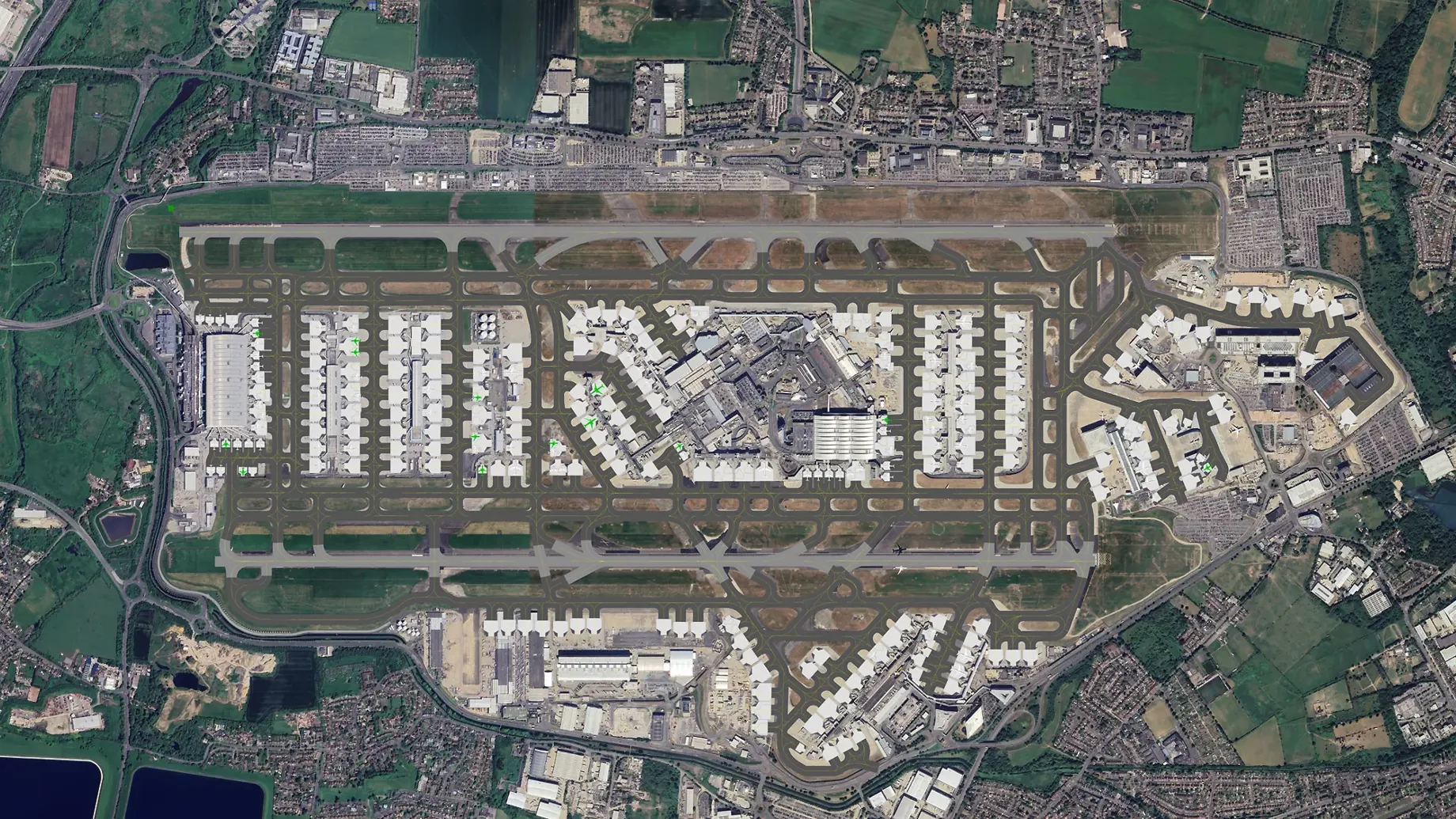
Heathrow Airport is the UK’s only hub airport and plays a pivotal role in the nation’s ability to trade and compete globally. Currently operating at full capacity, Heathrow is modernising and expanding to become an airport that is fit for the future. To achieve this ambition, it needs accurate and timely airfield modelling tools that support the planning process and provide assurance.
Arup built a flexible suite of digital models of Heathrow, one of the busiest and most complex airports in the world. These models explore the impacts of different proposals for Heathrow’s future, identifying opportunities to improve capacity, performance and resilience. As expansion plans progress for the airport, recognised as UK’s Gateway to Growth for its contribution to the national economy, our simulation tools adapt to keep pace.
Every pocket of additional capacity we identify reduces pressure on Heathrow’s overstretched infrastructure. This benefits airlines and passengers by reducing congestion and boosting punctuality. These efficiency improvements go hand in hand with Heathrow’s environmental commitments. When aircraft spend less time waiting or moving around the airfield, they burn less fuel, cutting emissions and noise. Modernising and expanding Heathrow will drive benefits for the whole UK through increased connectivity and economic growth.
Airfield simulation to modernise and expand Heathrow Airport
As proposals for Heathrow take shape, Arup has created two full digital models of the airfield. These models facilitate performance comparisons with the existing scheme and testing of aircraft movements across different scenarios.
Our fast-time models, using one of the leading airport simulation software suites, cover the entire airfield – including runways, stands, taxiways and terminals. They explore a host of variables, such as different layouts, stand allocation rules, easterly and westerly operational directions and runway operating principles.
The results allowed us to pinpoint potential hotspots, identify enhancement opportunities and influence design proposals. Simulation outputs also fed into environmental airfield modelling, providing accurate information on aircraft movements to reduce assumptions when assessing noise and air quality impacts.
These models were further used to assess the performance of a full toast rack layout, which organises stands and taxi lanes in parallel rows perpendicular to the two existing runways. Compared to the current airfield, this layout shows an average improvement of approximately 30 seconds in departure delays and 10 seconds in arrival delays. Over a day, this adds to roughly five hours saved in departure taxi time and two hours saved in arrival taxi time.
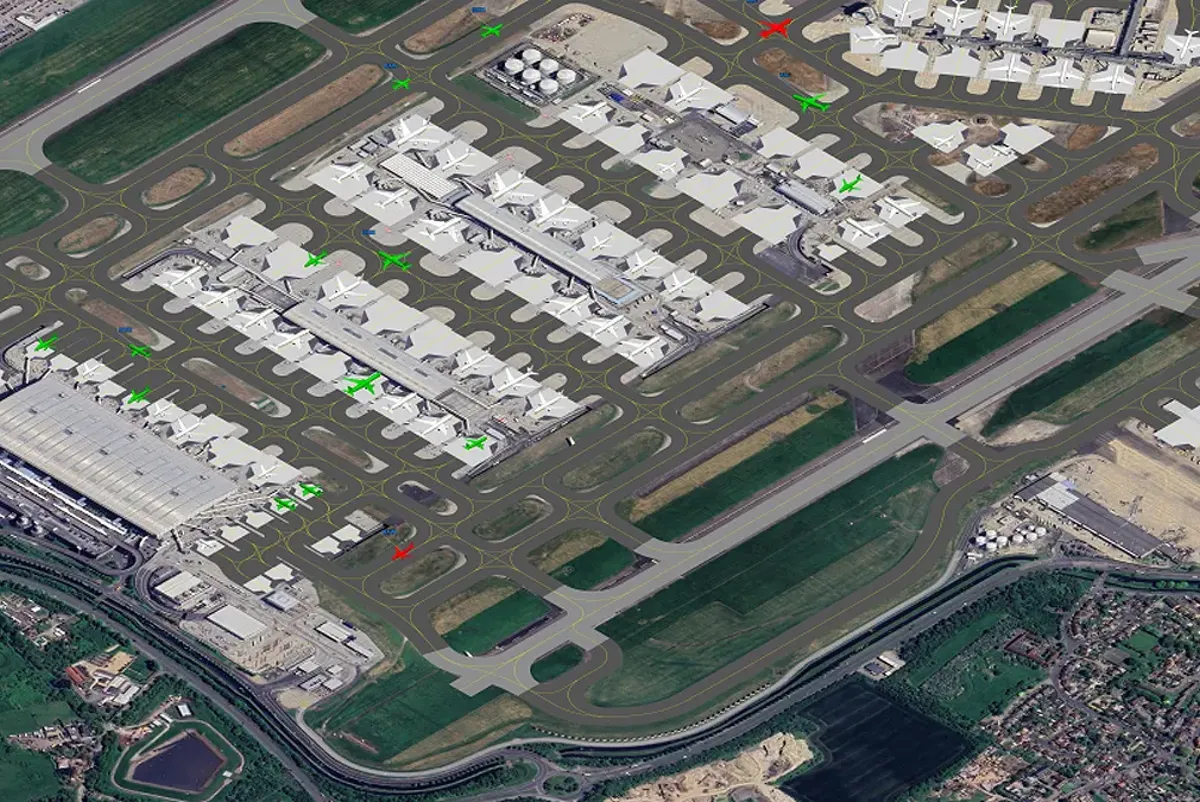
Western airfield during 27R departures.
Optimising stand allocation for passengers and airlines
Heathrow Airport serves up to 480,000 flights every year – just over 1,300 per day – so every pocket of stand capacity found can make a significant difference. Arup created a strategic stand allocation model that is now being used not only for airport master planning but also by Heathrow’s capacity team to support day-to-day decision making.
Our advanced stand allocation models are instrumental in verifying aircraft stand requirements as Heathrow evolves and expands. By rigorously testing a wide range of layouts, allocation scenarios and operational rules, we empower the airport to optimise every inch of stand capacity. This dynamic approach enables Heathrow to adapt quickly, ensuring efficient aircraft movements and supporting long-term master planning with robust, data-backed insights.
Arup’s airfield simulation and modelling team has been fundamental to Heathrow’s master planning, providing a powerful and credible basis for decision‑making. Their technical rigour, combined with practical operational insight, cuts through complexity and gives us absolute confidence in the capacity, performance and resilience of future airfield solutions.
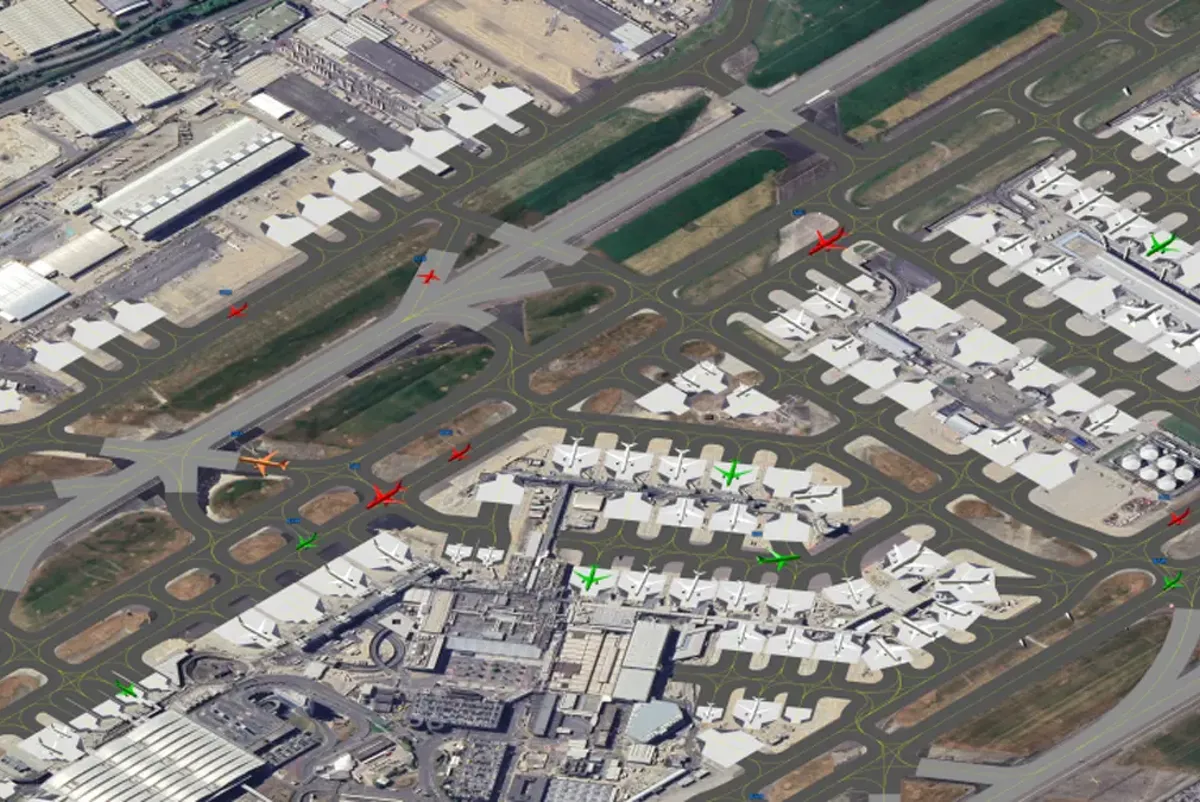
Eastern airfield during 27R departures.
Master planning for the future
Our modelling partnership with Heathrow spans nearly a decade, evolving from individual projects to full master planning as we continue to add value at every stage. As trusted advisors, our modellers are now fully embedded in Heathrow’s long-term growth and master planning team.
Through an iterative process, we assess impacts and quantify the benefits of infrastructure changes and growth scenarios – testing alternatives, sharing findings and refining proposals collaboratively. Airfield modelling is now used as part of the decision-making process.
Expanding Heathrow Airport will benefit the whole of the UK. Increased capacity will unlock more supply chain opportunities, enhance domestic connectivity, attract inward investment and boost inbound tourism.
Projects
Explore more aviation projects:

Redefining Japan’s future airport city
Narita Airport City, Japan

Transforming the travel experience at Zayed International Airport
Zayed International Airport Terminal A, United Arab Emirates

Crafting a New York–inspired atmosphere for passengers traveling through JFK’s global gateway to the world
JFK New Terminal One Art, Branding, and Digital Experience Program, USA

Helping Vancouver International Airport to prepare for unexpected weather
Vancouver International Airport After Action Review, Canada
Get in touch with us
If you'd like to speak to one of our aviation experts about any of the issues raised on this page or a potential collaboration then please get in touch by completing the form.
