
Modernising a historic London station to spark regeneration
London King’s Cross station
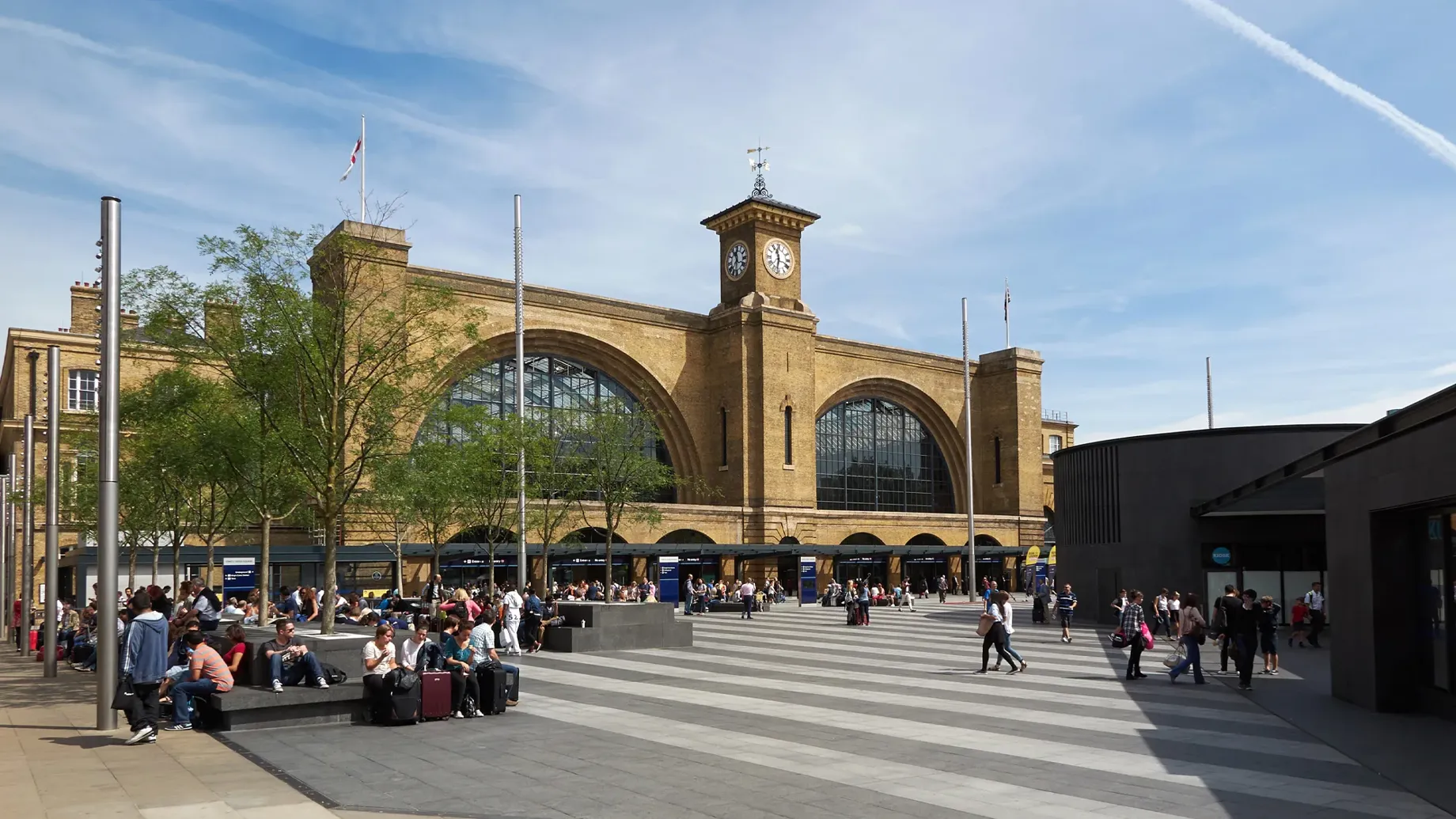
The £1.3bn redevelopment of London's King’s Cross station transformed an unloved Victorian rail terminal into an exemplary 21st-century transportation hub and commercial destination. Completed in time for the 2012 Olympic Games, the revitalized mainline and underground stations now sit at the heart of one of Europe’s largest downtown urban regeneration projects: King’s Cross Central.
As lead consultant for London's King’s Cross station, we threaded the requirements of modern mainline and underground stations seamlessly into, around, and beneath a historic building. Our design brought the passenger experience to the forefront while keeping one of the UK capital’s busiest transportation hubs running smoothly. The outcomes went beyond improving connection, leading to the creation of a new vibrant quarter for locals and visitors alike.
The revitalized station and the King’s Cross Central masterplan turned the area into a sought-after space for businesses, with the number of firms roughly doubling to 800 between 2010 and 2021, and the number of jobs increasing from 8,000 to 27,000 between 2011 and 2019. King’s Cross has become a place to live, as well as work: by 2020 there were 12,200 residents living in and around the site – up from 7,900 a decade earlier.
Designing for the passenger experience
Prior to its redevelopment, the King’s Cross area had been the focus of several unsuccessful regeneration attempts. The station itself was struggling to accommodate rising passenger numbers safely, and the building was hindered by an outdated 1970s concourse. Turning this around required careful planning and informed decision-making.
Arup’s pedestrian modeling experts worked on the project for ten years to help the design team and stakeholders understand how people used the station – right down to the last detail. This informed an architectural vision that removed the 1970s concourse and placed a new structure on the western side. Opening up the front of the station, as the original architect had intended in 1852, created the largest new public square in London for decades.
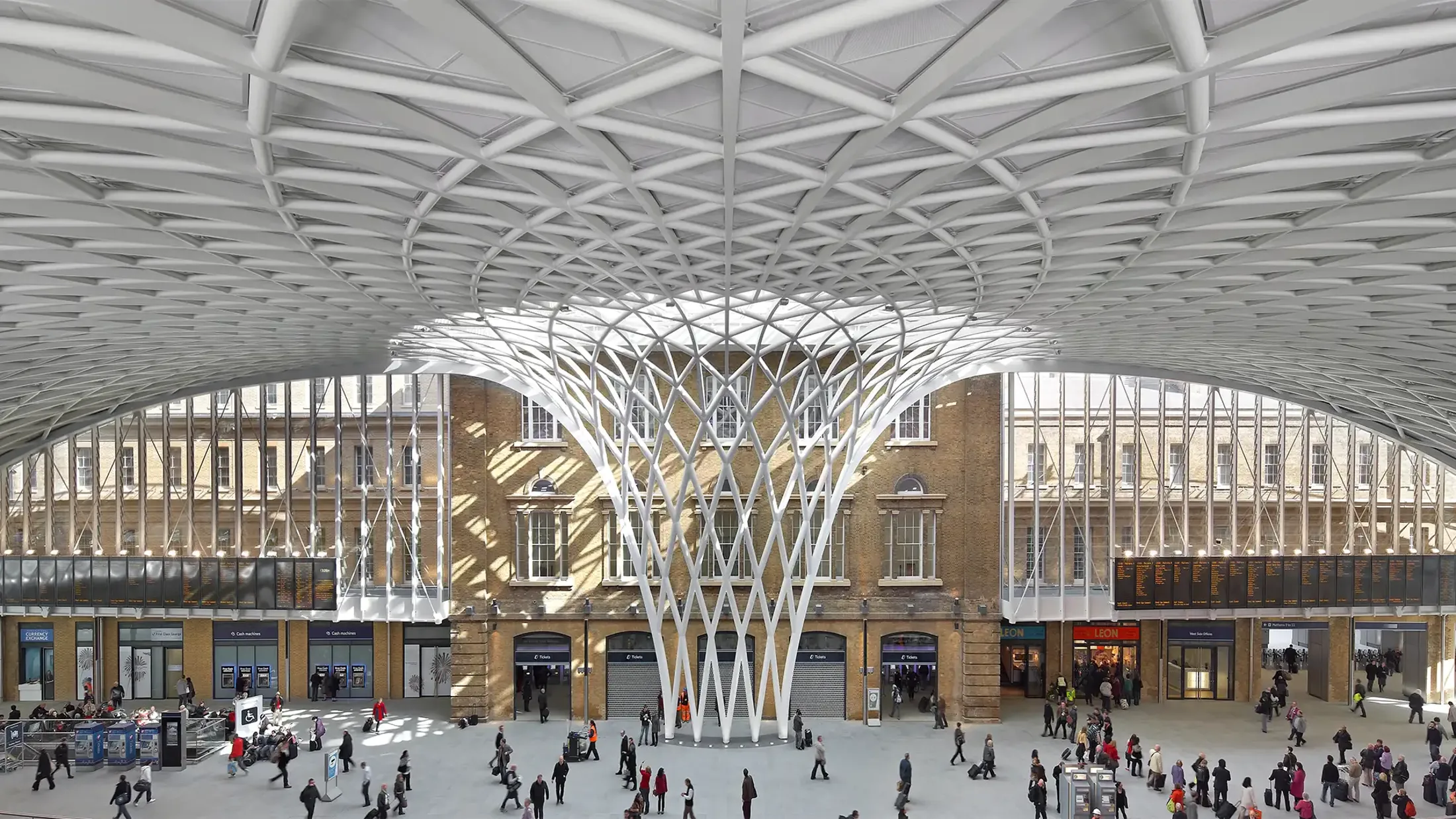
Our design brought passenger experience to the forefront while keeping one of the capital’s busiest transport hubs running smoothly.
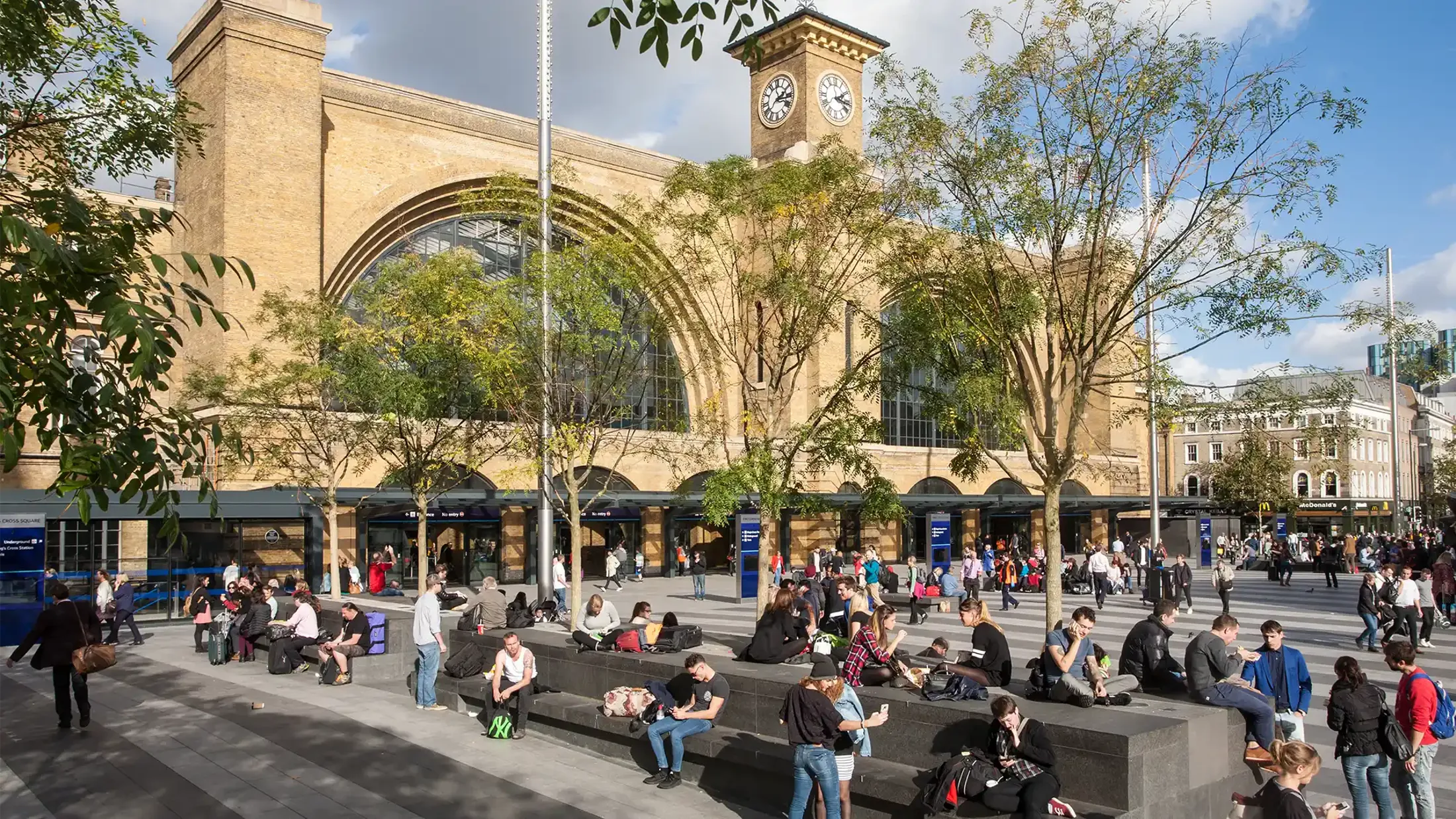
Arup’s pedestrian modelling experts worked on the project for ten years to help the design team and stakeholders understand how people used the station.
Unlocking a uniquely complex site
Seeing the thriving district that King’s Cross has become, it can be hard to appreciate just how difficult this was to achieve. We were faced with a uniquely complex site hemmed in by infrastructure above and underground – everything from rail lines to old Victorian gas tunnels. Many of these constraints only came to light once projects were underway.
We brought together different expertise and perspectives to respond to the multiple challenges that the development unearthed. At King’s Cross Central, our experience in planning, heritage issues, restoration, and archaeological engineering helped to breathe new life into many of the area’s 20 protected historic buildings. Throughout this long-running project, we focused on creating a successful place for people by transforming underused former industrial land into 1,900 new homes, offices, retail spaces, and a new university campus for the local community.
As one of Europe’s largest downtown brownfield redevelopment projects, this historic landmark – and the wider area – has made a place for people to prosper while safeguarding its rich industrial heritage. In recognition of its significant impact, King’s Cross Station won the Royal Academy of Engineering Major Project Award in 2014. The masterplan was shortlisted for the RIBA Stirling Prize 2024.
We have also played a key role in other well-known local initiatives, contributing to the development of this area for decades. We were instrumental in the redevelopment focused on historic preservation at St Pancras and the construction of High Speed 1, projects that unlocked redevelopment at King’s Cross. We worked with the developer Related Argent for twenty years to create a new quarter that includes the popular Coal Drops Yard district and collaborated with world-leading academic, cultural, research, scientific, and technology institutions across the Knowledge Quarter, such as the Francis Crick Institute and the British Library.
The whole station is an outstanding example of both sympathetic renovation and iconic new build complementing each other producing what is a truly a great legacy for future generations. I know this is a result of a team effort and huge amounts of personal commitment from thousands of people over the life of the project.
Engineering that celebrates the old alongside the new
In the years since its completion, the station’s elegant new concourse—which appears almost to float next to the original building—has become a landmark in its own right.
We had to design the concourse to fit between the adjacent Grade I and II protected historic buildings without placing any load on them. It also had to sit on foundations that were pre-installed as part of the underground station expansion, which we also designed. Our solution was an intricate diagrid shell structure roof that spans to and is supported by perimeter tree columns and a central funnel structure. This design makes it structurally independent of the sensitive Western Range building. Integrating the roof’s envelope and structure created a form that is natural yet modular, which streamlined fabrication and construction.
Our lighting design for the concourse complements the flowing roof. Highly efficient and color-stable projectors uplight the roof's diagrid structure, creating a bright and airy atmosphere that connects passengers to the time of day and the life of the city outside.
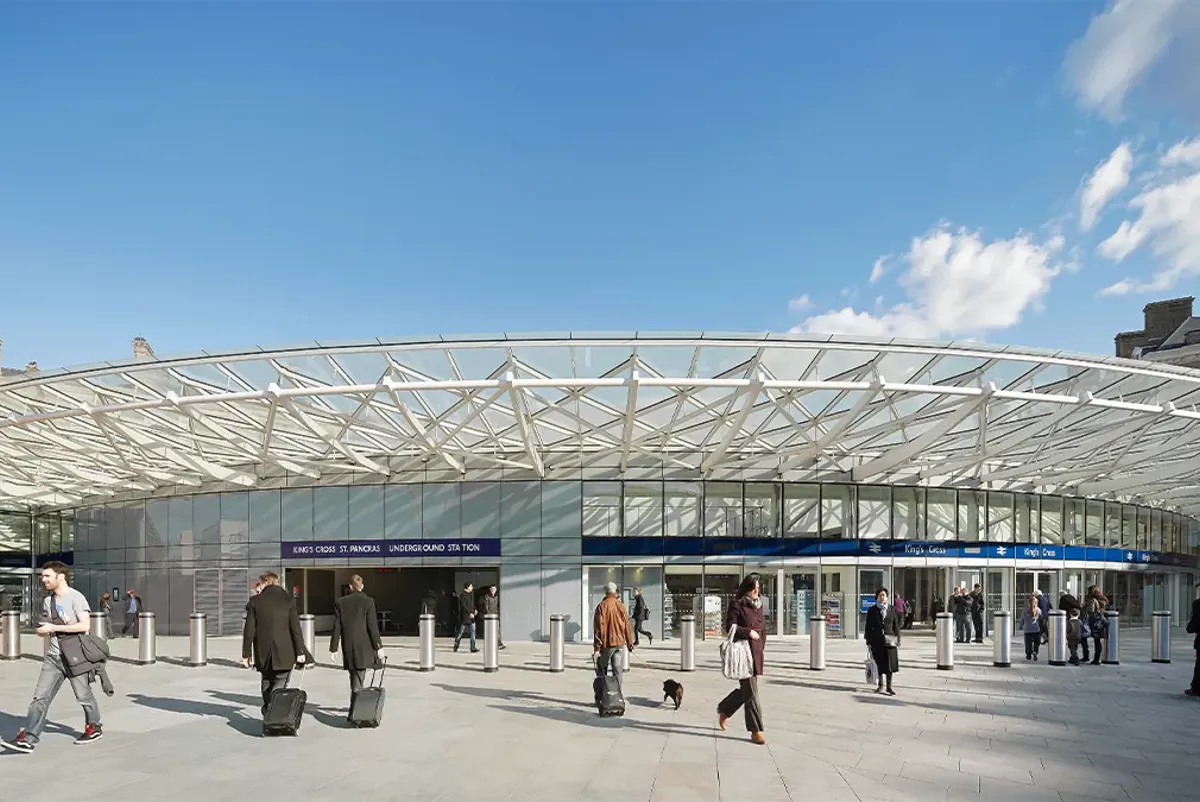
King’s Cross Station won the Royal Academy of Engineering Major Project Award in 2014.
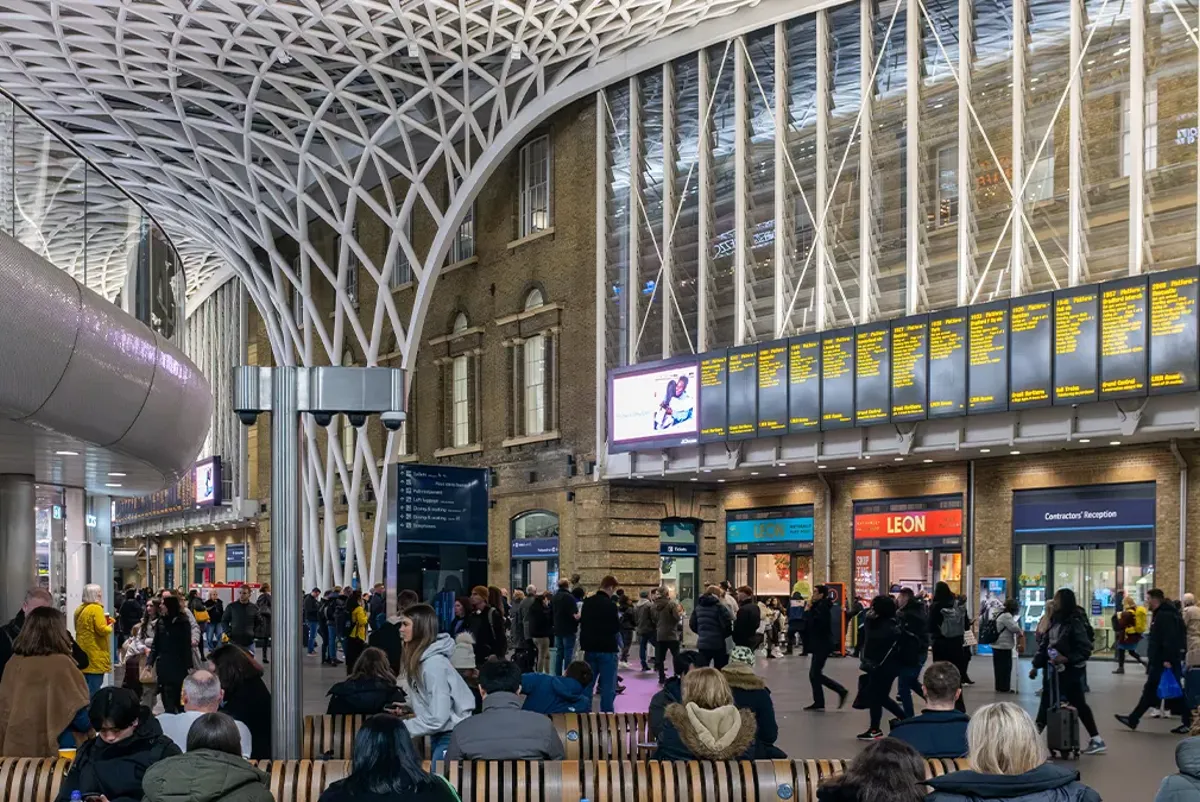
The lighting design for the concourse complements the flowing roof.
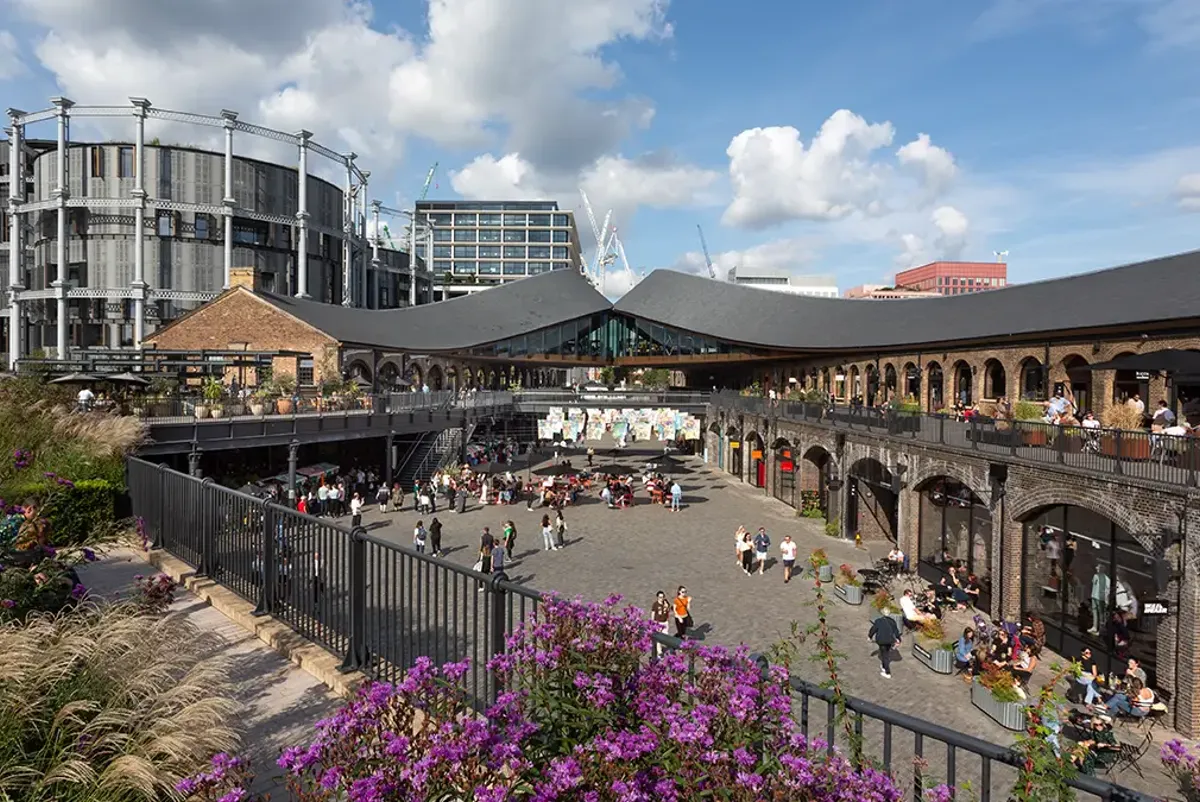
Our work in the area included the creation of the Coal Drops Yard district.
Managing complexity to minimize risk
As one of the busiest areas of London, King’s Cross required a careful approach that considered all the different elements. The highly congested site included new construction above existing underground tunnels and alongside main thoroughfares and two mainline stations. Arup prepared stage-by-stage construction sequences to reduce the risk of damage to the world’s oldest underground railway system and other heritage structures.
Redeveloping the underground station on such a constrained site was particularly challenging. The project had to provide accessible routes to the platforms from the new refurbished ticket halls with new pedestrian underpasses, escalator barrels, and elevator shafts. To minimize both risks to the workforce and disruption to passengers, we used advanced analytical and design approaches—including forming tunnels with a sprayed concrete outer lining and an internal spheroidal graphite iron lining. These features were essential to ensure the structure could withstand the loads and prevent potential failures.
The design team opened up a previously unused lower level as the main pedestrian route through the station, creating space to handle passengers from St Pancras International, as well as new retail offerings that have become a meeting point and leisure destination for passengers and non-passengers alike.
From the deepest underground tunnel to the tip of the new canopy, our specialists worked together to bring the entire program to a successful completion. All major milestones were achieved on time, and the station opened to the public on schedule in 2012—in time to welcome passengers making their way to the Olympic stadium in Stratford.
The renovation of the King’s Cross area is a stunning example of sustained engineering achievement and urban design within very specific design constraints. The reimagined King’s Cross station, for example, is a testament to the elegance of modern engineering solutions and a powerful demonstration of the vital importance of engineering to the UK economy.
Projects
Explore more station and depot projects

Shaping a resilient rail future for Singapore
Singapore Rail Test Center, Singapore

Realising a low-emission, efficient public transit vision for the Danish capital
Copenhagen Metro, Denmark

An ambitious station modernization program for New York’s subway system
MTA Enhanced Station Initiative, USA

A new integrated transport hub for Northern Ireland
Belfast Grand Central Station, United Kingdom
Get in touch with us
If you'd like to speak to one of our transport experts about any of the issues raised on this page or a potential collaboration then please get in touch by completing the form.
