
County-wide adaptation strategy to protect a critical Bay Area transportation corridor from sea level rise
Marin County Sea Level Rise Adaptation Study
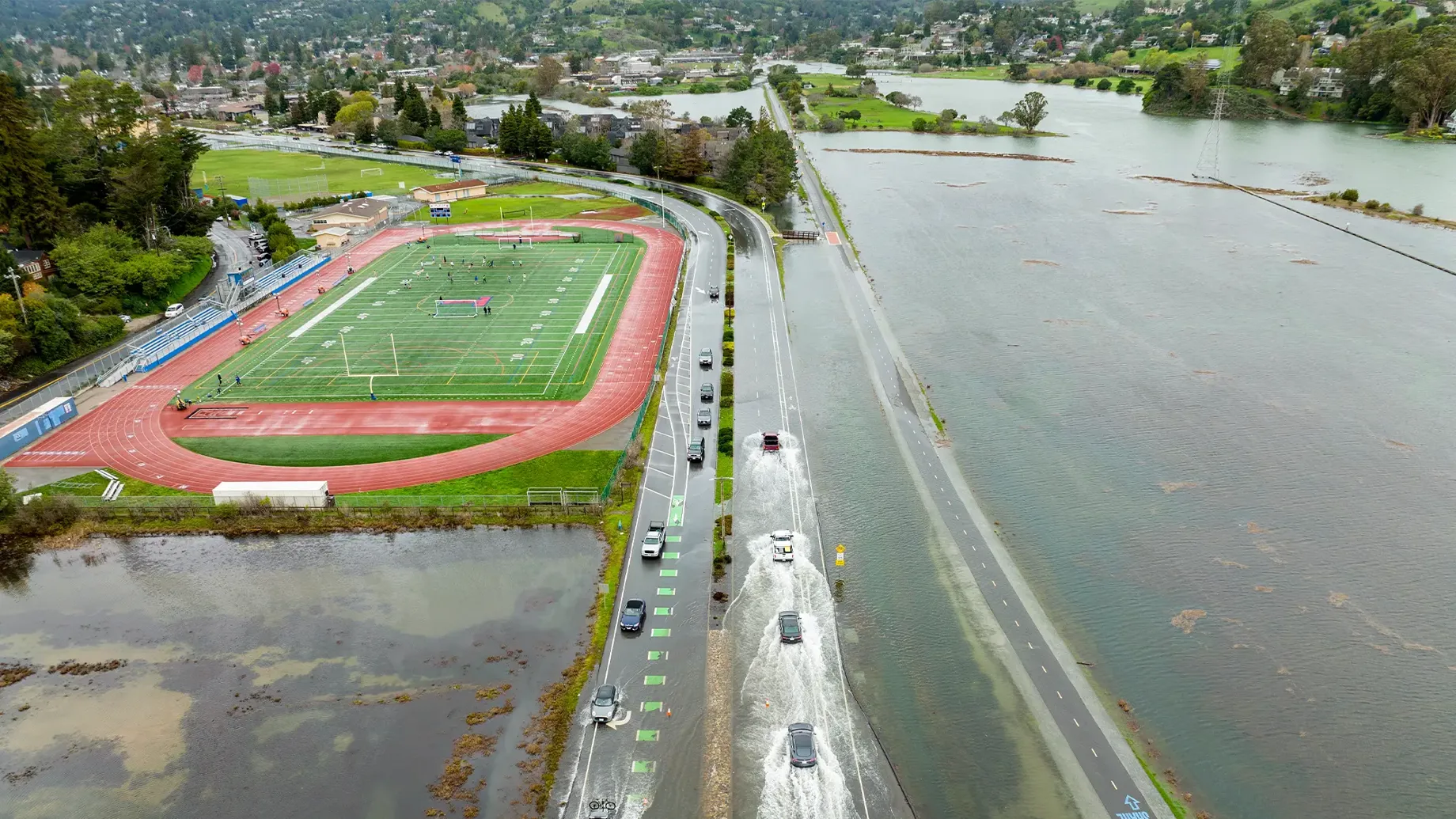
Marin County, located across the Golden Gate Bridge from San Francisco, is one of the areas in California most vulnerable to climate change, with critical transportation infrastructure already feeling the impacts. Sections of the county’s main highway corridor, US-101, are built through wetlands that are prone to flooding. Frequent high tide flooding events already cause major interruptions for commuters and degrade essential roadways and trails, an issue that will only worsen with sea level rise.
To address the challenges facing its transportation networks, the Transportation Authority of Marin (TAM) established a countywide sea level rise adaptation program. Arup was brought in as the lead consultant, with support from WRT and Pathways Climate Institute, to help TAM identify key vulnerabilities of Marin’s transportation network and recommend design interventions. The study analyzed nineteen focus areas including seven deep dives throughout the county and outlined adaptation strategies for each.
Arup helped TAM develop a long-term vision for protecting Marin County’s essential transportation infrastructure against flooding for decades to come. The study uniquely identifies both physical adaptations and policy strategies that together will enable vital projects to be implemented across jurisdictions. With these recommendations, TAM and its partner agencies are equipped with a future-looking implementation strategy to advance sea level rise adaptation for the entire county’s transportation network.

Frequent high tide events cause major interruptions for commuters © Josh Edelson Photography
Bringing a resilience lens to transport planning
To address climate-related challenges in both the near-term and long-term, Arup recommended a combination of approaches. The study identified 19 focus areas across the county and then developed deep dives for seven: Sausalito, Tam Junction and Marin City, Mill Valley, Corte Madera and Larkspur, central San Rafael, Santa Venetia, and Novato. For each, Arup identified hard infrastructure enhancements like raising roadways, constructing levees, and installing pumps to minimize flood impacts. In addition, Arup emphasized the power of nature-based solutions for addressing sea level rise. These strategies include marshland restoration, coarse grain beaches, and green infrastructure to absorb storm surges.
Beyond adaptation strategies, the study calls for policy and program initiatives that will advance transportation design standards and establish a cohesive effort for addressing climate change at the county and city level. The success of sea level rise adaptation projects is often contingent upon aligning incentives to generate the political will and funding resources necessary for implementation. By identifying physical sea level rise adaptation interventions and coupling them with policy and programmatic strategies, this dual strategy will bolster long-term success.

The study identifies the vulnerabilities of Marin's transportation network to sea level rise © Josh Edelson Photography

The study calls for a voluntary adaptation policy to ease adoption across jurisdictions in Marin County © Josh Edelson Photography
Enabling cross-jurisdictional collaboration
To ensure a holistic, well-coordinated plan of action, Arup and TAM engaged countywide stakeholder groups for input. Prior to the release of the study, Arup presented the project to local environmental and equity stakeholder focus groups, including representatives from individual cities, county government officials, and other groups advocating for environmental and equity needs. The engagement opportunity included a discussion on the current state of the study and suggestions for future inclusions. Further, Arup consulted with a technical advisory committee consisting of public agency partners to assure that proposed strategies are thoughtful and aligned with the local and regional context.
In addition to coordination across jurisdictions and departments, cost and funding are frequent barriers to realizing adaptation projects. To mitigate these challenges, Arup explored cross-agency coordination for project implementation, including applications for grants and other funding mechanisms. The study recommends leveraging funding from Marin’s Measure AA sales tax measure by encouraging voluntary adoption of TAM’s Sea Level Rise Adaptation Policy. This eases the process of incorporating adaptation upgrades into existing infrastructure projects by tacking the additional features onto projects that are already in the pipeline.
This study helps TAM advance the work done in the County and lays out the paths toward protecting the transportation system, community, and critical assets. We are excited to use the work as the foundation for TAM’s Sea Level Rise Program into the future, while we coordinate and collaborate with partners across Marin County, the Bay Area, and the State.”
WRT / Pathways Climate Institute
Projects
Explore more climate & sustainability projects

Shaping a sustainable, inclusive and thriving future for Agadir, Morocco
Agadir Green City Action Plan, Morocco

Improving water security and sanitation for millions in urban India
Australia-India Water Security Initiative (AIWASI), India

Promoting climate resilient flood defence and development through nature-based solutions
Lower Darent Riverside Strategy, United Kingdom

Wetland habitat restoration at a landscape scale
Great North Fen – Restoring the Durham Carrs, United Kingdom
Get in touch with us
If you'd like to speak to one of our roads and streets experts about any of the issues raised on this page or a potential collaboration then please get in touch by completing the form.
