
Enabling fast-track construction for a world-class airport design
Navi Mumbai International Airport Terminal 1
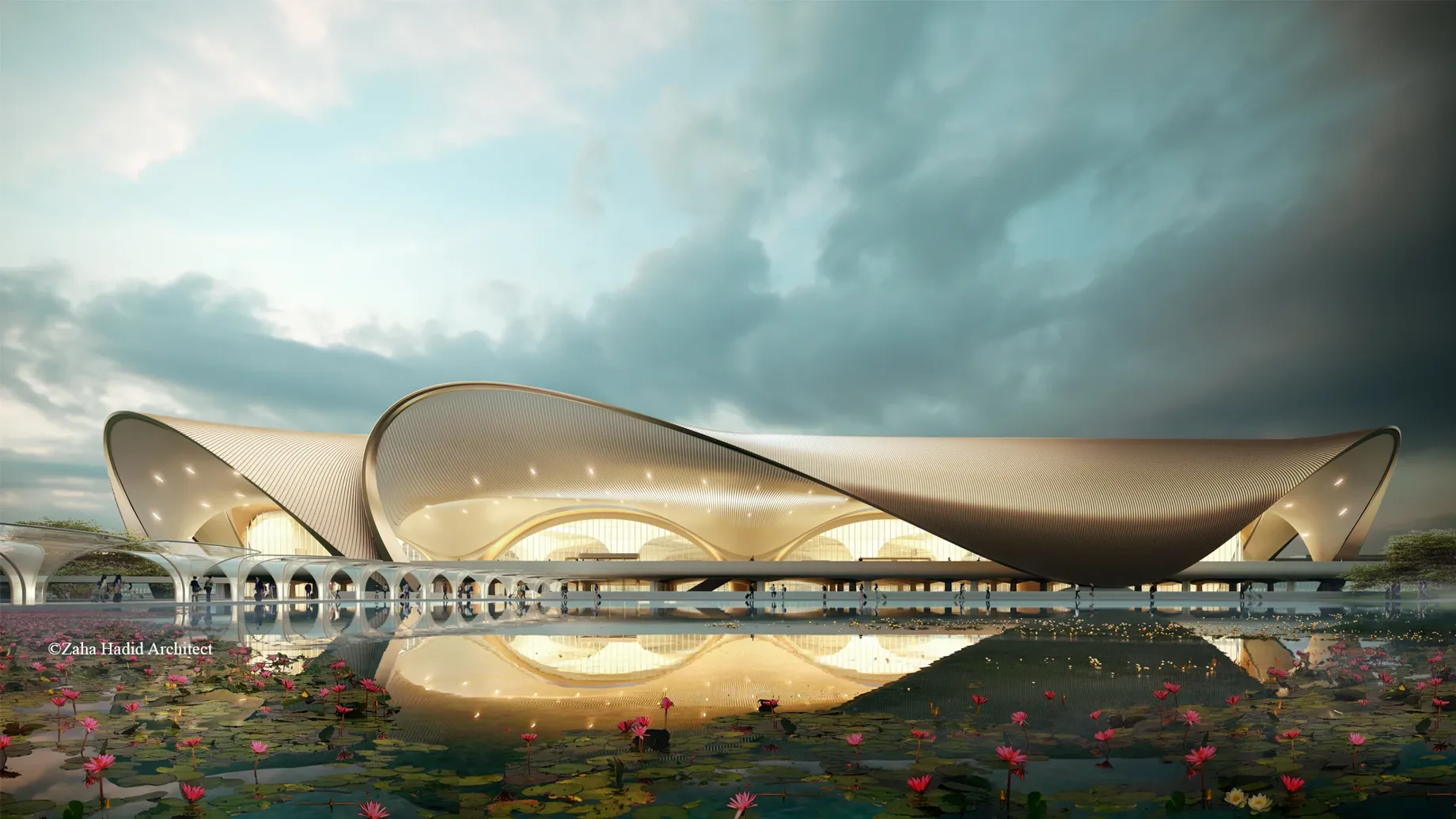
Rapidly expanding Mumbai urgently needed a second airport to support economic growth, trade and tourism. Navi Mumbai International Airport (NMIA) will eventually handle up to 90m passengers per year, becoming Asia’s largest regional connectivity hub.
Arup partnered with Zaha Hadid Architects to design NMIA’s Terminal 1, the first stage of this long-term mega-project in India’s financial capital. Our team worked rapidly, providing multidisciplinary engineering and specialist services for the concept and scheme designs for GVK, the airport’s developer. This formed the basis of a fast-track design-and-build construction contract. We also designed the central plant building and the concept for a new control tower.
Terminal 1 is set to accommodate up to 20m passengers and 0.5m tonnes of cargo annually, helping to relieve congestion at Chhatrapati Shivaji Maharaj International, 45km away. NMIA will also become an integrated, multi-modal transport hub owing to connections with the Mumbai Trans Harbour Link, Mumbai Metro, suburban rail networks and planned waterways.
Engineering an organic form inspired by cultural tradition
Zaha Hadid Architects’ design for the building resembles a lotus, India’s national flower, with the roof appearing to float above the terminal. When Arup – a longtime collaborator with Zaha Hadid Architects – helped win the competition to work on NMIA, we explored how to realise this complex form within the agreed budget and timeframe.
Standardising repeating elements was key to streamlining design and construction. We saw that the piers and boarding bridges, which take passengers from the terminal’s headhouse to the aircraft, could all use the same modular design. Recognising this, we used a functional, repeating grid for the headhouse’s main chassis.
Branching columns, which can support larger spans than straight columns, enabled us to realise the roof’s unfolding petals. By rotating the roof’s structural grid by 45 degrees, we created an open, flexible internal area with plenty of space to house the airport’s essential functions and retail concessions. The resulting structural design is highly efficient, using less than 100kg of steel per m2.
Careful attention to the interaction between the concrete frame and roof ensured the building would remain resilient in the event of an earthquake. This is important as Mumbai lies in an area of moderate seismic risk.
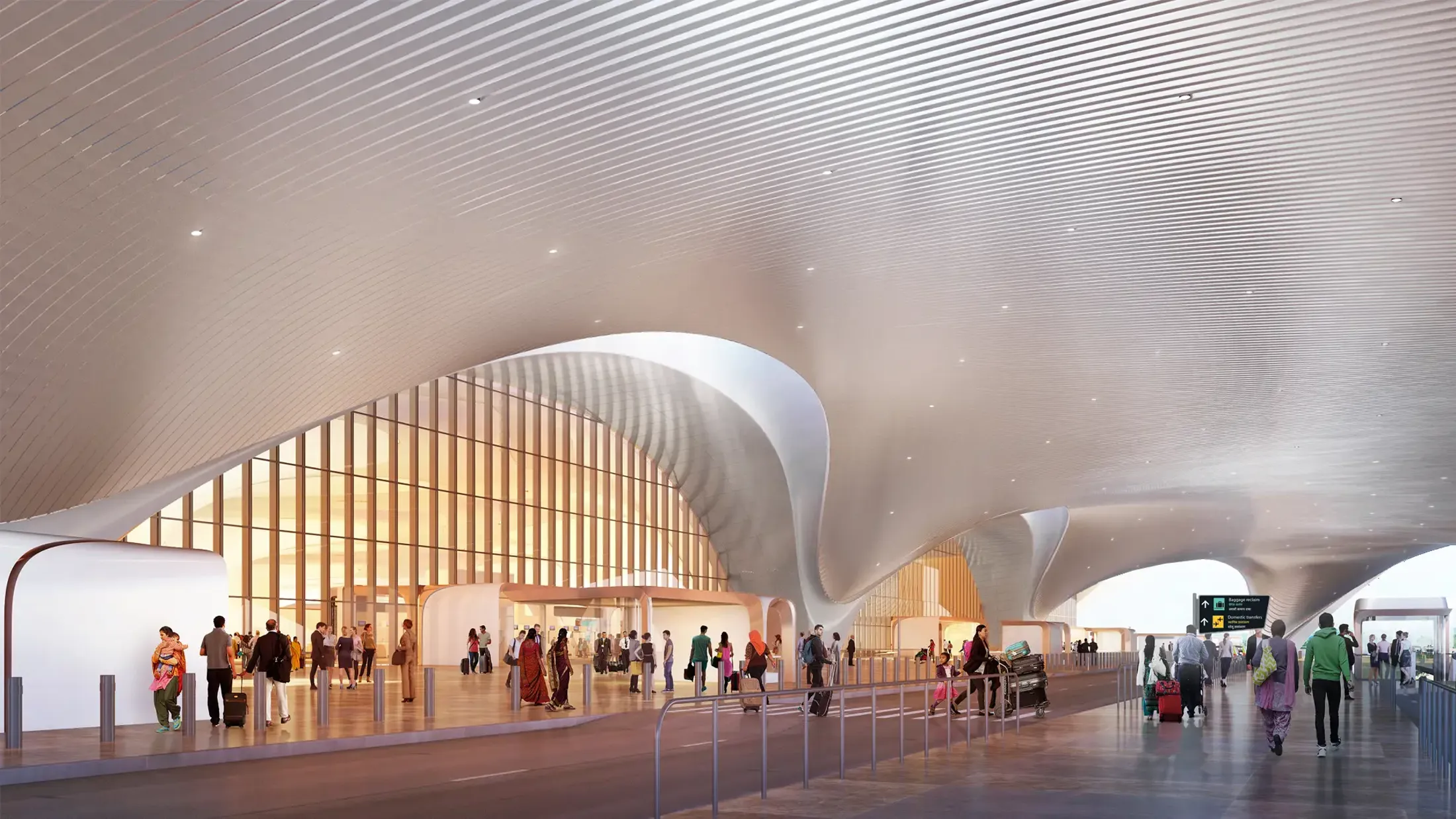
Exterior of Navi Mumbai terminal. © Zaha Hadid Architects
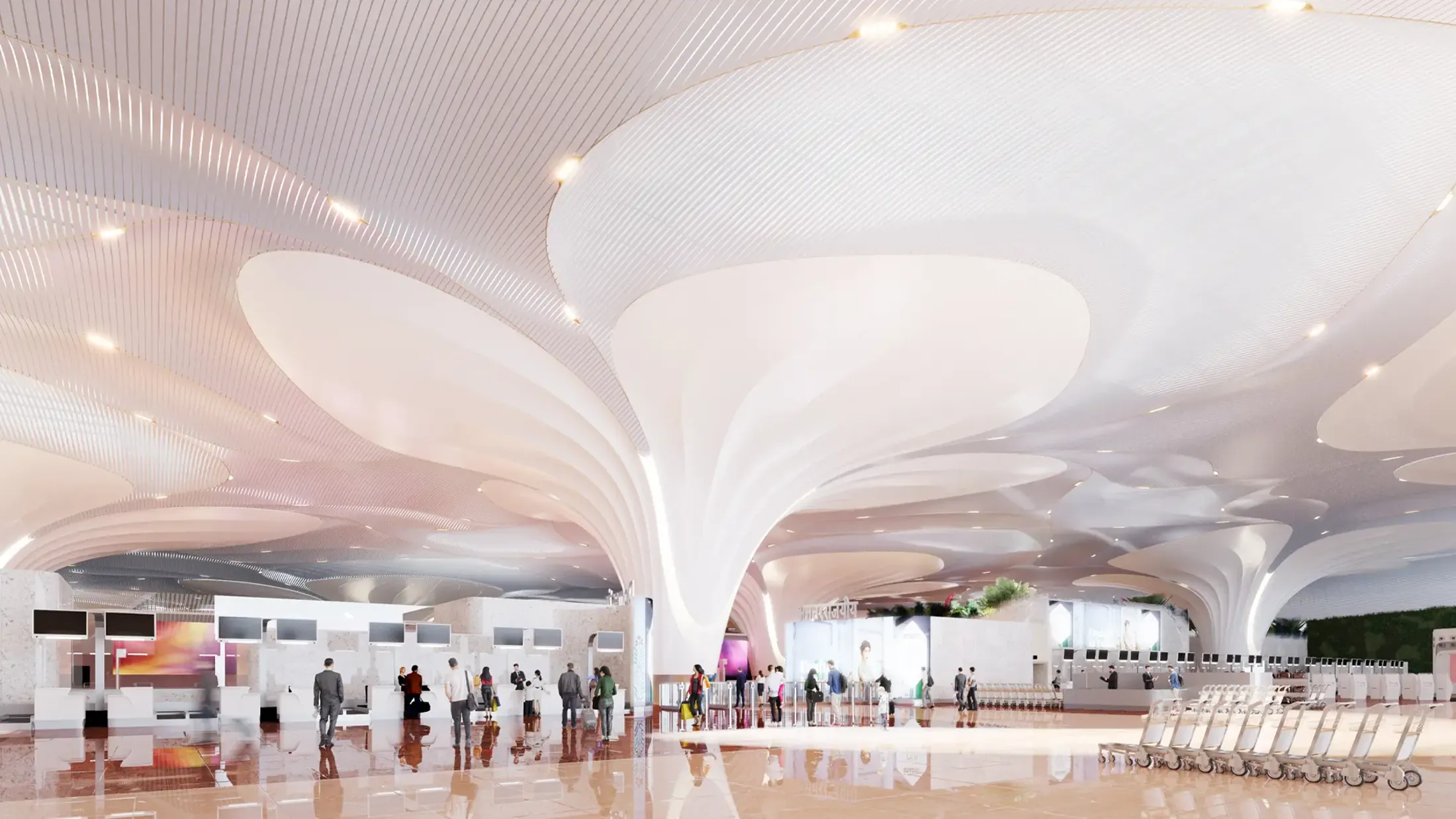
Interior of Navi Mumbai terminal showing the lotus flower design. © Zaha Hadid Architects
Integrating sustainability in an efficient airport design
Working with Zaha Hadid Architects, we divided the building into different zones before finalising the architecture. This allowed us to accommodate and coordinate all the heating, cooling, power, digital, audio-visual and communications systems more easily.
The terminal’s MEP (mechanical, electrical and public health) services needed to be adaptable, reliable, efficient and sustainable. Ease of operation and maintenance would also be important to the airport’s future owner-operator, Adani. From the outset, our experts scrutinised every aspect of the building to achieve these goals.
Passive design principles reduced energy demand for lighting and cooling, using façades and overhanging roofs to provide shading from Mumbai’s strong sun. Solar radiation analysis was used throughout the design process to test and optimise design options. This reduced energy consumption while still achieving the architect’s vision. These measures helped the project to target a LEED Gold rating.
The building was designed so its internal layout can be easily adapted to meet future needs. At the same time, the structural design reduced material use, particularly steel and concrete. Ribbed concrete slabs offered a straightforward way to achieve carbon reductions without compromising the programme.
Our façade specialists collaborated with the architects and other disciplines to develop an optimal solution that balanced aesthetic ambition with performance requirements, while minimising material use. The modular façade system uses prefabricated units to deliver consistency and quality in visual appearance, weather protection, airtightness, and continuity of thermal and vapour control layers.
This approach also enabled rapid installation and improved safety on site. The standing-seam roof system spans the airport’s footprint, making installation efficient and manages rainwater across the curved surfaces. We also developed a bespoke access strategy for the undulating canopy and façade, enabling safe inspection and maintenance across complex geometries. Approaches like these lowered the embodied carbon footprint of the terminal and kept costs down.
Our fire engineers analysed hazards, smoke control systems and a range of fire scenarios. Optimising structural protection, our fire strategy integrated the airport’s security requirements, met with the approval of the regulatory authorities and supported the fast-paced programme.
For a fast-track project like NMIA with complex architectural form, Arup’s highly experienced team proactively delivered outstanding, cost efficient, sustainable and robust engineering solutions.
Following international best practice without compromising aesthetics
In a complex project like this, every detail of the passenger experience matters. Our acoustics specialists carefully selected interior finishes to control reverberation and manage the build‑up of occupational noise, as well as providing effective sound separation between adjacent areas. We designed the public‑address and voice‑alarm system (PAVA) so that speech is clear and intelligible throughout the terminal. We also advised on the mechanical services and smoke‑extraction, ensuring these systems operate quietly.
Our team led the security strategy and designed the video surveillance system (VSS) and electronic access control system (EACS) across both airside and landside. Using advanced modelling of the video surveillance coverage, we ensured the systems are highly effective and fully integrated with the architectural design.
To support safe, reliable and efficient day-to-day operations, our building performance and systems team created a clear approach, recommending an integrated smart building management system (iBMS) for smoother coordination.
Enabling fast-track construction
With developer GVK working to a tight timeline and fixed budget, our designs used straightforward fabrication and construction processes. Site clearance began while the design stage was still underway, and we focused on enabling fast-track construction, through simultaneous workstreams.
To keep the programme on track, we collaborated closely with Zaha Hadid Architects, blending the best of traditional and digital working. Using regular, in-person meetings and 3D building information modelling, we coordinated the architecture and engineering in real time. This attention to detail meant the contractor, Larsen & Toubro, did not submit a single request for clarification.
Our team also undertook the concept design of the air traffic control tower so it could be fully costed and ready for completion as part of the second phase of the project. Terminal 2 will draw on many of the design features and standards we developed for Terminal 1, generating further efficiencies and enabling Mumbai to move towards its goal of becoming a major transport hub for Asia.
Projects
Explore more aviation projects:

Reimagining the passenger experience at the world’s busiest airfield
Chicago O’Hare Concourses D and E, USA

Designing a transformative multi-modal gateway to Los Angeles
LAX/Metro Transit Center, USA

Redefining Japan’s future airport city
Narita Airport City, Japan

Transforming the travel experience at Zayed International Airport
Zayed International Airport Terminal A, United Arab Emirates
Get in touch with us
If you'd like to speak to one of our aviation experts about any of the issues raised on this page or a potential collaboration then please get in touch by completing the form.
