
Cities are inherently complex, possessing incredible strengths but also long-term vulnerabilities. Recent events such as heatwaves, floods and pandemics have revealed just how fragile cities can be and how challenging it is to adapt quickly to new situations. In addition to so-called critical sectors like civil protection, energy supply, cybersecurity, and supply chain stability, municipalities often face further challenges: navigating transformation driven by demographic, social, and economic change. So how can cities understand the risks they face and better prepare themselves?
Working for the Federal Institute for Research on Building, Urban Affairs and Spatial Development (BBSR), Arup, together with the project and cultural consultancy Imorde, has developed a stress test for cities and municipalities in Germany. The research team built on findings from previous BBSR research projects and aligned with the goals of the “Urban Resilience Memorandum,” using an existing prototype as a foundation. In addition to the research team, representatives from eleven cities and municipalities actively contributed to the development process through a participatory approach.
The outcome of this research project has been a data-driven, interactive urban monitoring tool. It enables cities and municipalities to map their individual resilience profiles in relation to various crises, disasters, and disruptive events. The data is sourced from over 100 public databases, including the Federal Statistical Office and the German Meteorological Service
Unpicking the complexity of city life
The tool brings together key areas of urban life such as housing, employment, services, and mobility. These are embedded within overarching dimensions like environmental quality, social inclusion, and effective urban governance, which encompasses the interaction between politics, administration, interest groups, and the public.
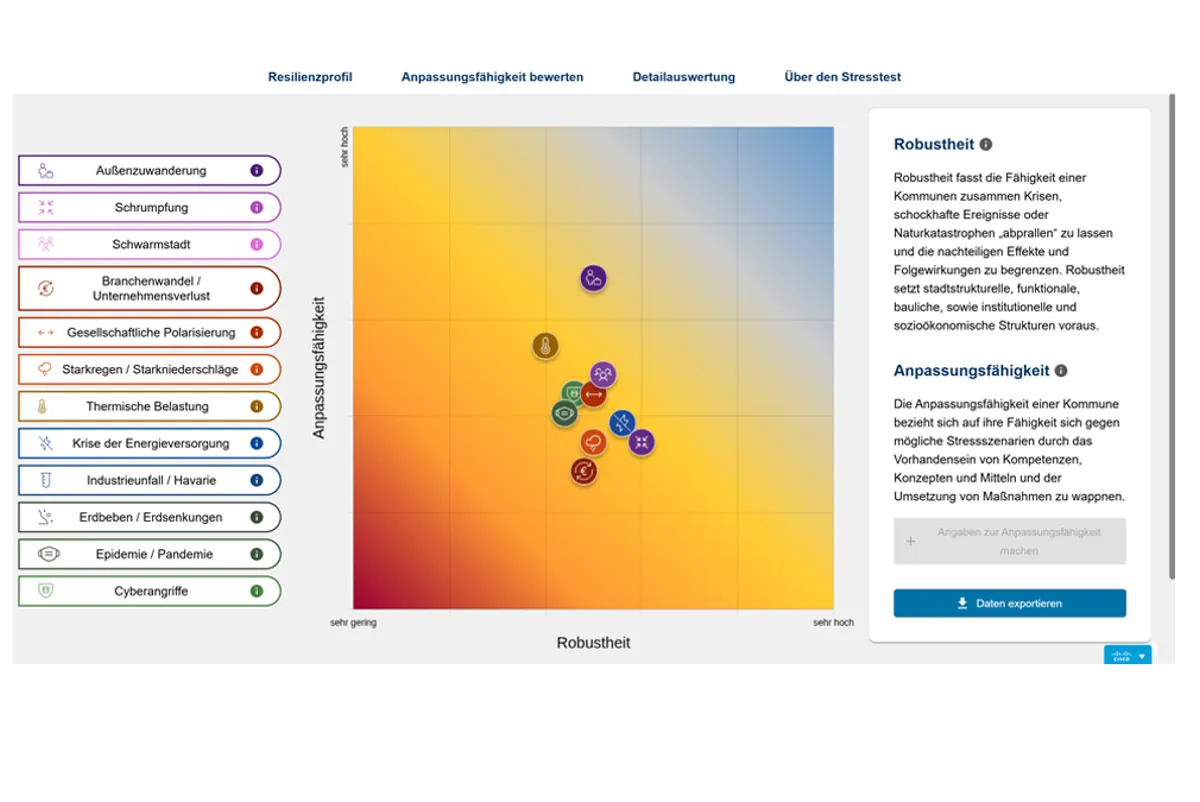
Example of a resilience profile. The stress test examines the resilience of all cities and municipalities in Germany to twelve typical stress scenarios. External migration, shrinkage, swarm city, industry change, social polarisation, heavy rainfall, thermal stress, energy crisis, industrial accident, earthquake, epidemic/pandemic and cyber attacks.
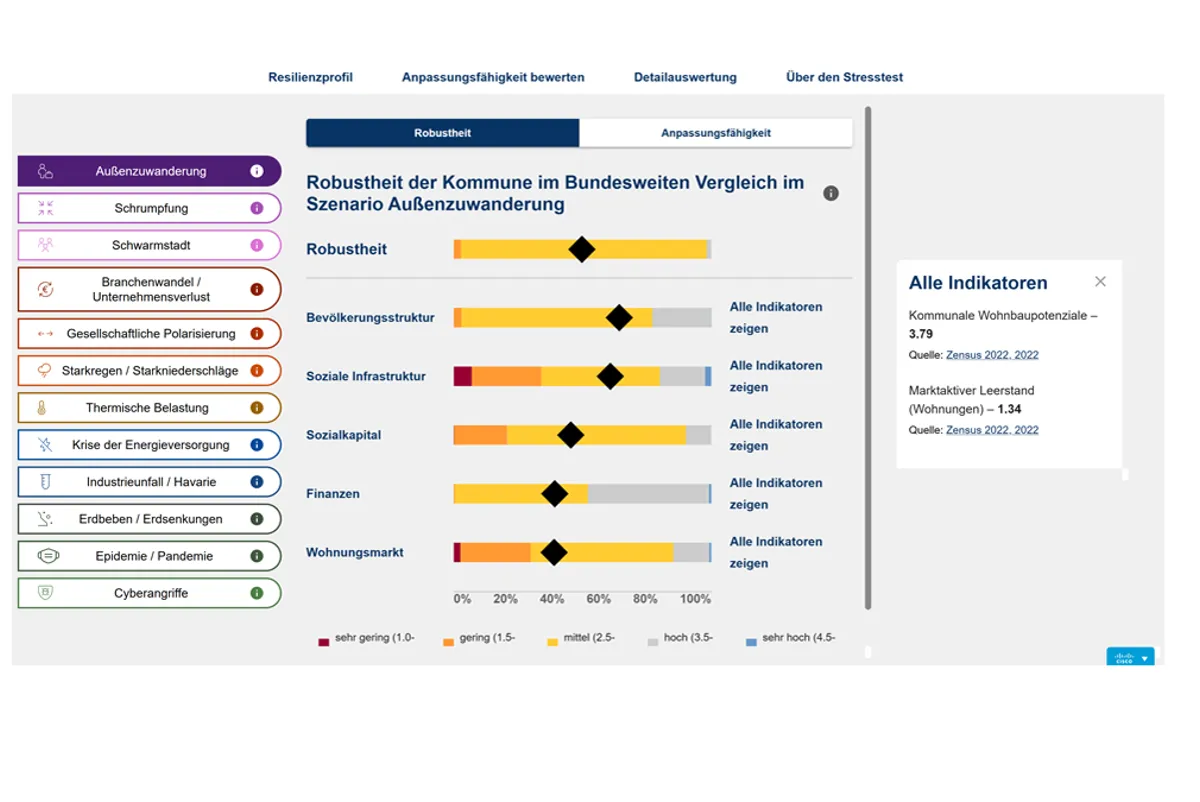
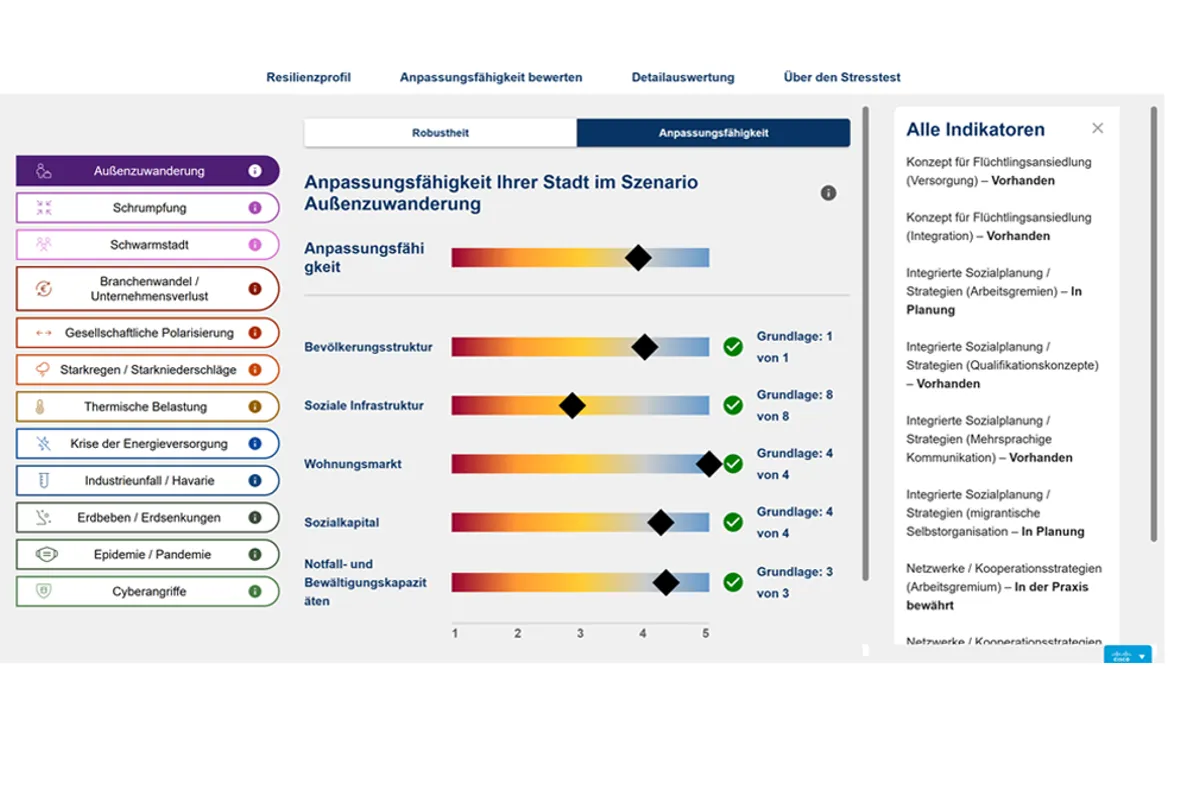
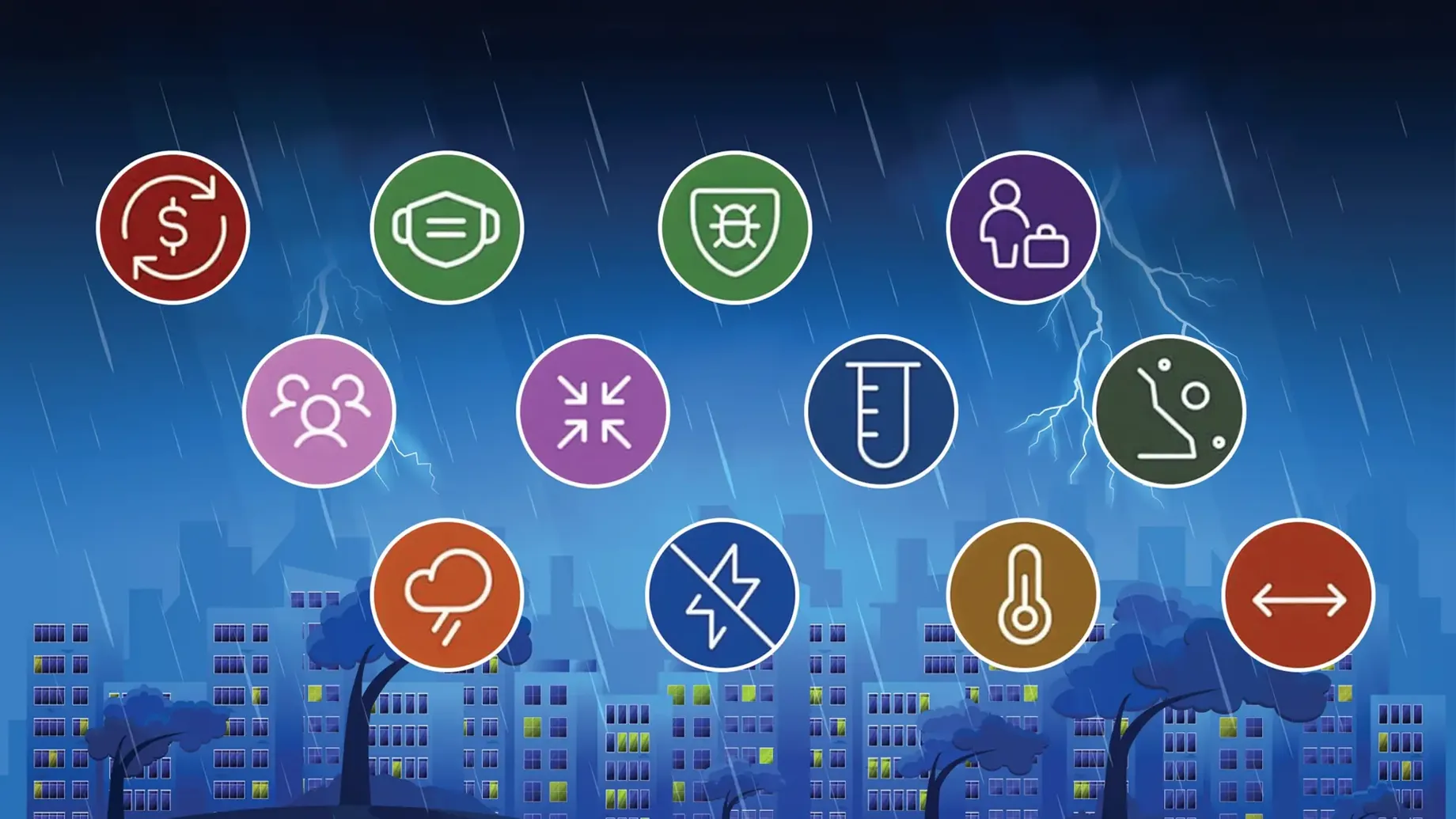
At the heart of the digital tool are twelve typical stress scenarios that represent potential crises, disasters, or disruptions, such as heavy rainfall, energy crises, or social polarisation. These factors may occur individually or in combination, affecting the delicate balance within the city.
To gauge the impact realistically, the stress test combines quantitative data to assess robustness with a qualitative self-assessment by municipalities to evaluate local adaptive capacity. Indicators are then grouped into categories such as economic structure, technical infrastructure, or emergency response capacity.
The result of the collaboration between Arup and the BBSR is a powerful yet easy-to-use tool for measuring urban resilience. The stress test serves as a strategic early warning system for crises, threats, and disasters, and supports municipalities across Germany in improving risk preparedness as part of integrated urban development.
Building understanding of resilience priorities
The tool produces resilience profile, displayed via an interactive dashboard that shows how resilient and adaptable a city or municipality is in the face of different scenarios. The visual approach is there to make complex relationships quickly understandable and support discussions within local government and policymaking. Ensuring the results are easy to interpret helps to build public trust in any loca decisions or investments that are made as a result of the analysis.
The development team, comprising Arup, the BBSR, and Imorde, presented the tool on September 16, 2025 at the 18th Federal Congress of the National Urban Development Policy in Rostock. Since then, the application has been freely available to all of Germany’s approximately 11,000 municipalities at www.stresstest-staedte.de.
Federal Institute for Research on Building, Urban Affairs and Spatial Development (BBSR) / Project & Cultural Consultancy IMORDE
Projects
Explore more cities projects

Shaping a sustainable, inclusive and thriving future for Agadir, Morocco
Agadir Green City Action Plan, Morocco

Masterplanning Adelaide’s new inner-city neighbourhood
Thebarton Masterplan, Australia

Delivering a sustainable city within a city
Kai Tak development, Hong Kong

Redefining Japan’s future airport city
Narita Airport City, Japan
Get in touch with us
If you'd like to speak to one of our cities experts about any of the issues raised on this page, or a potential collaboration, then please get in touch.
