
Designing a thriving, resilient airport for Western Sydney
Western Sydney International (Nancy-Bird Walton) Airport Design
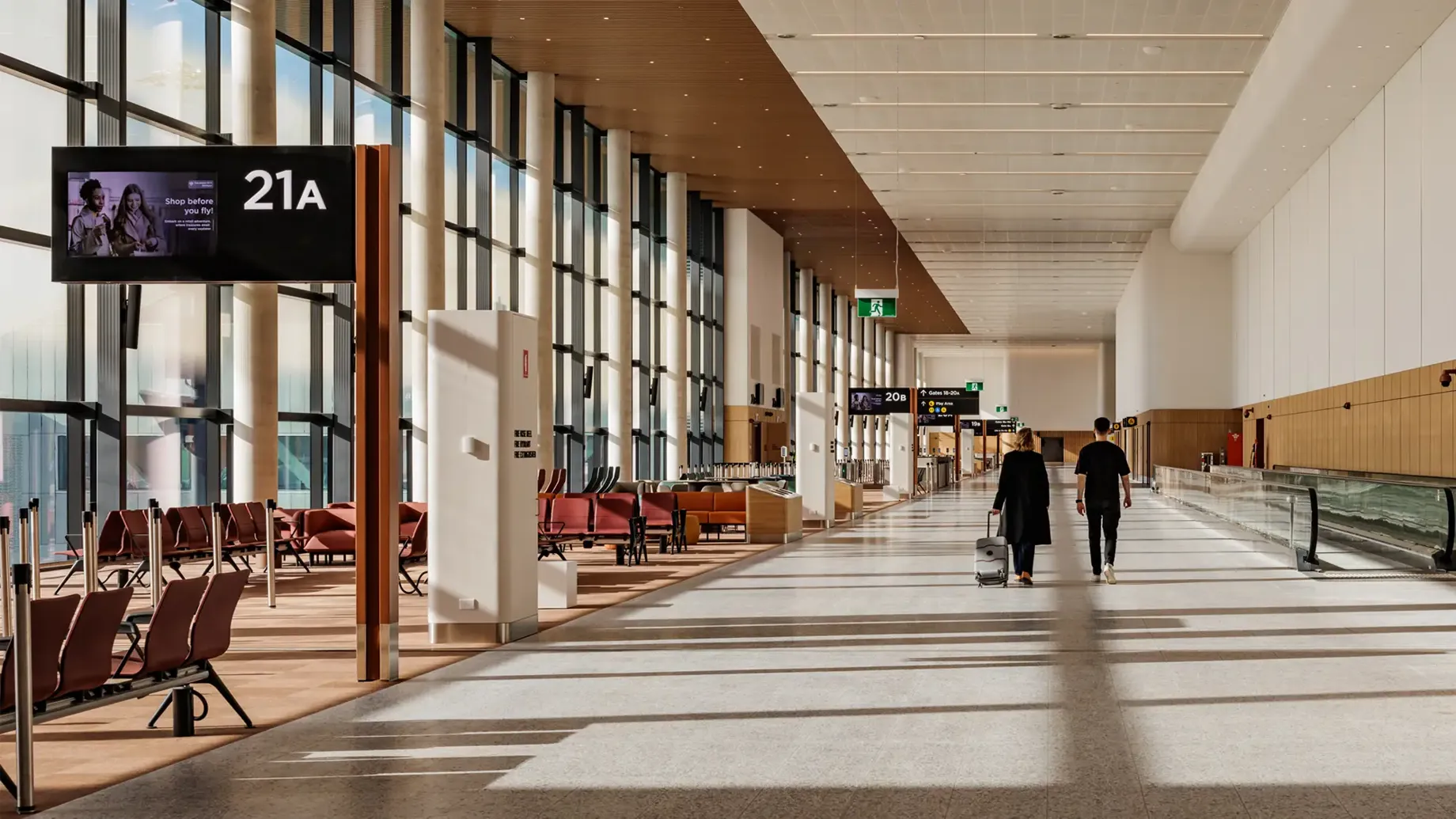
Demand for aviation services in Sydney is expected to double in 20 years and Sydney (Kingsford Smith) Airport alone cannot meet this demand. More than two million people live in Western Sydney, making it Australia's fourth-largest city and third-largest economy. To meet this demand and help support Western Sydney’s growth, the Australian Government is building the Western Sydney International (Nancy-Bird Walton) Airport (WSI).
Since 2021, we partnered with Multiplex and Woods Bagot on detailed design and project delivery of the passenger terminal and associated facilities. We took a multidisciplinary design approach, bringing together 26 disciplines, spanning over ten offices, involving over 500 engineers and designers. Some of our achievements include leading the security strategy for the new airport and improving passenger comfort through adaptive daylighting and thermal design.
Opening in the second half of 2026, WSI will significantly expand Sydney’s air travel capacity, serving as more than just a transport hub. WSI will connect millions of Western Sydney residents to new travel and job opportunities. Designed for long-term growth and climate resilience, the airport will support a thriving, future-ready Sydney. Designed with an initial capacity to support up to ten million annual passengers, WSI is designed to grow with Western Sydney to cater for up to 82 million annual passengers in the 2060s.
Multidisciplinary design approach achieves fast-tracked airport design
We faced a tight schedule for the project’s detailed design, with the terminal project awarded in May 2021 and construction starting by October 2021. This required us to rapidly mobilise a team during pandemic lockdowns and swiftly transition from design to construction, all while incorporating aviation approvals and client feedback.
We took a multidisciplinary design approach, bringing together 26 disciplines, spanning over 10 offices, involving over 500 engineers and designers. Working collaboratively together and with Multiplex and Woods Bagot, we overcame challenges, made timely decisions and coordinated and delivered all engineering disciplines, ensuring efficient management of the fast-paced project delivery.
Our team leveraged digital tools, including Building Information Modelling (BIM) and clash detection to streamline the design and construction process. This digital approach enhanced collaboration, streamlined decision making and allowed us to adopt a paperless design process.
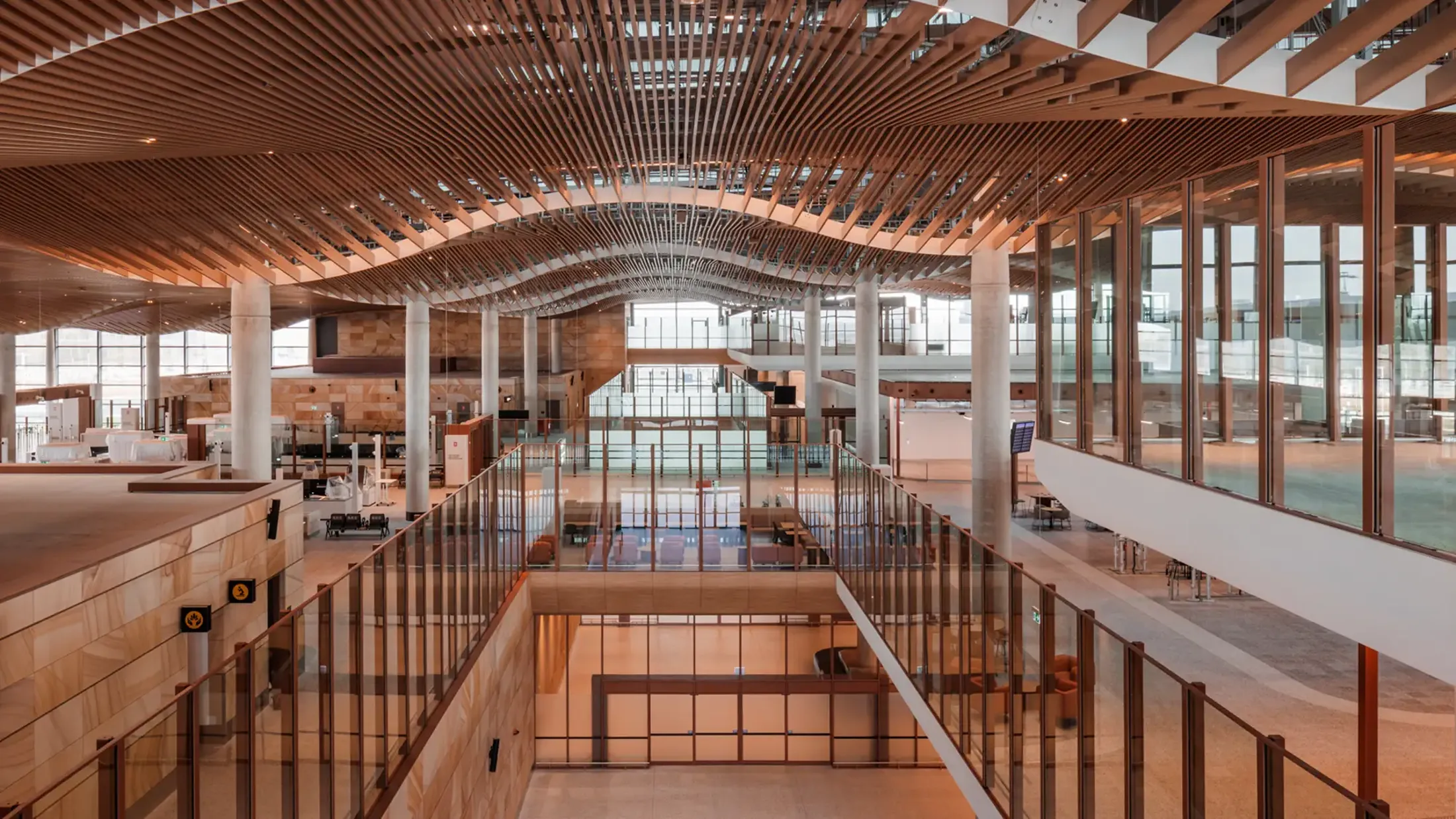
Striking design inside the passenger terminal © Trevor Mein
A sustainable and people-focused terminal design approach
Our design prioritises passenger comfort through a combination of skylights, high-performance facades, insulation, airtightness, daylight-responsive lighting, shaded pathways, adaptive comfort control, biophilic materials and pressurized spaces with filtered air.
By taking a modular approach to structural systems, using a 9 x 9-metre grid, which streamlined construction, we increased construction efficiency, and minimised carbon impact by reducing wet trades on site. Operational carbon was cut by 38 per cent through air monitoring, lighting controls and occupancy-driven energy use. Low-carbon materials, responsible sourcing and Environmental Product Declarations (EPDs) for concrete, steel, flooring, and ceiling finishes contributed to an 11 per cent reduction in upfront carbon.
Integrating resilience and security into aviation design
Our team led the security strategy under Multiplex for the airport terminal’s design and construction contract, thoroughly understanding its complex operations and prioritising compliance, risk management and protective design at every stage. The strategy looks at every operational stage, including screening passengers, staff and luggage to managing the movement of waste to enable a seamless process for passengers. Our approach was risk-based, effectively managing potential threats.
Research and testing played a significant role in developing effective protective design solutions. Our team used a combination of modelling, testing data, and literature to inform our designs and provide the highest level of safety and performance. This collaborative effort and continuous interaction among team members were key to achieving the project’s security and design goals.
Throughout construction, Multiplex and Arup worked collaboratively to deliver the design. Arup’s expertise was particularly key in delivering the terminal’s roof and feature ceiling.
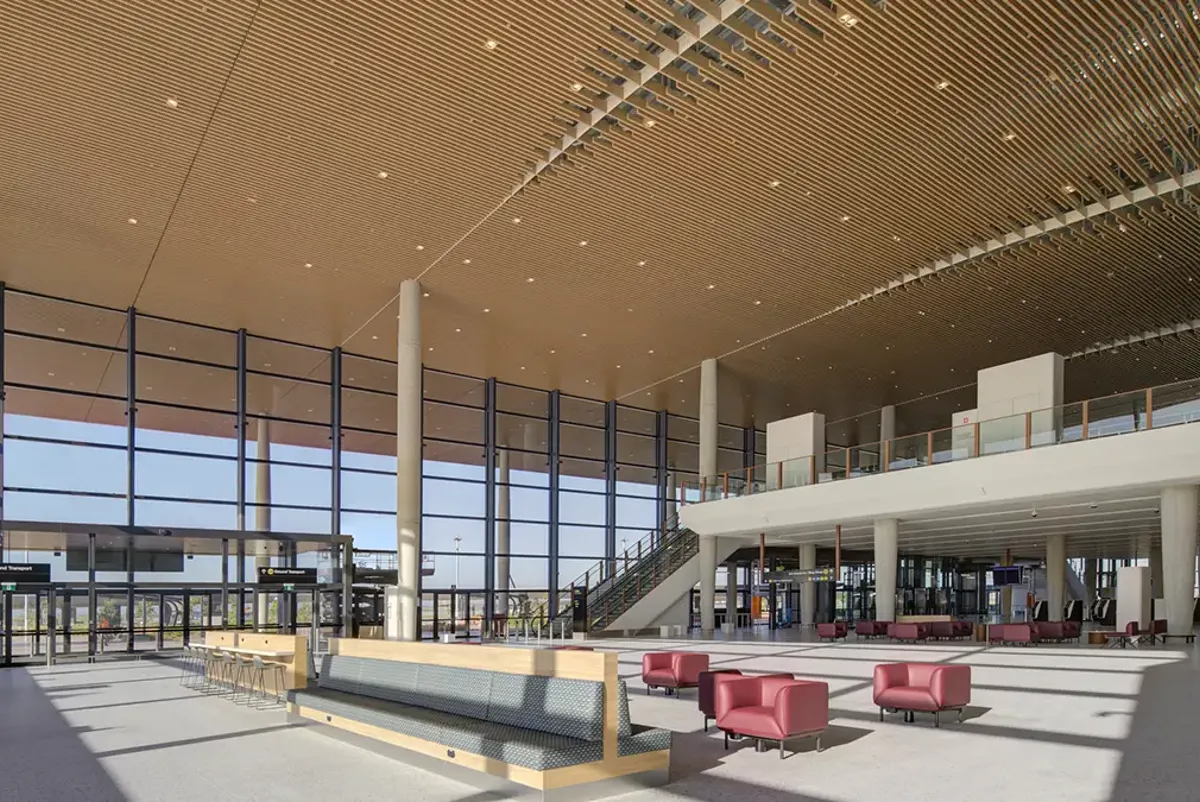
Large foyer entrance © Brett Boardman
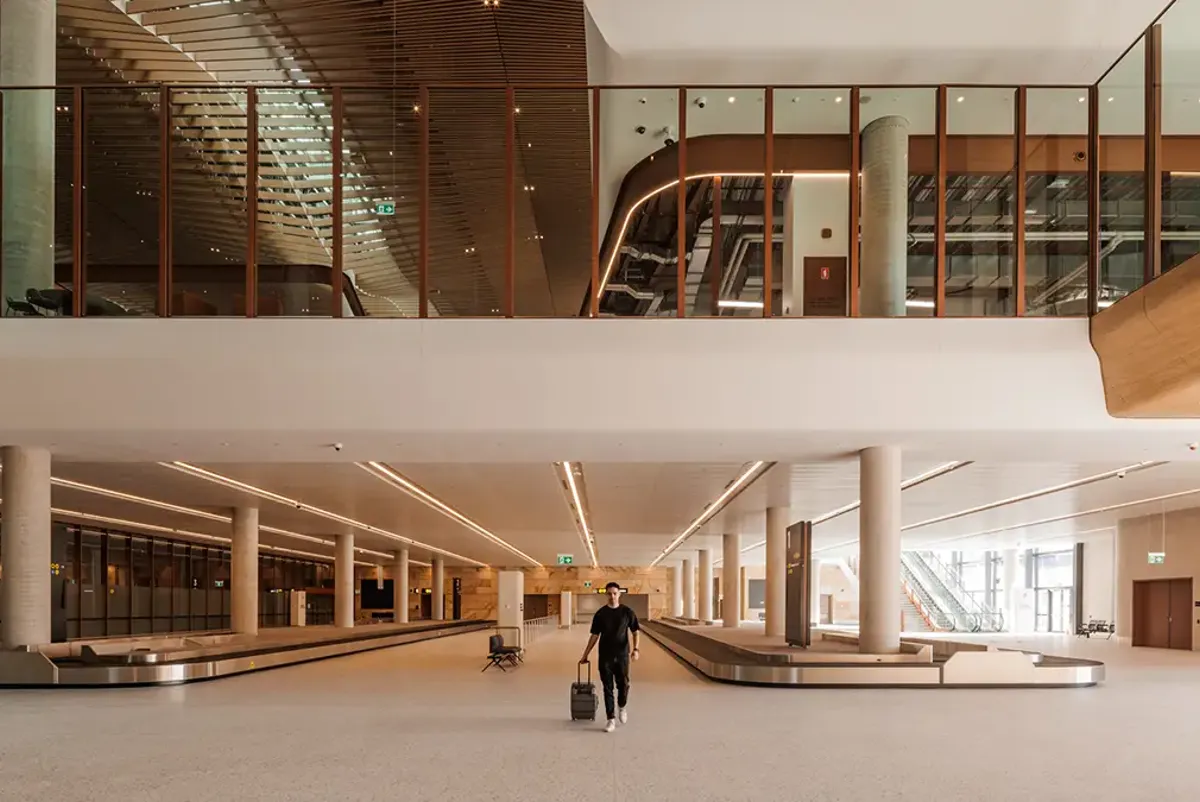
Baggage carousels with plenty of space © Trevor Mein
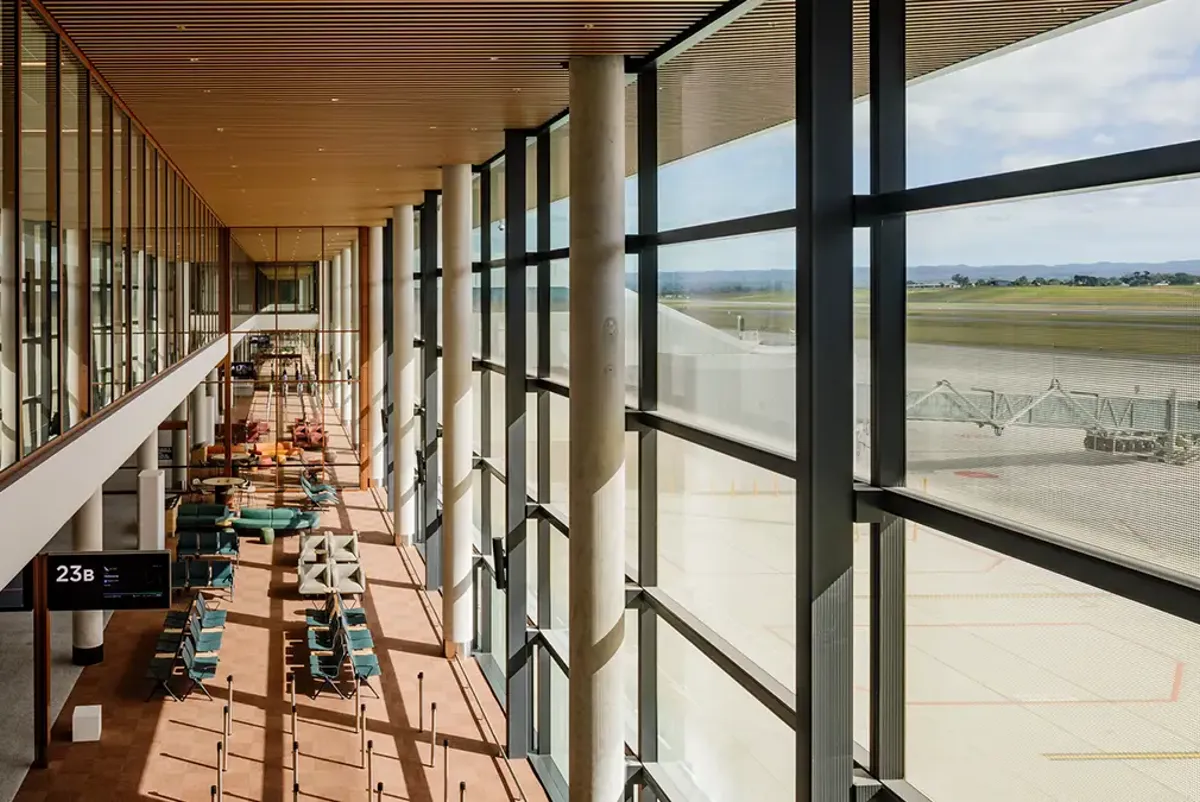
Comfortable lounges with natural light © Trevor Mein
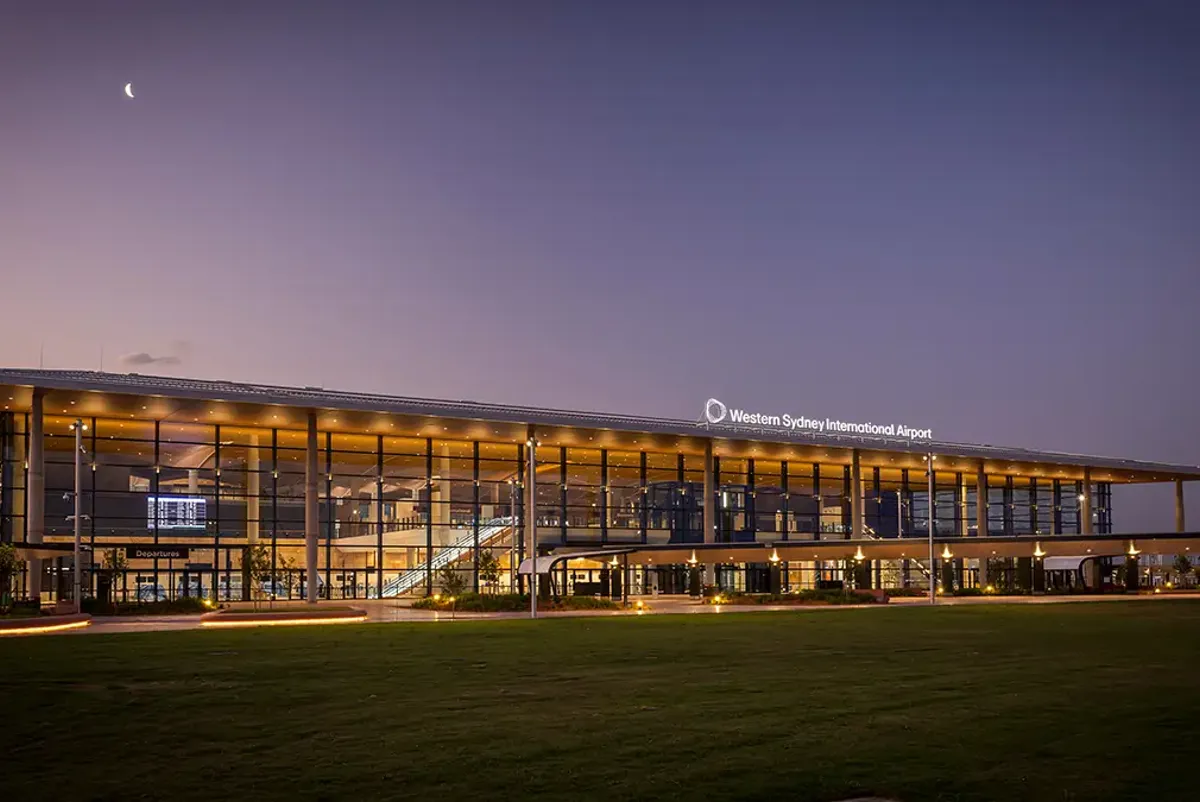
Terminal building at night © Multiplex
Woods Bagot
Projects
Explore more aviation projects:

Redefining Japan’s future airport city
Narita Airport City, Japan

Transforming the travel experience at Zayed International Airport
Zayed International Airport Terminal A, United Arab Emirates

Crafting a New York–inspired atmosphere for passengers traveling through JFK’s global gateway to the world
JFK New Terminal One Art, Branding, and Digital Experience Program, USA

Helping Vancouver International Airport to prepare for unexpected weather
Vancouver International Airport After Action Review, Canada
Get in touch with us
If you'd like to speak to one of our aviation experts about any of the issues raised on this page or a potential collaboration then please get in touch by completing the form.
